This exercise was quite a challenge for me. I am autistic, so I see the world differently to neurotypical people. Something that most autistic people struggle with is things meaning something other than what they are. In communicating with other people, we can struggle as we don’t get context and ‘hidden meanings’ behind words, often feeling confused as we say exactly what we mean and expect others to do the same. It’s no different in other areas of life. I understand the concept of a metaphor – that something is being described and isn’t actually that descriptor. For example, depression is often described as a dark cloud following you around. I know there isn’t literally a dark cloud following people around, it’s just a way to describe the feeling depression gives, a storm looming on the horizon bringing you down and hiding the ‘sun’ (happiness).
So I understand this. And I can understand the process of creating visual metaphors. You take these verbal descriptions of feelings/concepts/objects, and depict them visually. Simple enough. You could draw someone who looks sad, or pained, with a giant black cloud floating above their head everywhere they go. This would be a visual metaphor for depression. In theory, this means I understand the concept of visual metaphors and how they can be used in illustration, right?
But I really struggled. Not so much with creating my own visual metaphors, but with finding examples of them in other art. I felt like there was something I just wasn’t getting, and it took me days of frustration and feeling like I was attempting the impossible to realise why. I had asked for help from several people, and wasn’t getting much further. I looked at the learning logs of fellow students to see what they had chosen as examples and just felt completely lost. I didn’t understand how people could see a piece of art and instinctively know it was a visual metaphor. I couldn’t understand what made something specifically a visual metaphor, versus just a regular piece of art.
I ended up speaking to someone who understands autism very well, and understands how I work as an autistic person, in a final attempt to piece together what I was looking for in an illustration that made it a visual metaphor. They suggested that I take an art history approach, and look at artists who have been known to use metaphorical imagery in their work. This was brilliant advice, and almost instantly I started thinking of various artists and art styles who I could attribute this to. But the more we talked, the more we unearthed the difficulty I was having when approaching this exercise. Isn’t all art metaphorical?
For me, all art is subject to interpretation – any piece of art can have a hidden meaning. We can engage with art technically and observe the usage of colour, texture, material, and the context in which it is situated, to gain an understanding of it. Or,we can engage with art emotionally and subjectively, translating it into something vague – a feeling, a concept, an idea, or just point blank what it is. Both of these ways of engaging with art, however, are ways of interpreting it and what it means – this is exactly what you’re doing when you engage with a metaphor.
So I couldn’t understand what the difference was between a ‘visual metaphor’ and regular art. I suppose you can have very overt depictions of metaphors, like the cloud following a person around, or less obvious depictions such as a simple grey sky. But to me, these are the same. They are both covert and require analysing and deep thought to understand. It isn’t natural to me to use metaphors, or to see things as things they’re not. It’s an active conscious choice. I see no difference between a painting of dull, dark clouds, representing depression and pain, and an illustration of a man with a cloud above his head. They are both representative of depression, but also of so much else the more you think about it.
Using metaphors both in imagery and in every day conversation is like a game to me. It’s fun, trying to come up with the best descriptors and explanations. Sometimes people will exclaim how good a metaphor I’ve used is, and I’m not even aware that’s what I’m doing because I’m just trying to play the game of communication like everyone else. But everyone else isn’t playing a game, this sorta stuff just comes naturally. Narrowing down which pieces of art are metaphorical and which aren’t felt like such an enormous task, because it’s simply all metaphorical to me.
I feel like I can’t grasp the understanding of visual metaphors expected of me here, as I can’t categorise easily the differences between the overt and covert metaphors. I assume the concept of visual metaphors is referring to the overt ones, but there isn’t even a blurry line between the two for me. That line doesn’t exist. Living in a world where everything seems to mean something else, and I can’t understand what it is that it’s meant to mean most of the time, has given me an advantage when it comes to interpreting art. I’ve learned how to make a skill out of interpreting the world around me. But also I have a disadvantage, as I might fail to see the immediacies that other people do.
The artist who immediately sprung to mind when art history was mentioned to me was Banksy. I feel like his work is a great example of metaphorical art. His work clearly means something deeper, and it’s often used as a response to social and political actions. Art movements that I feel are filled with visual metaphors are Surrealism and the modern art movement. The imagery in Surrealist art is meant to be read into. To take it at face value would be to miss the point of the artwork entirely. The bit I think I’m missing is that this is incredibly open to interpretation, whereas I suppose metaphors are a lot more blunt.
After thinking about this in depth for several days, I decided to just start with the second part of the exercise – drawing your own visual metaphors. I feel like this is something I might find easier than specifically picking them out in art.
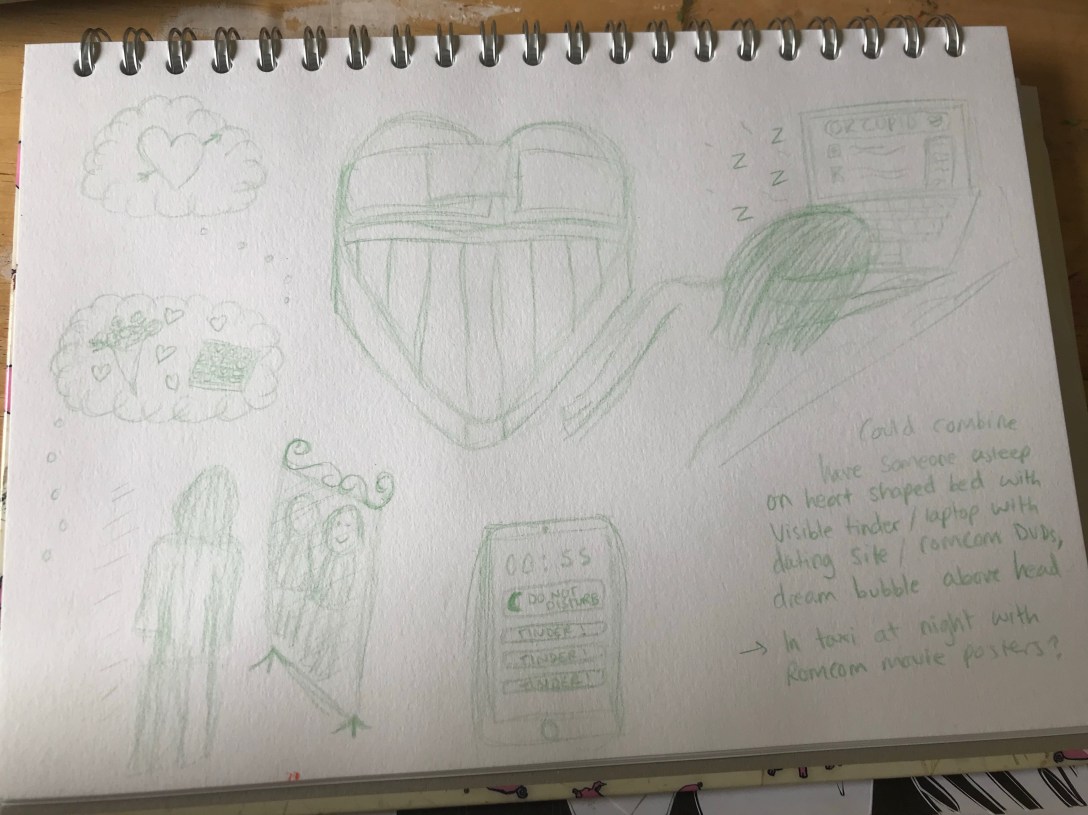
I picked the phrase ‘dreaming of romance’. I found drawing my ideas out in visual shorthand not too dissimilar to exercise 5, however I noticed that I was finding it a lot easier this time. I think my ability to think visually and generate ideas in this way has developed over part 2 and it made it much more enjoyable. I was able to quickly sketch out thoughts and they lead me onto new ideas with little issue. I even ended up producing an idea for a fully worked illustration that could communicate the phrase using several metaphors in one.
I was focused on tying together the concept of ‘dreaming’ with ‘searching for romance’. The ‘dream’ bubbles filled with traditional representations of romance, the heart-shaped bed, falling asleep at a laptop whilst scrolling dating sites, looking into the mirror and imagining yourself with a lover, and so on. My idea for a finished illustration tied these all together, having someone asleep on a heart-shaped bed, their phone showing notifications from the dating app Tinder, laptop still open on a dating site, a dream bubble coming from them showing love hearts or maybe a wedding, magazines on love and romance scattered around them, and DVDs of romantic comedies on their desk. I also considered someone gazing out the window of a car at night, showing advertisements of romcoms and their phone lighting up with notifications.
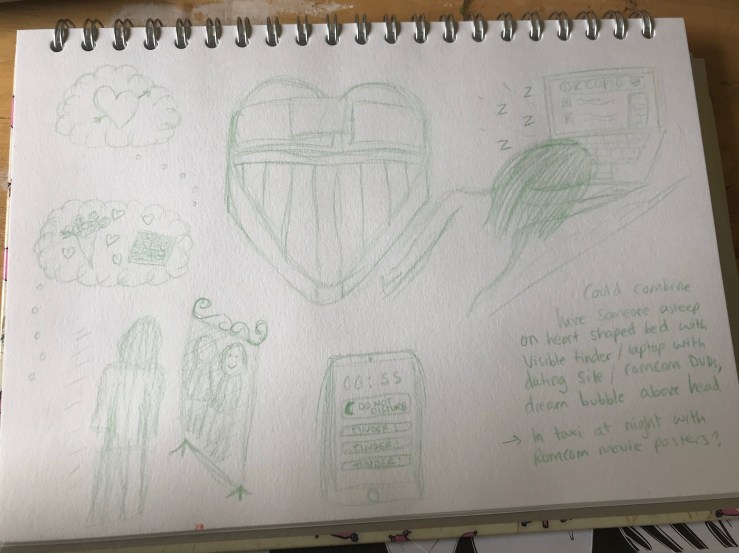
I showed these sketches to a friend and asked what she felt they communicated. She said ‘someone who’s lonely/seeking romance’. I think that’s pretty close to what I was trying to convey – if you’re dreaming of romance you’re usually looking for it.
Overall this exercise was hard. However I feel it showed me how much progress I’ve made in part 2. I found idea generation much easier and didn’t struggle as much with using visual shorthand. I was excited and slightly shocked by how quickly I developed a fully fledged idea, with ideas for a colour palette and textures too. I feel like I’ve overcome a lot of fears relating to perfectionism that I had when I first began this unit, and that makes it easier to just start drawing. I also feel like I’m better equipped to solve problems artistically and try to understand the meaning in art. Whilst I may not ever be able to fully grasp the concept of a metaphor, or learn how to instinctively see one in art, this exercise has given me a deeper appreciation of my own ability to communicate obscure concepts.
 Learning Log