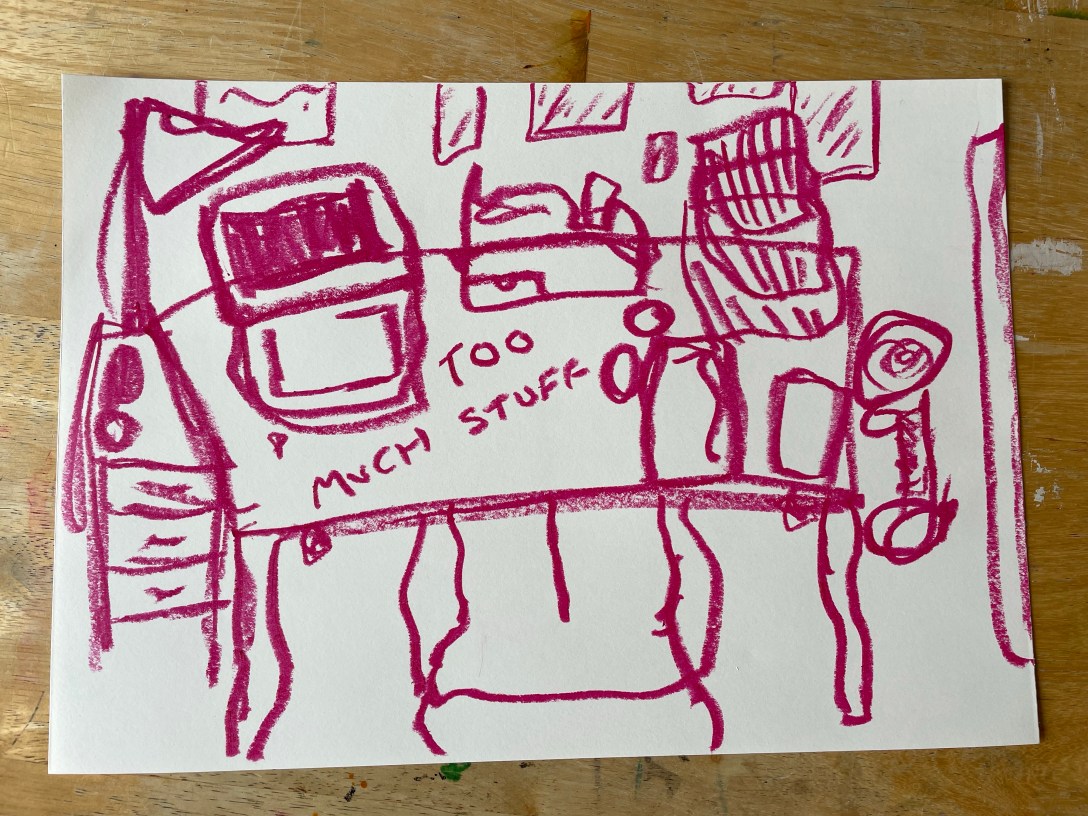
This exercise was focused on getting comfortable with the process of working very quickly, making lots of mistakes, and moving on from it. It was broken up into two sections – the first involved making four very quick drawings of my surroundings, and the second involved cutting up those drawings to make into books. The goal of this process was to challenge any preconceived beliefs that sketchbooks are places where work should be perfect, finished, and free of error.
For the first part of the exercise, I was asked to gather four sheets of paper and four different drawing materials. It was noted that these could be conventional or unconventional, but I was encouraged to choose tools out of my comfort zone. I was then asked to draw, very quickly, what was in front of me, then what was behind me, then what was to my left and right. The exercise recommended working loose and fluidly, spending no longer than 5 minutes on each drawing. I had to fill the whole page during this time, capturing the essence of what I could see.
There was a clarification that for the purpose of this exercise, the word ‘draw’ referred simply to any kind of markmaking. I could ‘draw’ whatever I wanted. It could be literally what was in front of me or abstract and gestural, maybe including words describing what I saw, or it could be emotional – communicating how I feel about my surroundings.
I thought somewhat carefully about the materials I chose. I did want to branch out and try some unconventional drawing tools, but I was also concerned I would be preoccupied with how they work rather than with the purpose of the exercise. Whilst looking through my art supplies, I spotted a pencil case full of old makeup that I set aside a few months back. I had intended to use these in my art and have never gotten around to experimenting with them. I decided to choose a lipstick from this selection as it fit the requirements for this exercise perfectly. I then grabbed a cork and a random bottle of India ink, which I have also been saving to combine for some time. I’m very intrigued by the porous properties of the cork and how this might interact with water-based colourants.
Throughout my process of selecting materials, I kept picking up and putting back down a Pentel ink brush pen I have. It felt too conventional of a tool to be working with, despite the fact I was drawn to it and was very uncomfortable working with it. I eventually got over myself and added it to the list of tools to use. It was appropriate in my mind as it wasn’t in my comfort zone, and it, in theory, is a very fluid and dynamic markmaking tool. I also decided to use an art crayon, as this is possibly the most fluid of all the materials I own. It glides across the page with extreme ease and leaves bold, intense lines. It’s a brilliant tool to use to just let go a little.
I chose to use four sheets of cartridge paper for this exercise. It’s slightly off-white in colour, smooth in texture, and a nice medium weight. I needed it to take the India ink and the lipstick without buckling, but I didn’t want to use something overly heavy as I was aware of the folding required later on. I then got to work drawing. I started with the art crayon as it felt like a good way to introduce myself to the exercise and to working fluidly. I set a timer for 5 minutes and drew what was in front of me. I was not drawing exactly what I could see, nor was I drawing everything. I chose to draw what I felt was visually interesting and eliminate what didn’t fit. I very quickly had filled the whole page and realised my timer was only half-finished! I had expected 5 minutes to feel very quick.
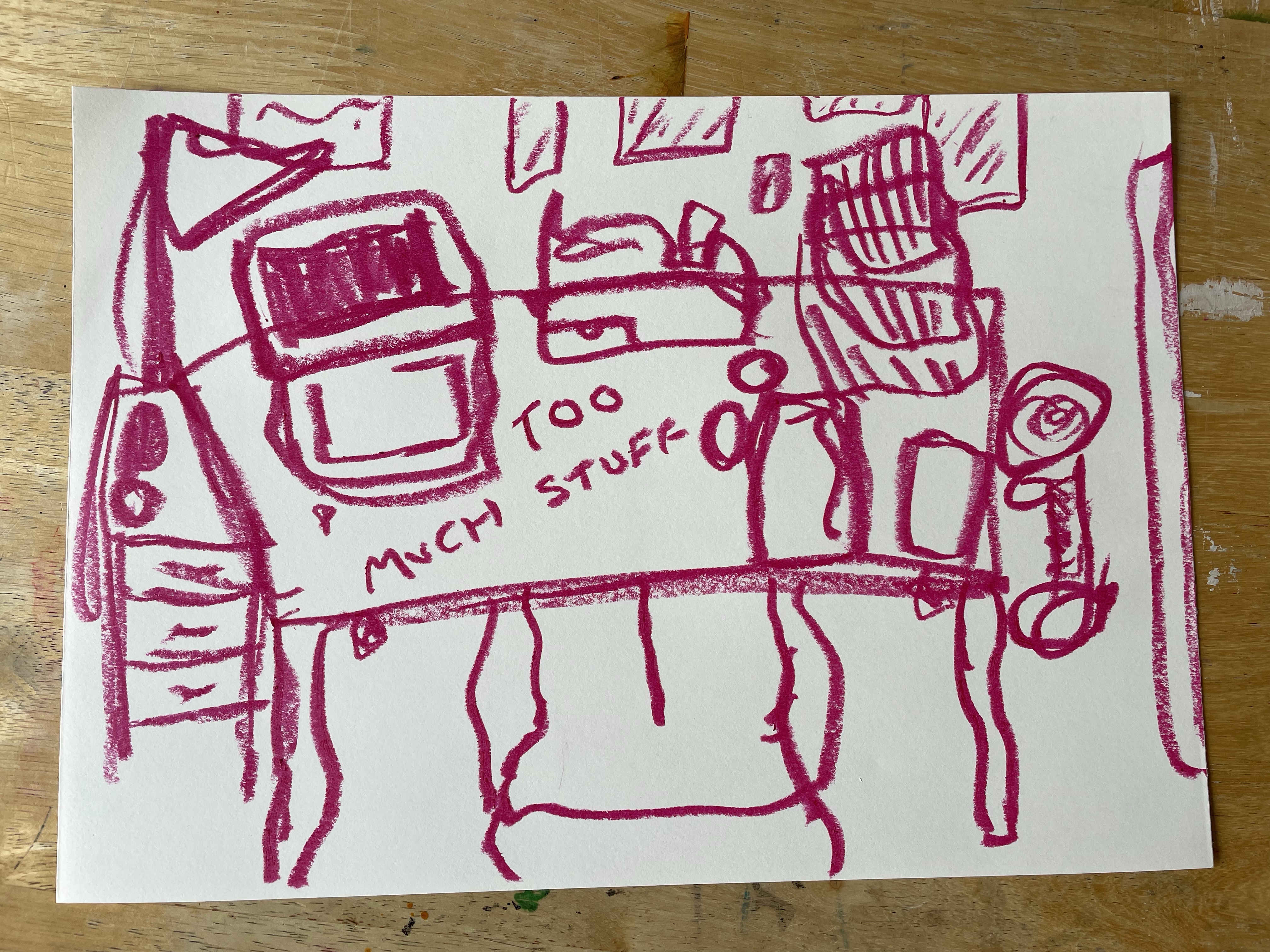
I then moved on to using the brush pen and drawing what was behind me. Again, I set a timer and worked to fill the page. This was where I really started to feel the mistakes coming through. Everything was overlapping and out of place, and the perspective is really off. It doesn’t look too much like what was behind me, but at the same time, it captures all of the key elements perfectly. I also really enjoy the way I captured the textures of some of the components.
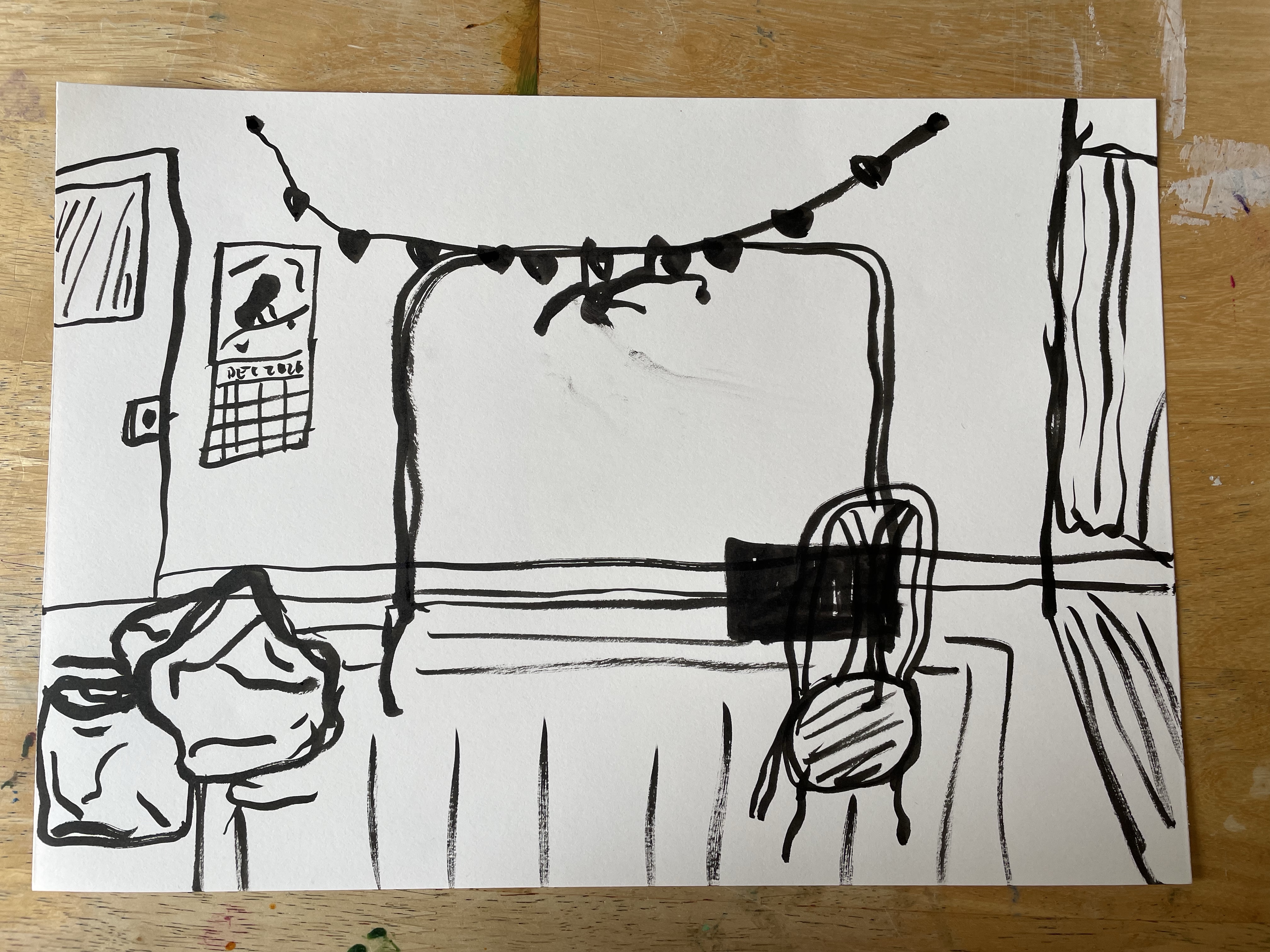
I carried on, next to the lipstick, which was surprisingly fun to use! I drew what was to my left this time. Interestingly I drew this on a much larger scale, which may be down to the material I was using. Once again, I could see all of the mistakes coming through, which was beginning to frustrate me. In retrospect, however, I can see so much that inspires me that I’d like to try out again. The last thing I used was the cork and India ink combo. This drawing is probably the ‘worst’ one, objectively. It’s definitely the one I like the least and the one I wish I could do again.
Firstly, the cork was not at all absorbent despite my hopes. I guess it has a waterproof coating as it’s meant to be a bottle stop, or maybe I just don’t understand how cork works. This made it really hard to use as a tool! The ink was dripping off it, and I constantly needed to add more to get any pigment. Secondly, the fact that this was a wet medium actually made it harder to work quickly. That feels counterintuitive, as wet mediums are very loose and fluid, so maybe it was a combination of that and the cork as a tool, but it was difficult to achieve any sort of definition in my lines. Adding texture or pattern was impossible as it just blurred into one.
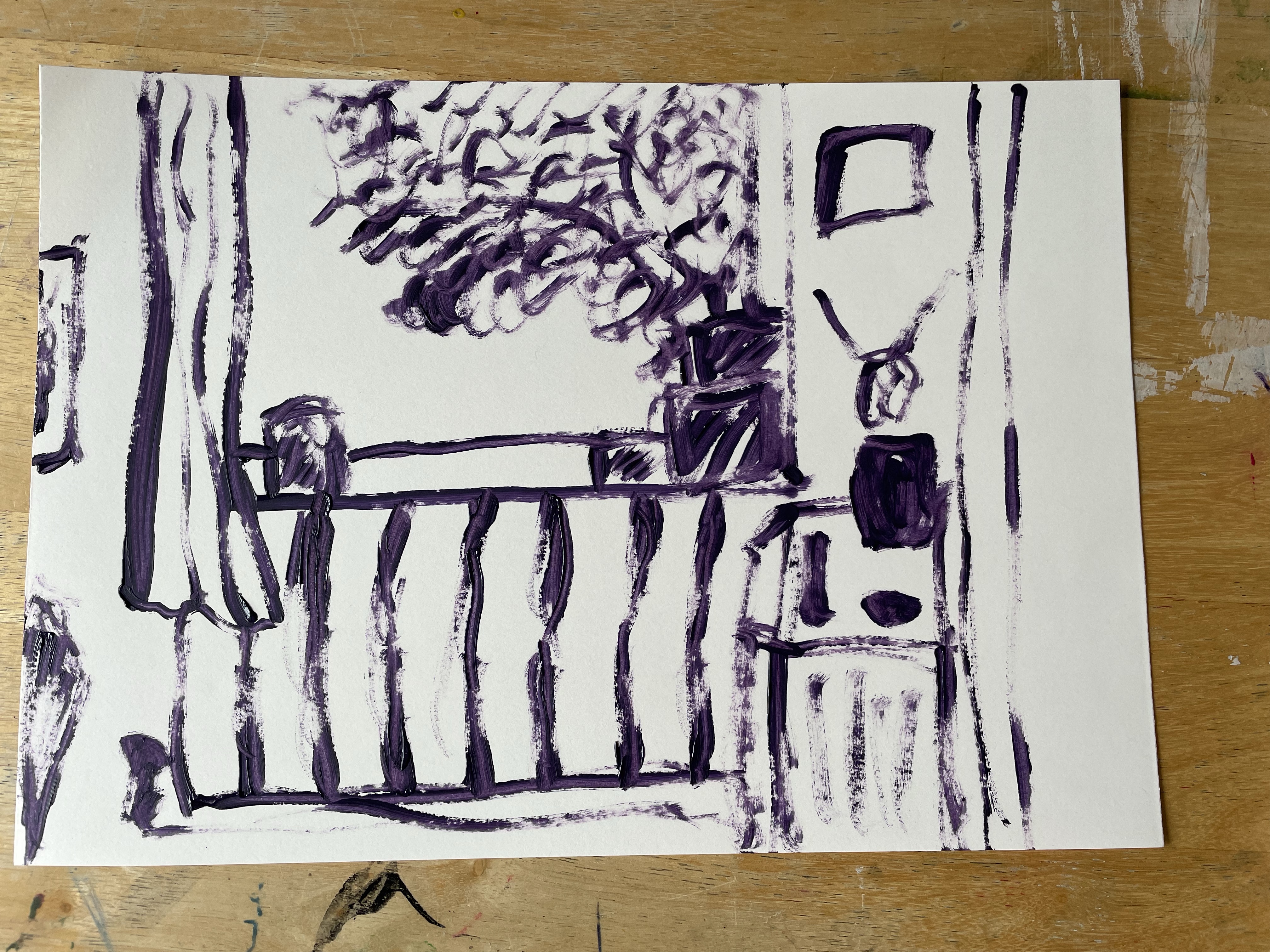
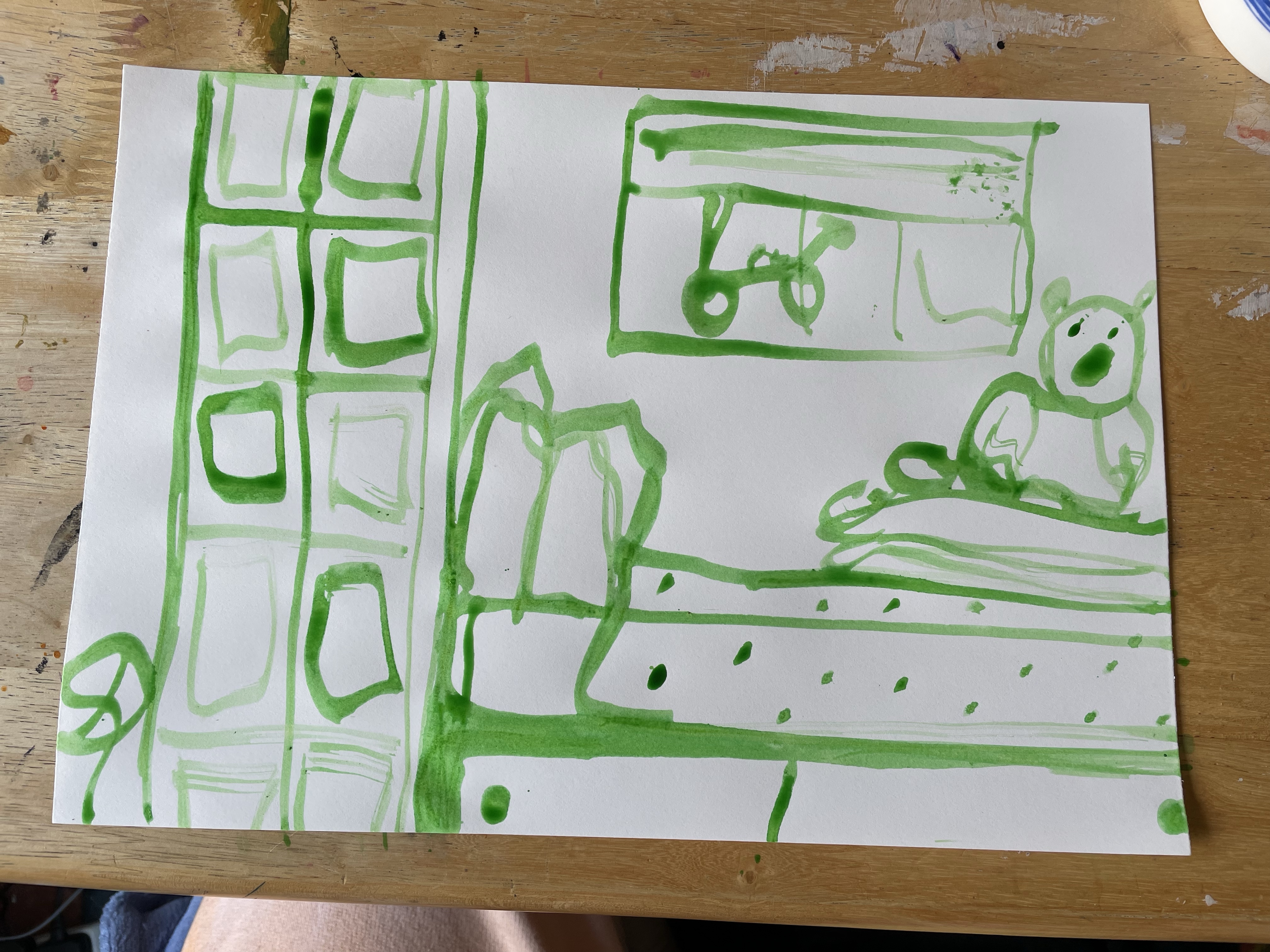
I was then asked to think about how this process made me feel. At the time I wrote that I felt liberated, curious, inspired, frustrated, and disappointed. I felt liberated by the freedom of the process and by not having to worry about the outcome, curious about the materials I was using and how I could push them further, inspired by both the process itself and the outcome of it, frustrated by the mistakes I was making and the fact that it even bothered me in the first place, and disappointed mainly by the fact the cork and ink idea was so far from what I had hoped. Ironically, despite being so crushed by this, I think that piece is the most successful in this exercise. It’s the one with the most mistakes, which was the goal!
I then moved on to the bookmaking activity. There were four different bookmaking techniques outlined, one for each drawing made. The exercise recommends trying them on spare paper before starting on the drawings, but as the exercise is about making mistakes, and because I’m quite confident in my ability to accurately do what was required, I started straight on the drawings.
Overall I enjoyed this part of the exercise as it was nice to see the bookmaking process work out and to see how it impacted the drawings. However, I found it hard to make the fourth book. I had gotten quite attached to the drawing I had made, and I really loved how it looked. Cutting it in half and destroying the thing I was so happy with felt upsetting. I had intentionally chosen to not think about which drawing I used for which book as I wanted to push myself out of my comfort zone – and it worked. I feel comforted by the fact I have a photo of the image prior to cutting it up, but I still wish I hadn’t.
Above, you can see a flip through of the four books that I decided to film. I thought this would be the best way to document the finished pieces, as they’re quite difficult to photograph! I have now secured them with bulldog clips ahead of Exercise 1.3. I was asked some questions to help me reflect on the process and see how creating books like this could benefit my creative process.
Can you work in it again with another mark-making implement or colour? Or, do you want to leave it as it is?
I am intrigued about how doing this would impact the overall piece when the books are unfolded. I like how each individual page tells its own little story and how each has its own unique qualities. There are some places where I feel the page may benefit from another colour, texture, or element of markmaking and some areas where I love how it looks now. This process helps you see things you may not have seen before and allows you to be inspired by things you may not have seen if you’d only been looking at the full image. I like leaving that alone, just to let my mind play with what’s there. So really, I guess my answer is maybe, depending on the page and/or purpose. I definitely would like to try to at least see how it changes the full image.
Are other ideas sparked from looking at each page? Are you reminded of something else?
This is quite a big question – the short answer is ‘yes’. I could probably sit and dissect all of the pages of every book and go into how I would change them or the ideas they spark, but that would take forever. They really do help, though, to inspire me, even as books of textures or lines that look interesting. The main idea that sparked from all of this is to create an intentional book where each page is its own self-contained piece of artwork, yet when opened up, there’s a whole new piece visible.
Which format do you prefer?
I think my favourite format is number 3, the very tiny book I made. I would like to make a miniature sketchbook using this method at some point, just to have fun with it. Maybe I will make a pocket texture book or pattern library. Who knows!
Overall, this exercise pushed me out of my comfort zone and gave me loads of ideas that I want to further explore. I’m also impressed with my ability to let go and allow the artwork to just come to me – for my conscious mind to ‘check out’ and my subconscious to work the drawing. I feel more comfortable now with making mistakes – and perhaps most surprisingly – more comfortable with cutting things up. I hope to feel less precious about my art and maybe more comfortable with the act of intentionally destroying it as I go on with this unit.
 Learning Log