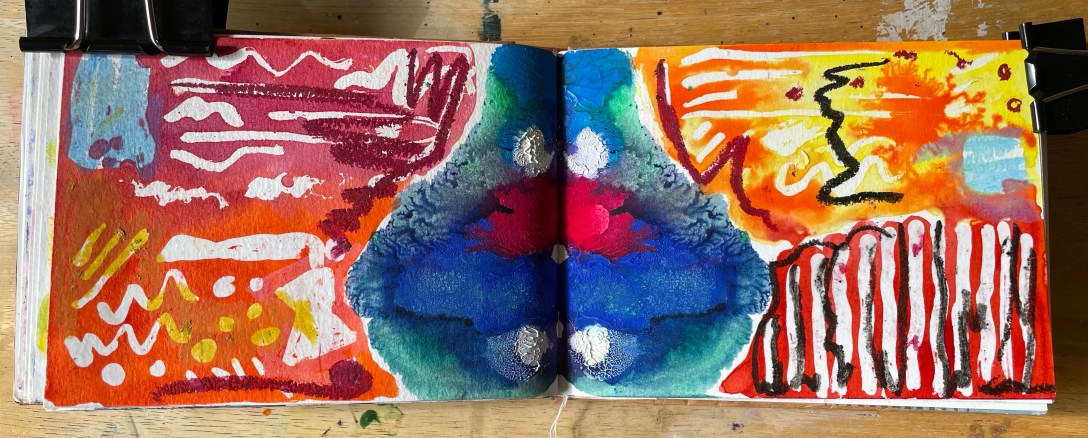
For this exercise, I was asked to undertake studies in order to investigate the physical properties of different materials or processes. I had to pick a set of mediums or ways of working and isolate some sections in my sketchbook to act as ‘chapters’ of work, each containing micro-studies of research into my materials. What I depicted in the studies was up to me, but it was advised I keep it simple and focus on the materials rather than the illustrations.
I was very excited about this exercise as the aim was to be as exploratory as possible, which I was craving. I didn’t put a great deal of thought into my chosen mediums. My first pick was gouache as I have a new palette set up that I’m enjoying using – however, I don’t have much experience with it and want to understand it better as a medium. I then picked India inks as they’re some of my favourites to work with, and they have very different properties to gouache despite also being water-based. Finally, I chose watercolour crayons because I recently bought a whole new set of them and was itching to play.
As the exercise was to reference the work of Lucy Austin – the focus for Research Task 2.1 – and because my tutor had emphasised my need to plan less when working in my sketchbook, my aim was to be as free and ‘thoughtless’ as possible when working through this exercise. I wanted to see where the materials led me and do what I felt came naturally rather than excessively planning each stage. However, I did jot some rough notes down on what I could do to test each medium as a starting point. I also decided that I would do a fourth mixed media chapter to see how all three combined, as that’s how I’d like to use the mediums in practice.
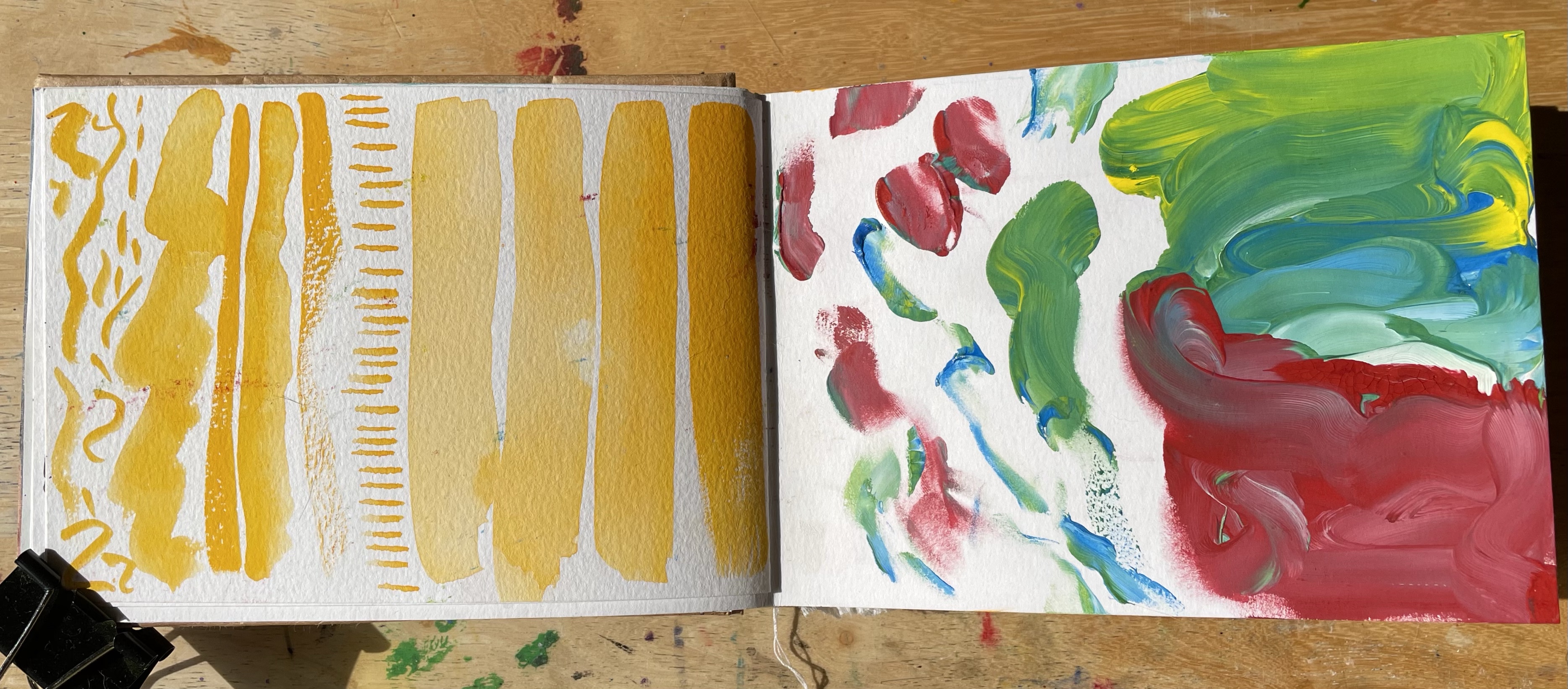
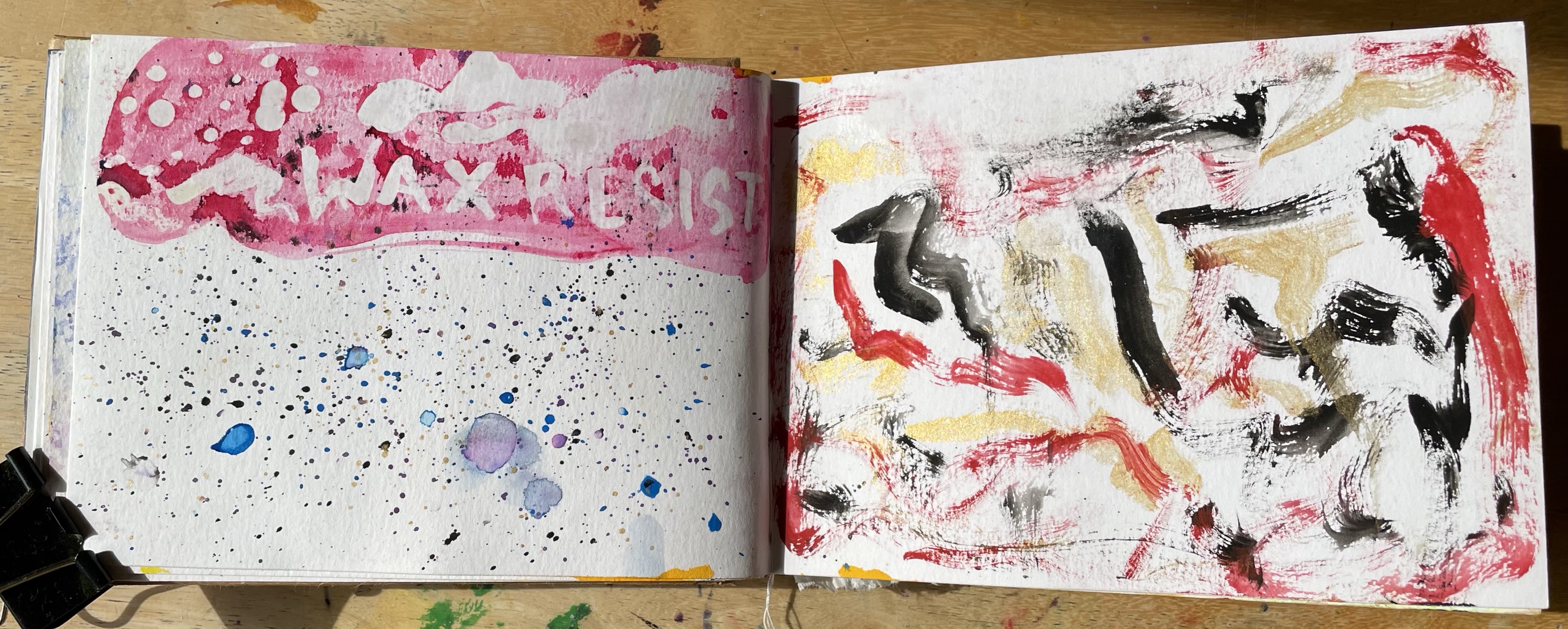
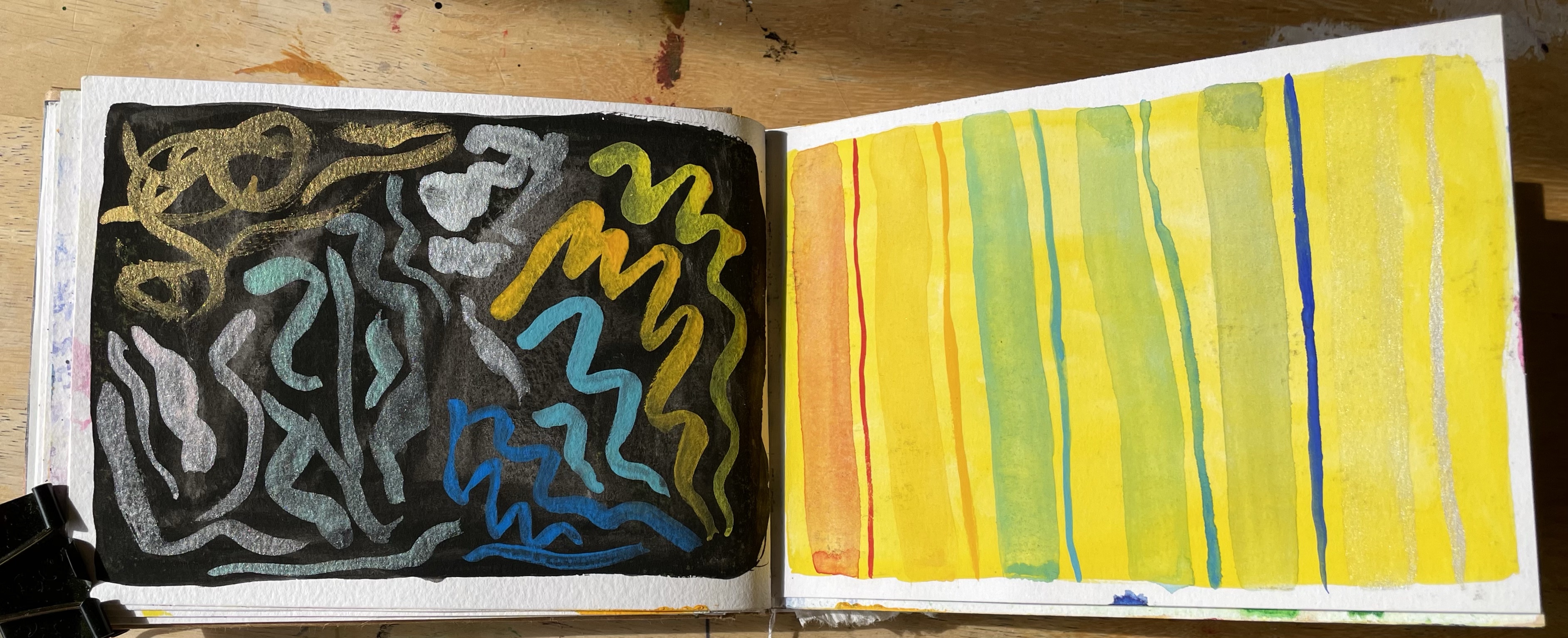
My first chapter focused on gouache. As mentioned earlier, I recently bought a palette and filled it with gouache so that I could use it in a more accessible way. Dry gouache when rewet is somewhat different in consistency and how it can be used, but I find I prefer it this way. I thought it would be interesting to explore the differences between the two throughout my chapter. The first two pages consist of this: the left is rewetted dried gouache, and the right is wet gouache applied directly onto the page. The left page shows a variation of markmaking, opacities when more water is used, and different brushes. For the right page, I mixed several colours directly on the page with my fingers, then used them as markmaking tools. I like how up close you can see the texture of my fingerprint throughout the mixed paint. It was also really fun to do this!
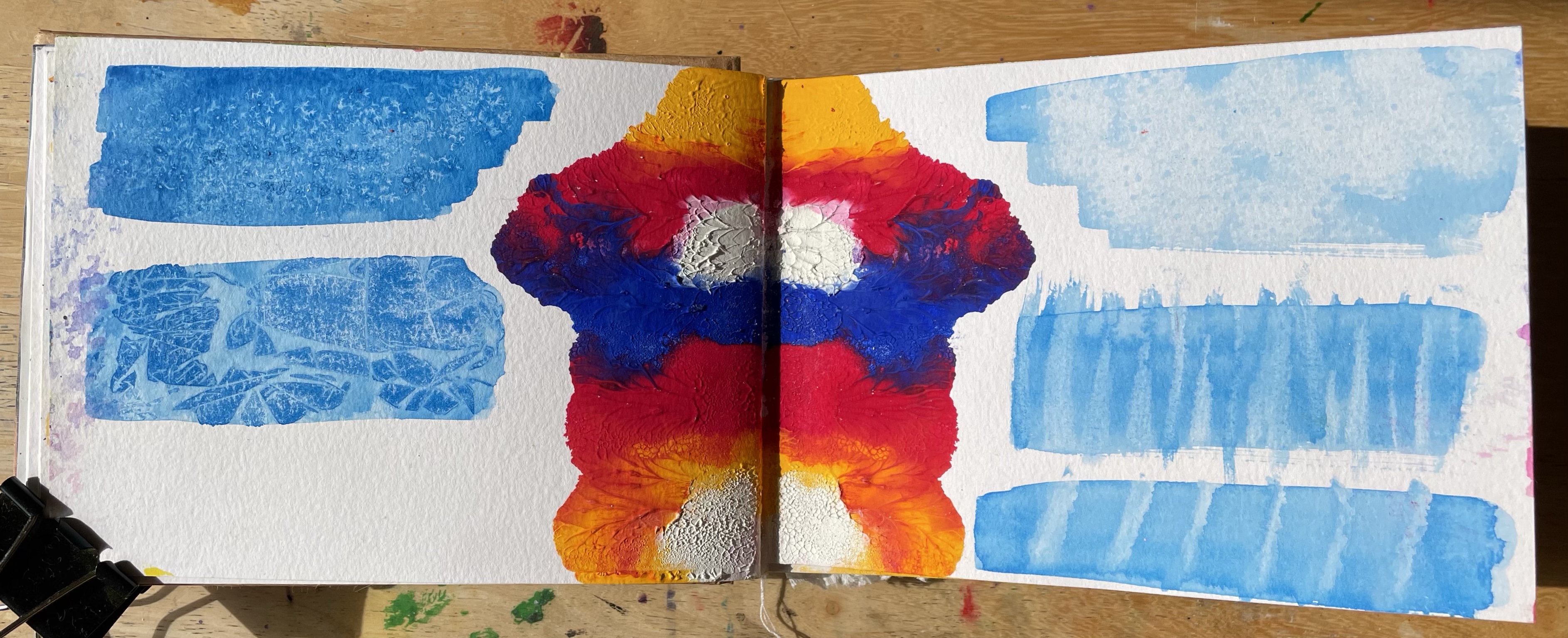
Using my fingers led me to wonder about other childlike ways of engaging with art, specifically folded paper paintings. On the next spread, I applied paint directly to the centre of each page, shut the book, and used my fingers to move around the paint from the cover. I was so excited when I opened it to see what was there. I love the effect, how the colours have mixed, how the paint has spread, and the texture that has been created. I then painted some quick studies on either side using rewetted gouache and explored lifting/removing the paint. On the right, I used kitchen towel to remove the paint in different ways, and on the left, I used salt and cling film. I don’t feel particularly drawn to any of these, but they are good references to have for the future.
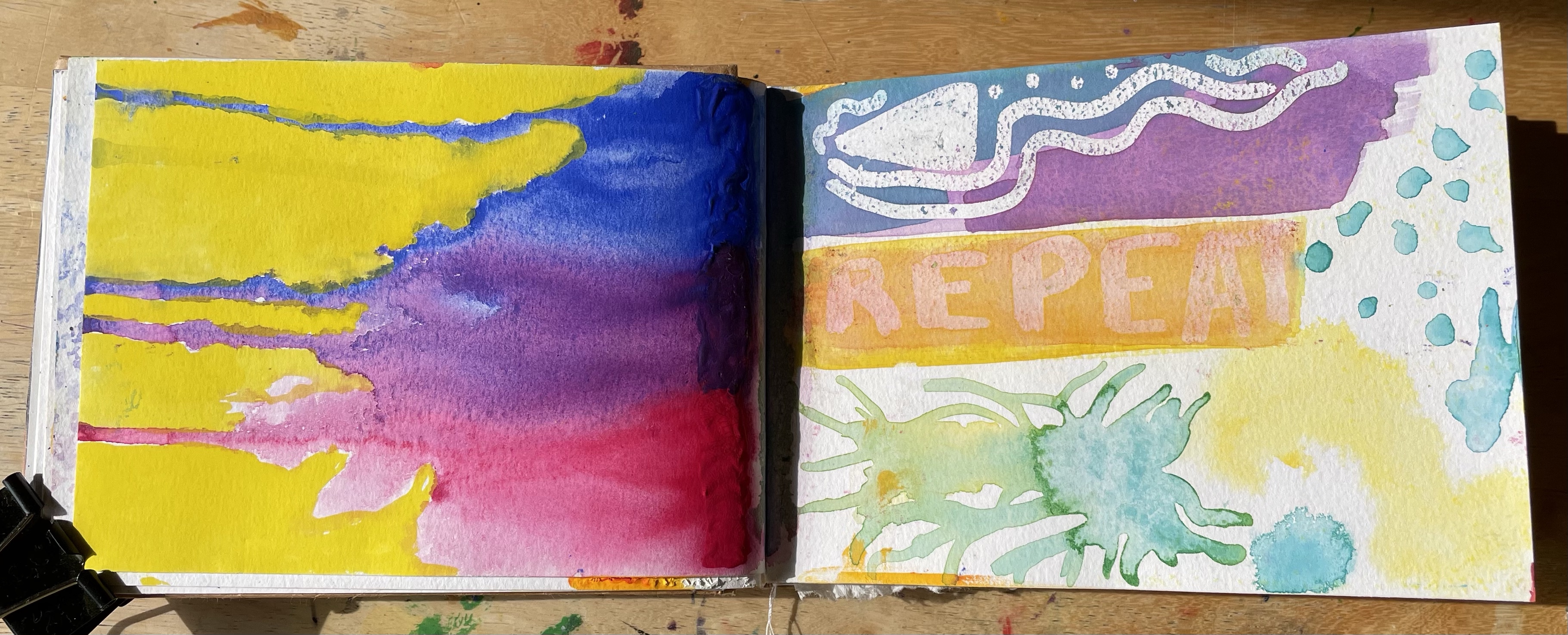
From folding the paper, I had another idea regarding rewetting gouache and how it could move around the page. I chose two colours and applied them directly to the paper, mixing them in the middle. I then let them completely dry. Taking a spray bottle and eyedropper, I then added water to the gouache, holding the sketchbook upright to allow the water to drip down the page. I encouraged the paint to move by continuously rewetting it, blowing on it, and turning the book in different directions to allow gravity to take over. This was really intriguing and definitely a process I would explore further. The idea of wetting gouache once it has already been used is interesting to me. Once it had dried, I filled the rest of the page with yellow gouache from my palette, just because I liked the colour combination.
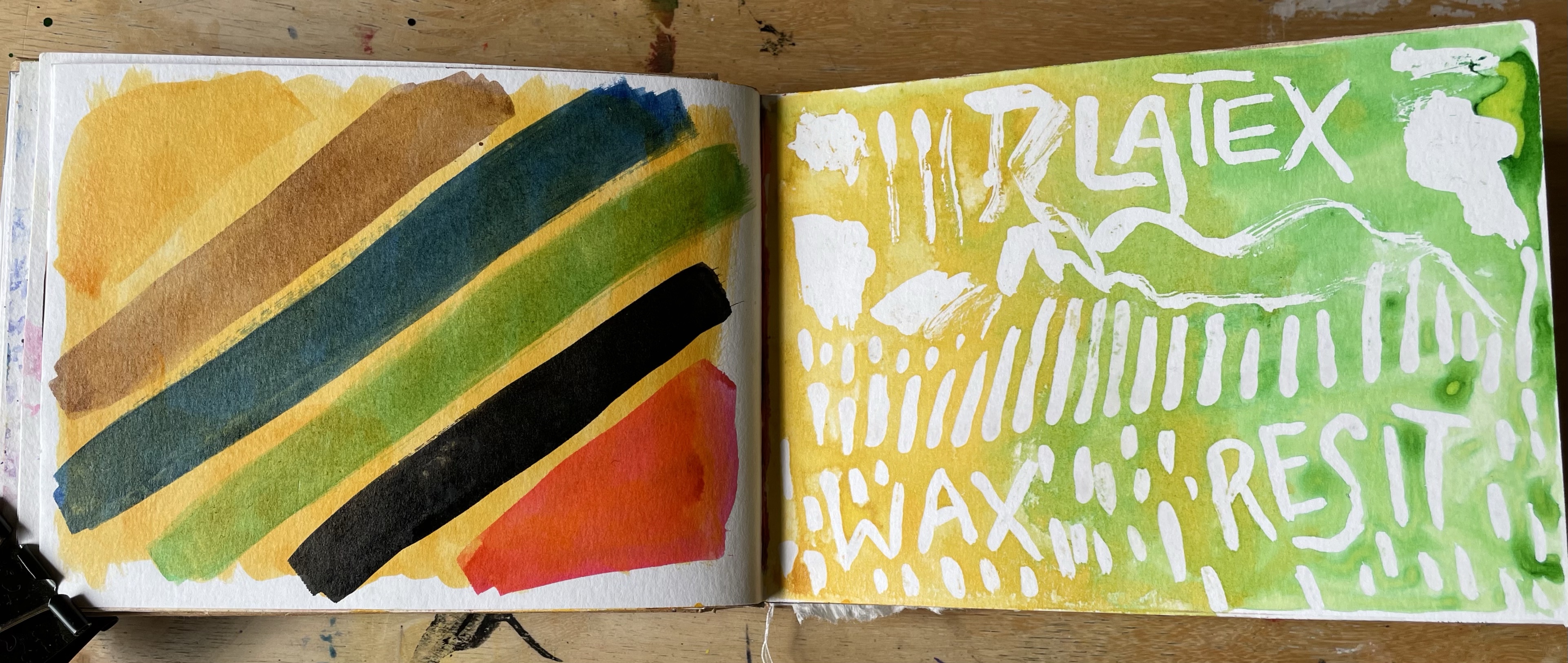
The next three pages were about exploring further markmaking and masking techniques. On the first, I used a liquid latex marker pen to mask the paper before painting over it. I also tried different ways of wetting the page, individual droplets from an eyedropper, spray from a bottle, and lots and lots of water manipulated in specific ways. Then I tried to use wax as a mask, once again painting over it. I think I prefer using wax to the marker pen as it’s more opaque. Alongside it, I tried splattering the page with my brush and using a dry brush to create different textures.
Finally, I took two pages to explore the layering properties of gouache. On the left is a solid black background and on the right a solid yellow one. I picked these colours as they’re contrasting as darker and paler. I then used a range of different colours in different ways to see how they interacted with the background. Was it possible to see them? Did the colour of the background change the colour I was applying? Interestingly, the colours used on the black background seemed bolder and more opaque. This again serves as a good reference for future projects.
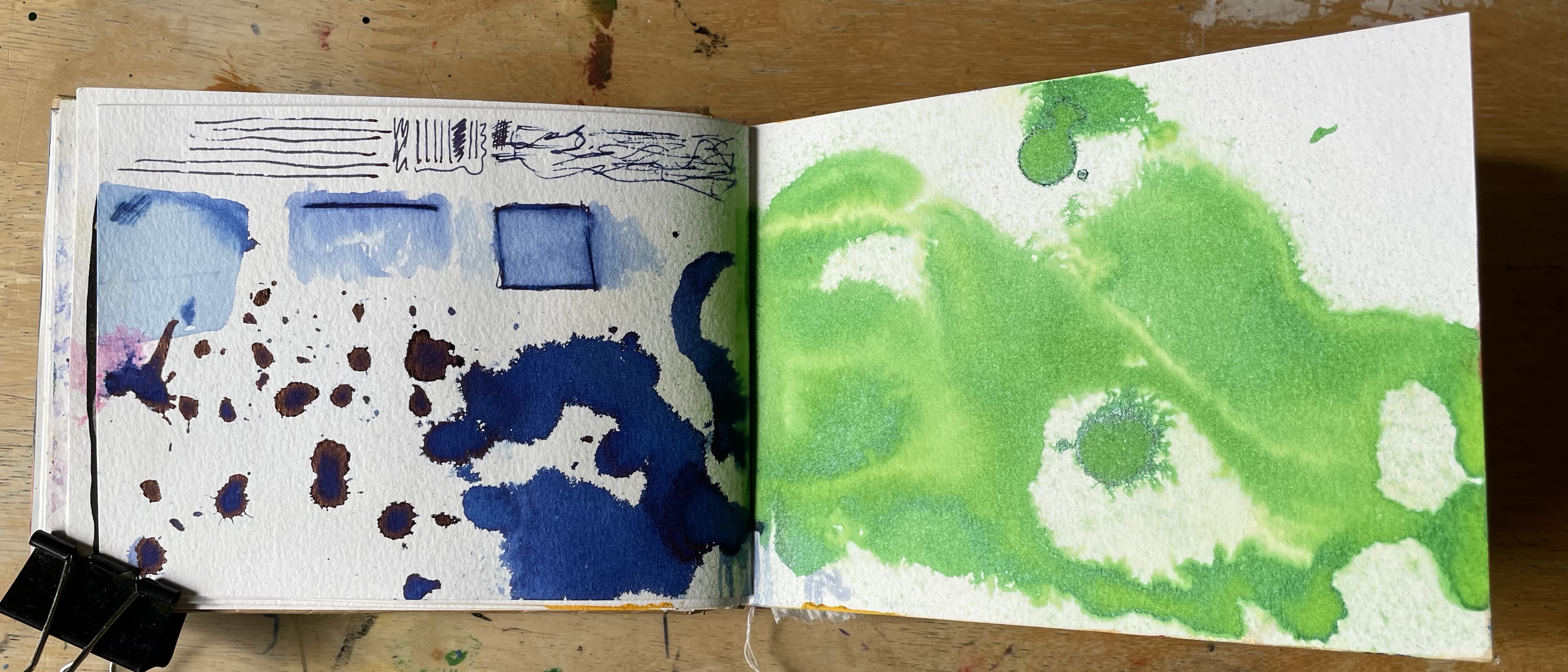
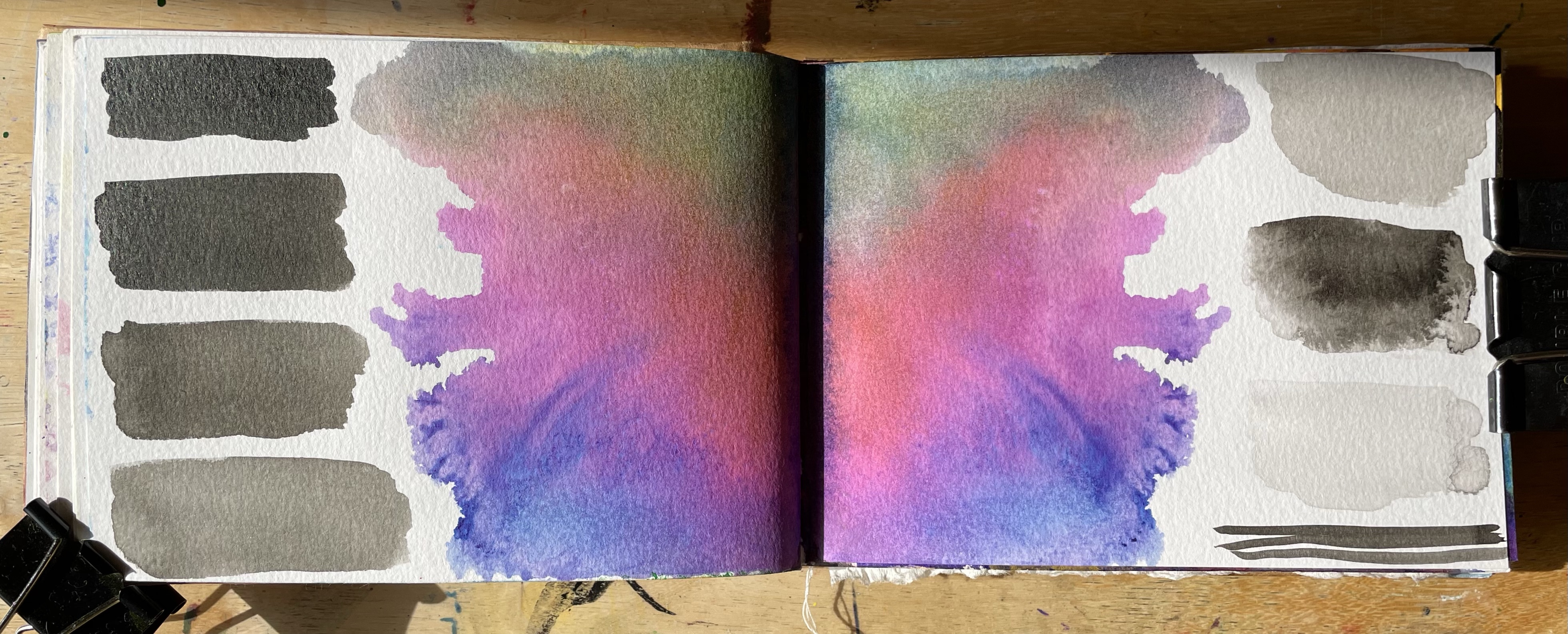
I felt satisfied with the amount I had explored gouache, so I moved on to the next chapter: ink. I wanted to try some of the processes I had explored for gouache to compare them and see how they would interact with the ink, but there were also some ways I wanted to experiment that were unique to the medium. On the first page, I explored a little using a fountain pen and one of the refills I have for it. I don’t often use my fountain pen to draw, mainly because it isn’t waterproof and can smudge quite easily. I tried to play with these qualities specifically on this page, and I explored ways of manipulating the ink. On the second page, I used an eyedropper to drop ink directly onto the paper and used a spray bottle to move the ink around.
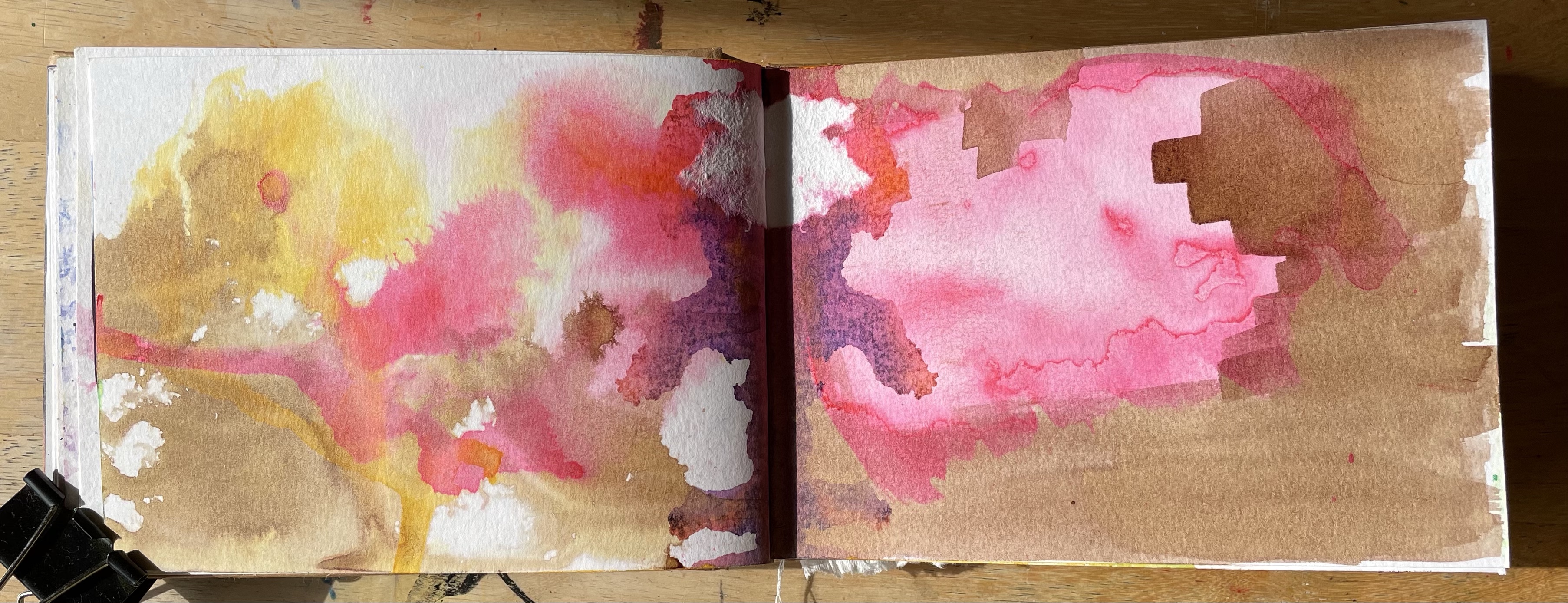
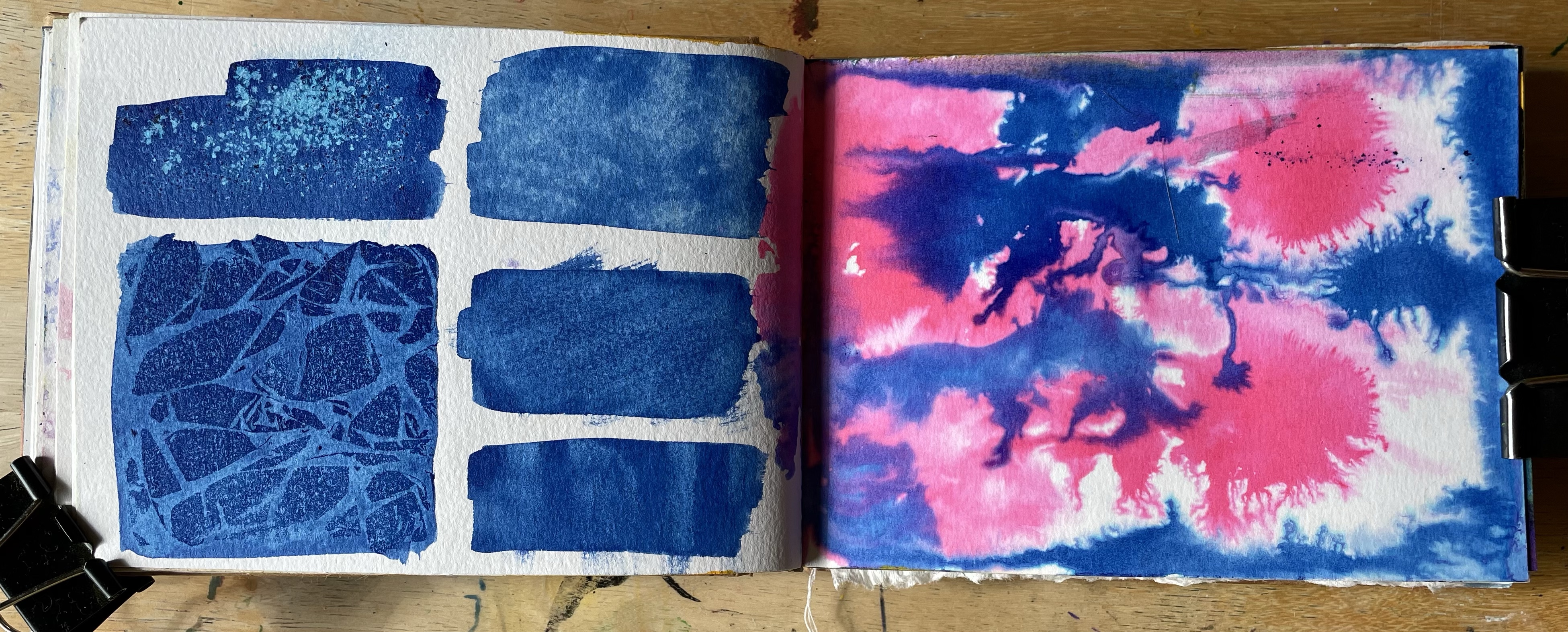
I was fascinated by this and by the way the ink dried showing variations of colour and opacity. I explored this further on the next spread, first by repeating my process of using a spray bottle and dropper to manipulate the ink, then allowing the layer to completely dry. I then added layers in different colours over the base layer using the same technique. It was wonderful watching how the ink had a mind of its own and seeing how it engaged with the colours behind it. I then played specifically with opacity by laying down a section of ink and then using water to dilute it on the page, trying to create a cloud-like texture. When dry, I painted alongside and over this using another colour, once again exploring how the layers interacted with each other.
The layering reminded me of the experiments I had produced with the gouache, so I decided to replicate the paler one, as I feel I know from experience that darker colours cannot be painted over. In hindsight, maybe I should’ve explored this further, as I don’t know for sure how the colours interact. This process, however, is similar to one I undertook during an exercise for Key Steps in Illustration when attempting to find the right colour combinations for a painting. I feel experimenting with processes, methods, and colours is a part of the illustrative process that will probably be used in every creative project.
I also repeated my masking experiments, but this time I used liquid latex and a paintbrush rather than a marker. I prefer this to the marker as it was a little easier to control. I especially love the colour combination I used here, and I like how the pooling of ink caused by the resistance of the masking materials creates areas of harsher opacity. Next, I repeated the lifting experiments I had used in the gouache chapter, and alongside it, I explored how ink interacted with an already wet page. This technique is possibly my favourite in terms of the effect it produces. It sparked an idea that I explored later on, and I would like to generally explore it further.
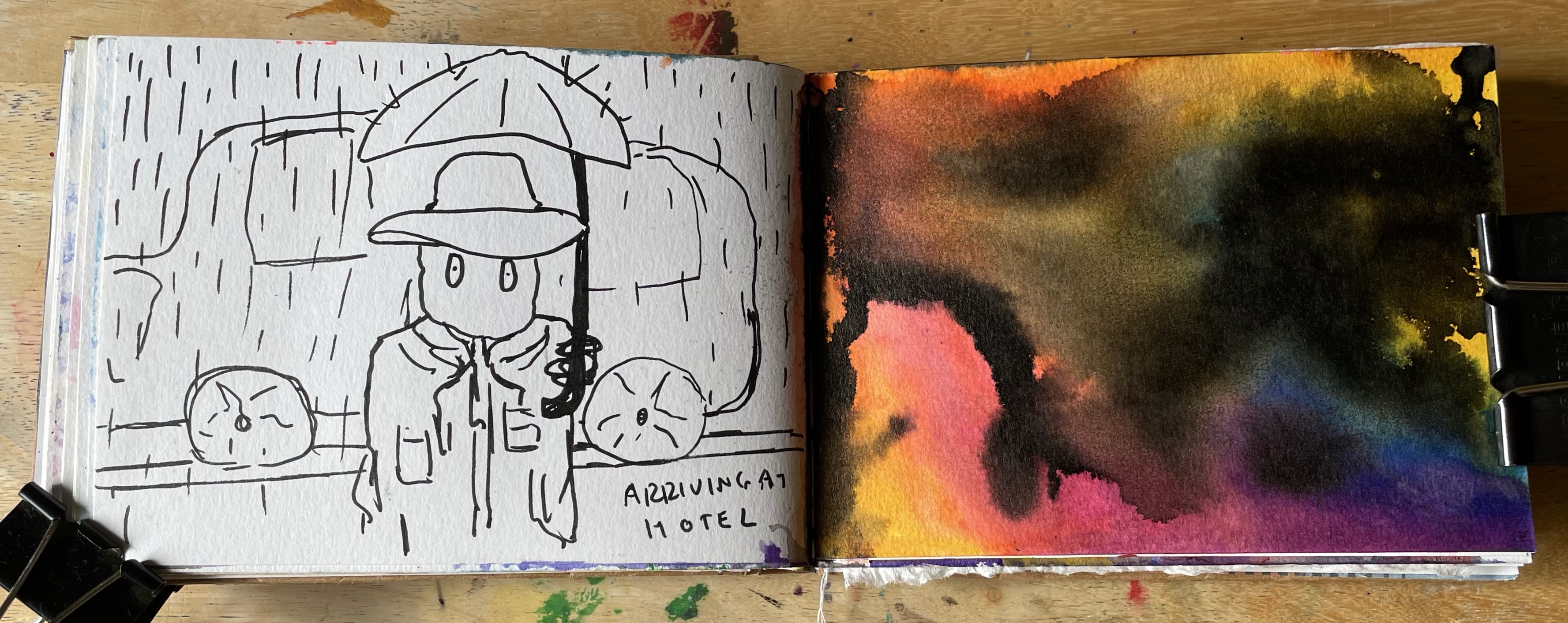
For the next page, I used the same page folding technique as in the gouache chapter. Once again, I am thrilled with the results and the way the ink mixed on the page. I can see myself doing this more regularly. Alongside it, I tried diluting ink to varying degrees to see how it would impact the opacity. The final spread is a little weird. The page on the right followed the idea I mentioned earlier – I painted a background with various bright colours and let it completely dry. Then I soaked the page and added spots of black ink, allowing it to spread throughout the page however it wanted. I didn’t quite get the results I expected, but it was a good first step. The drawing to the left is not really part of the ‘chapter’ at all – it was a character and scene I had thought up out of nowhere that I felt I wanted to document. So there it went, as that’s where I was currently working.
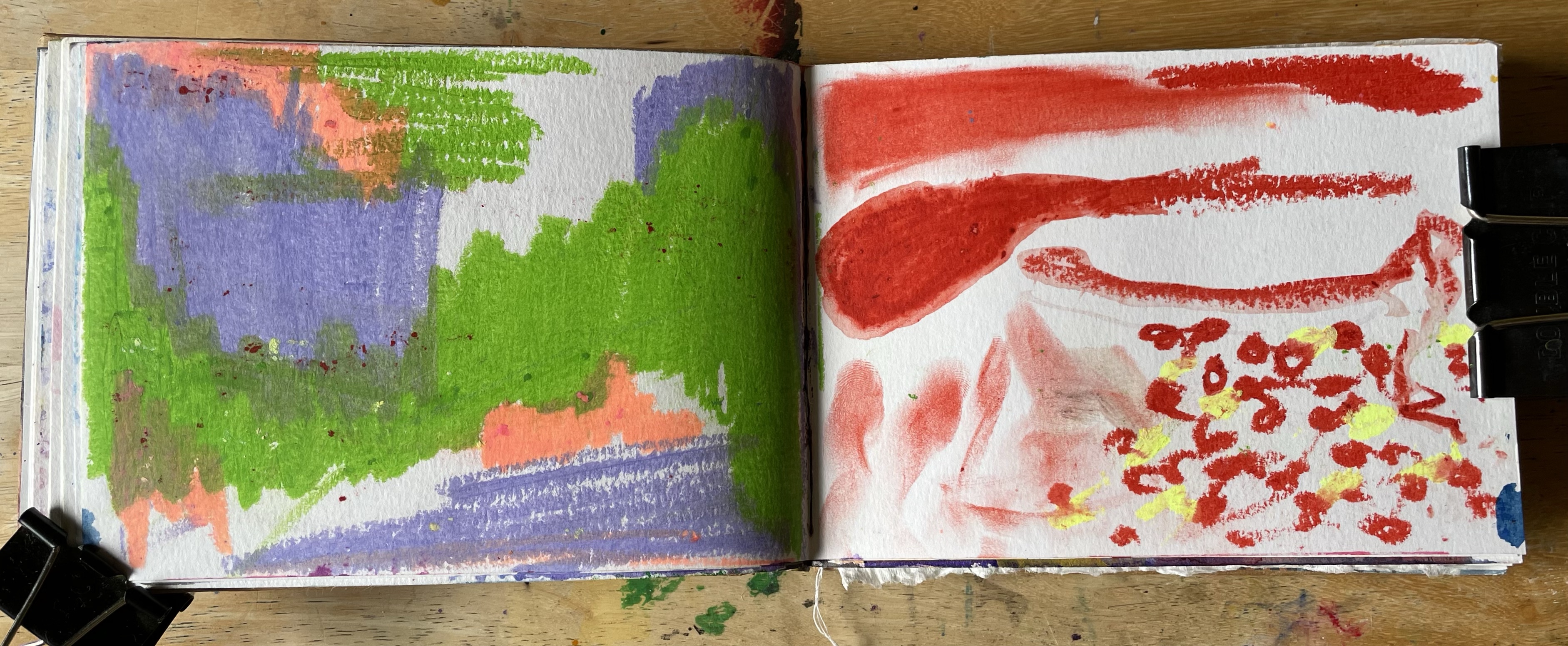
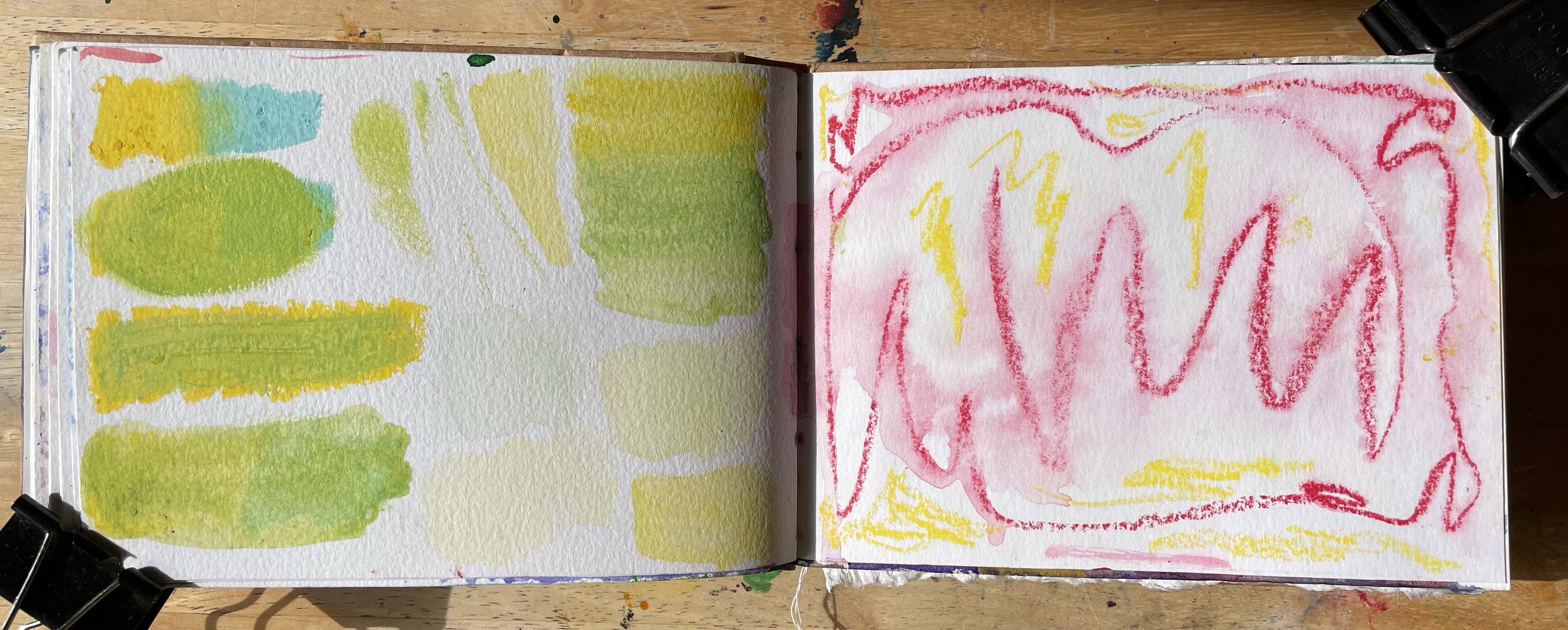
Next up was my crayon chapter. I had three soft watercolour crayons from a Scrawlrbox that I used in Assignment 1, and I fell in love with them as a medium. I ordered a huge case of them in various colours so that I could get really stuck in to using them. I didn’t have much I wanted to do to experiment with them solo – I was more excited and interested in how they interacted with other materials. I still tried them out in as many ways as I could imagine, just to see how they worked.
Page one is simply the crayons in their purest form, on paper, overlapping and with varying pressures. The second page experiments with smudging, wetting the crayon before using it, and different forms of markmaking, including fingerpainting. The third page consists of explorations of colour mixing and blending, as well as using the crayons as a ‘paint’ by colouring a section of a palette and wetting it there. Then, for the fourth page, I soaked the paper and tried using the crayons on this.
Whilst the crayons are boasted to be water-soluble and essentially paint in stick form, I would describe them to be partially so. They don’t work as well when wet themselves, but any marks made on paper can be easily manipulated when water is added. Despite only filling four pages for this chapter, I feel I better understand the qualities of the medium and how I enjoy using it. These will be good references for future projects.
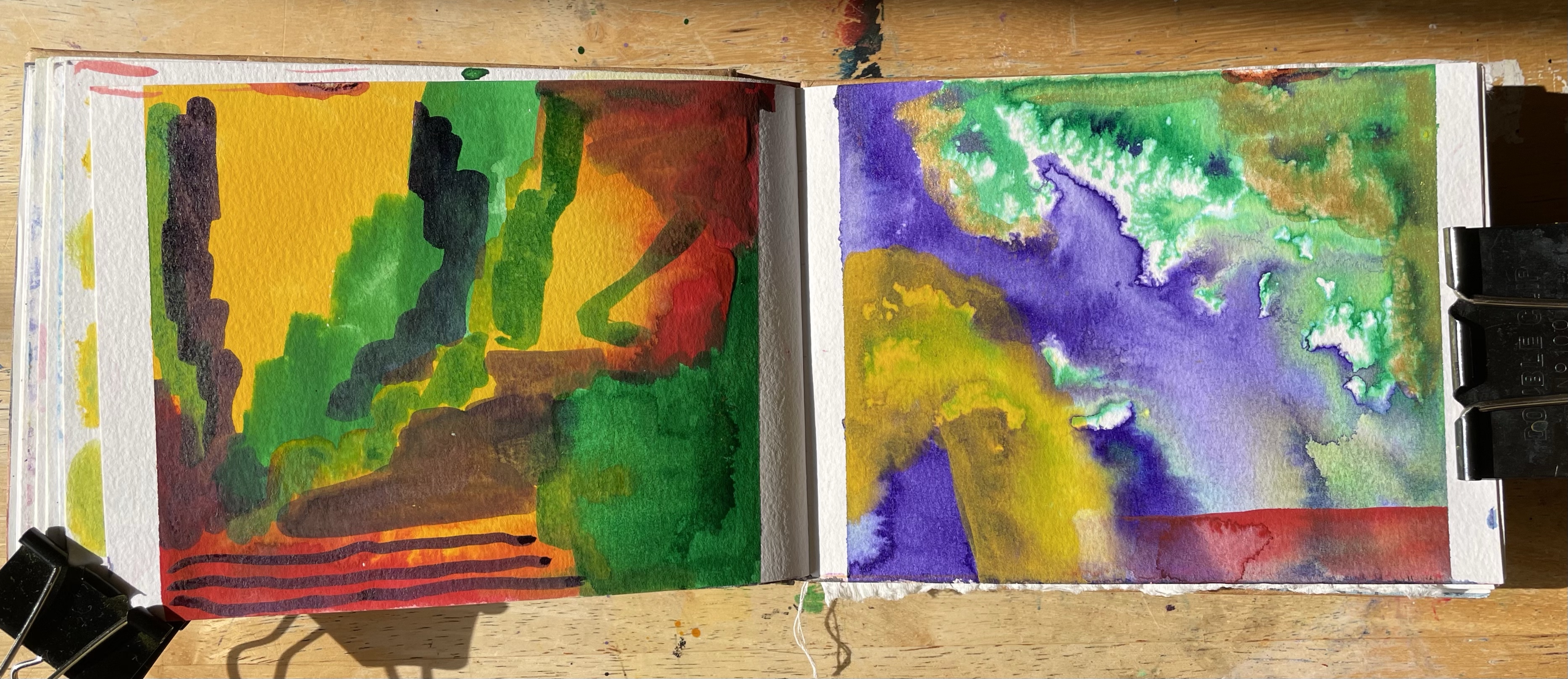
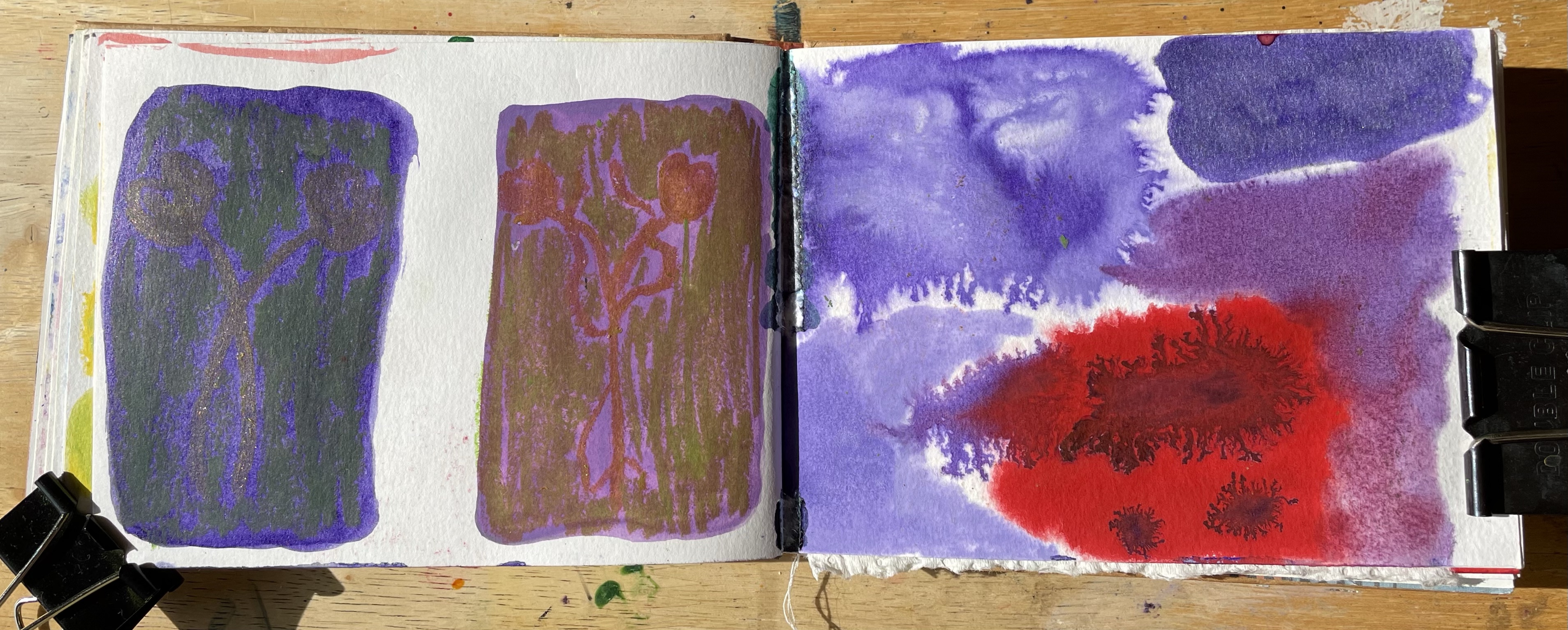
After completing each solo exploration, I was excited to venture into combining the materials. I looked through the work I had completed so far and took note of my favourite techniques as well as the various properties I wanted to experiment with. This chapter was by far the most structured and ‘curated’ of all four. My aim was to create not just explorations of mediums but also pieces of work that inspired me to continue working with the new techniques.
On the first two pages, I did the same thing in reverse. First, I filled a page with gouache, blocking in, overlapping, and blending the colours on the page. Next, I filled a page with ink using the ‘wet page’ technique I had experimented with previously. I let both of these pages completely dry, and then I applied the other medium over it – ink over the dry gouache and gouache over the dry ink. I was more deliberate and intentional with my placements of colour than I was in previous chapters, and I feel both pieces work really well.
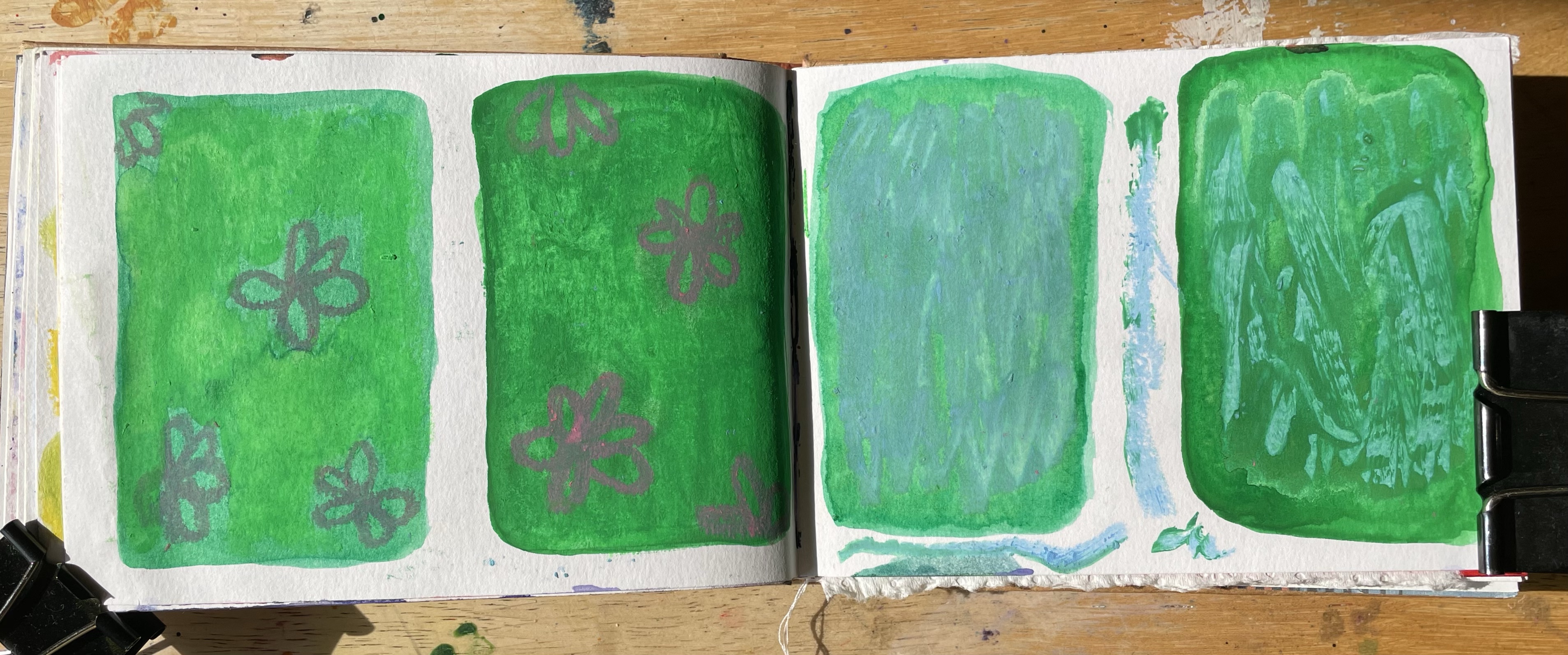
Next, I wanted to see how the crayons worked with the two mediums. I painted two swatches, one gouache and one ink, and waited until they dried. Using the same crayons on each, I doodled a flower and coloured in the space behind it. It’s really interesting the way the two mediums almost ‘absorb’ the colour from the crayons. When I first applied them, it was much brighter and more intense. Alongside it, I explored how the two wet mediums interacted if I mixed them together whilst wet. As gouache is matte and fairly opaque as a medium, combining it with the transparent qualities of India ink produced some exciting effects.
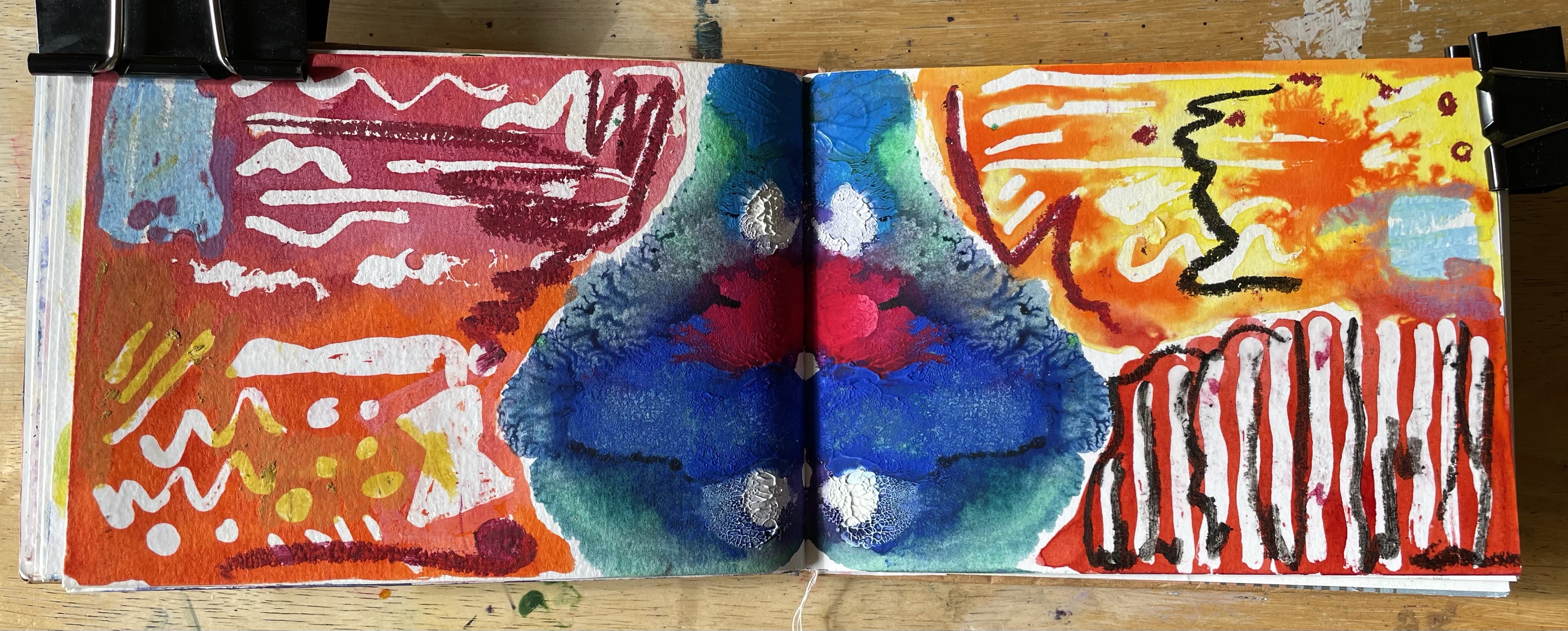
I continued with some more swatch studies of all three mediums combined. First, I tried the crayons wet over dry gouache and ink, and then I mixed them when all were wet. Once again, this was fascinating to see, especially how the colours altered over time. Finally, I had to revisit possibly my favourite part of this exercise: the page folding. I placed ink and gouache along the centre of two pages, then closed the book and spread the paint as before. Seeing the two mediums interact and spread in such an uncontrolled way is so cool! The textures and colours produced in the fold are very exciting to me. The depth of the piece is fantastic – the gouache almost sits on top of the ink.
To finish off, I masked off areas around the fold using both wax and liquid latex, then painted over them with mixes of ink and gouache, simply playing around and trying to create interesting textures and colours. Once dried, I added in some bits and pieces using the crayons, once again following my intuition and playing with the space. There was no plan or thought here – I just did what came to me. This page is my favourite page from this whole exercise. The colours and markmaking in it make me feel so happy. I love looking at it, and I love how it turned out. It’s a testament to how the process of experimenting led me to find things I enjoy.
This project felt like a dream to me. I could honestly have continued with it until my entire sketchbook was full. I just kept having more and more ideas and wanting to test and push things further. Not only do I have a wealth of inspiration and reference to look back on when needed, but I have also connected with and appreciated new processes of using my favourite mediums, which I am so grateful for. I think I will continue to use some of these techniques in my practice for a while. Experimentation is always needed when approaching projects, and sketchbooks are perfect places for running trial and error projects and making mistakes. However, experimentation as an art process rather than as a means to an end is extremely enjoyable. Letting go and allowing freedom and play into my creative practice makes me feel like a better artist.
As I mentioned earlier in this post, I will always revisit experiments in order to further my projects and achieve my visions. I do also, however, think I need to do more intentionally free explorations. There are many more mediums out there I am intrigued by and want to understand further. I also wish to take classes on the technical properties of the materials that excite me. I hope to engage in more of these micro-studies as I branch out into using other mediums and processes.
 Learning Log
Thanks for sharing. I can see that you had a lot of fun. The key to great art is not skill but process
LikeLike