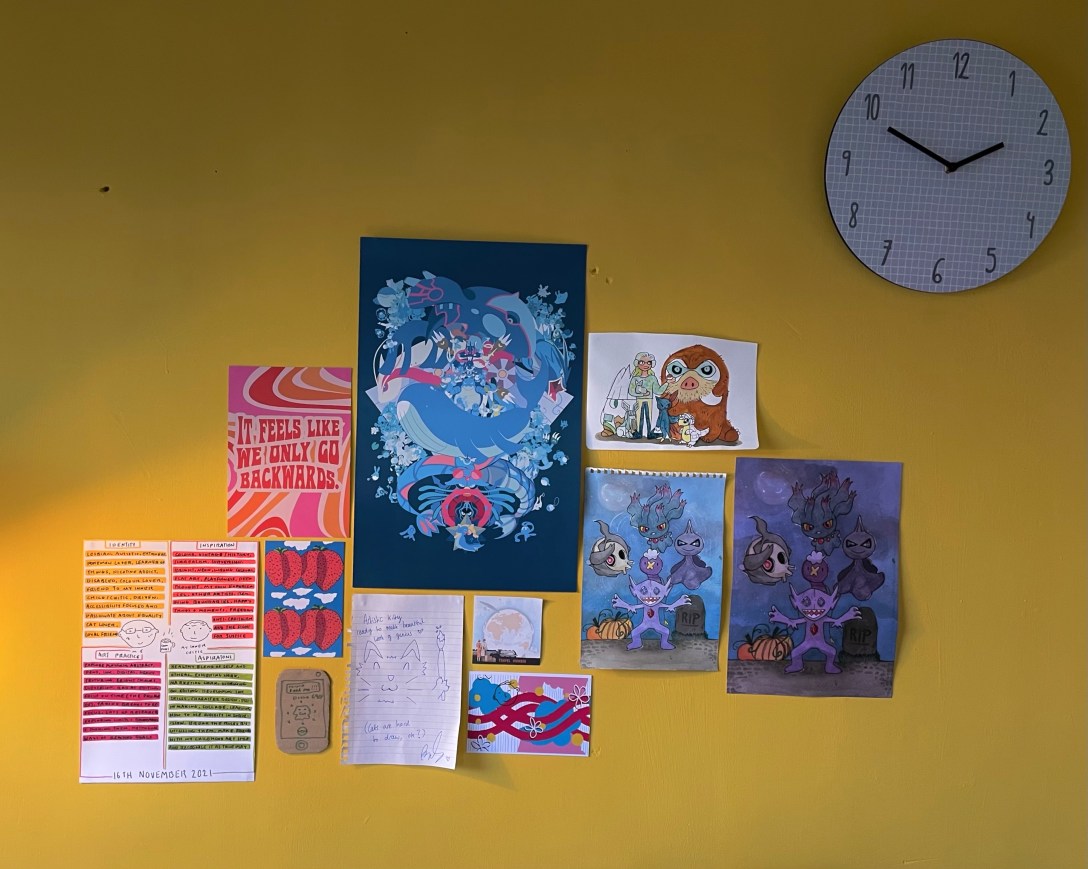
On Tuesday 16th November, Emma Powell – a tutor at the OCA – ran a workshop for all Visual Communications students to help overcome and explore creative block. I signed up because the topics of identity and inspiration are specifically interesting to me and because I have been feeling an enormous amount of creative strain lately. I knew this was attributed to the things that are going on in my life in general, but I was eager to see how the workshop could help. I also would like to attend more workshops in general, so this was a perfect first opportunity for me.
After everybody had introduced themselves, Emma began asking us a list of questions. They were quick-fire – we were intentionally only given a short amount of time to respond to them. This was so that our answers were the most authentic to how we were feeling, without much overthinking and internal debating. The questions started quite simple: ‘name three things about you’, ‘three colours you like’, and ‘three artists who inspire you’, then they began to get a little more complex. Emma challenged us to think about our inner critic, what it says to us, and how we want to handle it. She asked us to consider what helps us when we’re stuck creatively and what we find ‘recharges our creative batteries’.
There were some questions I had never even considered before, like ‘do you prefer triangles, circles, or squares?’, ‘which part of the creative process do you prefer?’, and, ‘do you prefer 3D, flat, or other?’. I appreciated these questions the most, as they helped me learn things about myself and my approach to art that I had never discovered before. In total, Emma asked 27 questions. Once we had written our answers, we were asked to categorise them in some way that was meaningful to us. Then, we had to make some sort of artistic or visual representation of these answers, picking out the ones that meant the most to us and displaying them somehow.
The purpose of this was to create a reference point for our own development and creative growth. We could look back at this visual piece and use it to help inspire us, to overcome art block, and to remind us of where we wanted to go at one point in time. Emma asked that we include a representation of ‘me’ (ourselves) and of our ‘inner critic’ somewhere on the piece. She recommended that we try to demonstrate what we want to do with/to our inner critic. Other than that, what we decided to create was entirely up to us, and it could look like anything we wanted.
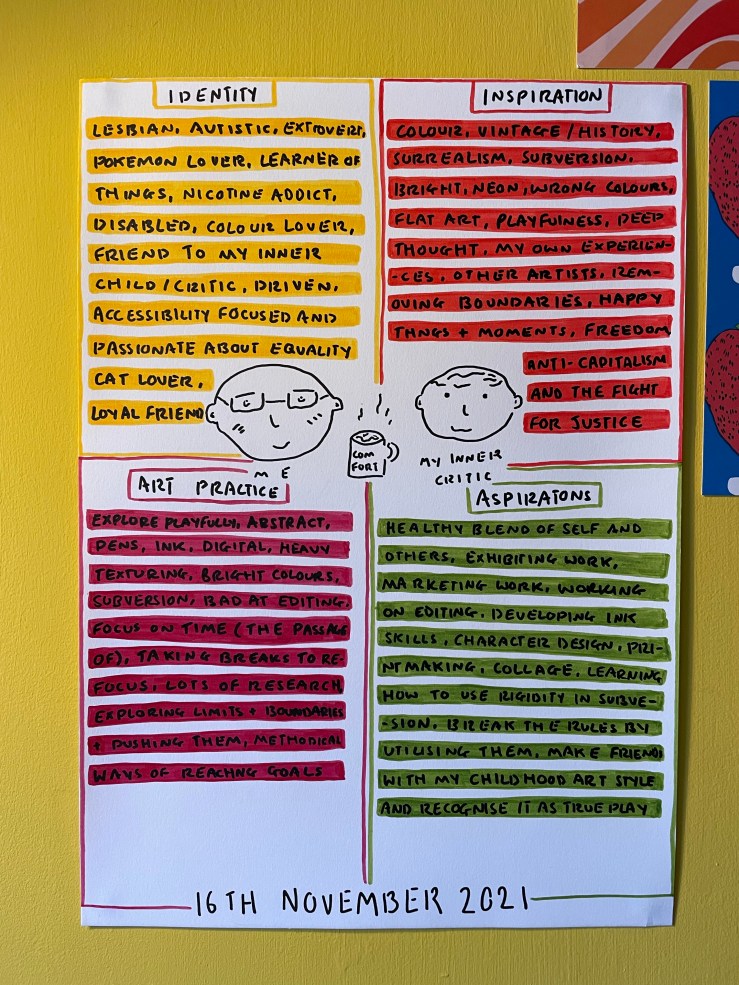
I wanted to create something that I would get a lot of joy from looking at. I felt there was no use in having a visual reference of my own artistic practice if I didn’t like seeing it on a regular basis, plus I wanted to stick it on my wall so I could always see it if needed. I had a vision almost instantly, and with only 20 minutes to put the piece together, I dove straight into it. I began by adding the most important features – myself, my inner critic, and the date. The date was particularly important to me as I wanted it to be a reminder that I am not a static person. I continually grow and learn new things, both about myself and about the world around me. The writing on this piece of work only represents who I am today, not who I am in two months time.
This may seem obvious to most people, but I struggle with trying to fit into my own constraints. I follow the rules to a T, which means if I make a rule, I’m gonna find it hard to break it. Saying ‘this is who I am creatively’ feels constraining and like a rule. Whereas, saying ‘this is who I am right now, and I am going to change later’ feels more freeing. So, I added the date right at the bottom of the page. I also drew what I wanted to do with my inner critic: love it, become friends with it, and comfort it. My inner critic exists as a result of pain and trauma, and pushing it down or yelling at it only makes it grow worse. I want to love every part of me, even the parts that seem mean or upsetting.
Next, I re-read my answers to the questions and tried to figure out four categories they could fit into. I wanted to split the page into quadrants and write them in each one. I came up with: Identity, Inspiration, Artistic Practice, and Aspirations. I then highlighted each of the answers, so I knew which group which one belonged to. I made sure to use bright colours to draw out my quadrants, and then I began writing everything in. This was a little time consuming, as the black pen I was using is not waterproof, which meant I had to do the coloured highlight first, wait for it to dry, then write over with the black.
Once the 20 minutes had run out, we all shared our work with each other. It was really interesting seeing how other people had approached the exercise. Notably, I was the only person who wanted to befriend my inner critic. Everyone else wanted to get rid of it or yell at it. This showed me quite a lot about my own self-development and growth, both personally and as an artist. The other people in the workshop added to-do lists to their pieces, which was cool to see, especially as I hadn’t considered anything of the sort. There were also more illustrations and drawings on the other pieces, which I guess shows my preference for infographics and other forms of graphic design.
I came away from this workshop feeling fantastic. I loved the piece I had created, and I felt passionate about making art in general. I had clear-cut avenues to go down to further my artistic practice, and I was able to ground myself a little bit and see the reality of the situation. I now have this piece on my wall, as intended, and I look at it almost every day. I don’t always read what it says – sometimes I just smile at the bright colours and me, my critic, and our cup of comfort. That alone motivates me to keep going. Throughout this sketchbooks unit, I keep coming back to the same thing: I want to always make art that makes me smile.
 Learning Log