Prior to this exercise, I was asked to look at the work of Brandon J. Wallace, an artist who often explores movie and television scenes through storyboarding in an attempt to better understand narrative and storytelling. Unfortunately, his work seems to have vanished from the internet. Instead of undertaking my own research, I read through some other students learning logs to get an idea of what Wallace does and to prepare me for the tasks ahead.
This exercise asked me to carry out the same studies – storyboarding a pre-existing scene from TV or film, exploring how viewpoint can change narrative structure. I was asked to pick a minimum of 15 minutes of footage to work with and to pause whenever there was a ‘cut’ or change in shot and thumbnail the stills. I had to aim for at least 20 frames, but to limit the time spent to 2 hours to ensure I was truly thumbnailing and not caught up in detail. It was recommended to repeat the task, this time choosing a very different scene or type of media, to compare how the narrative is paced and how viewpoint and compositions are used to demonstrate mood and drama.
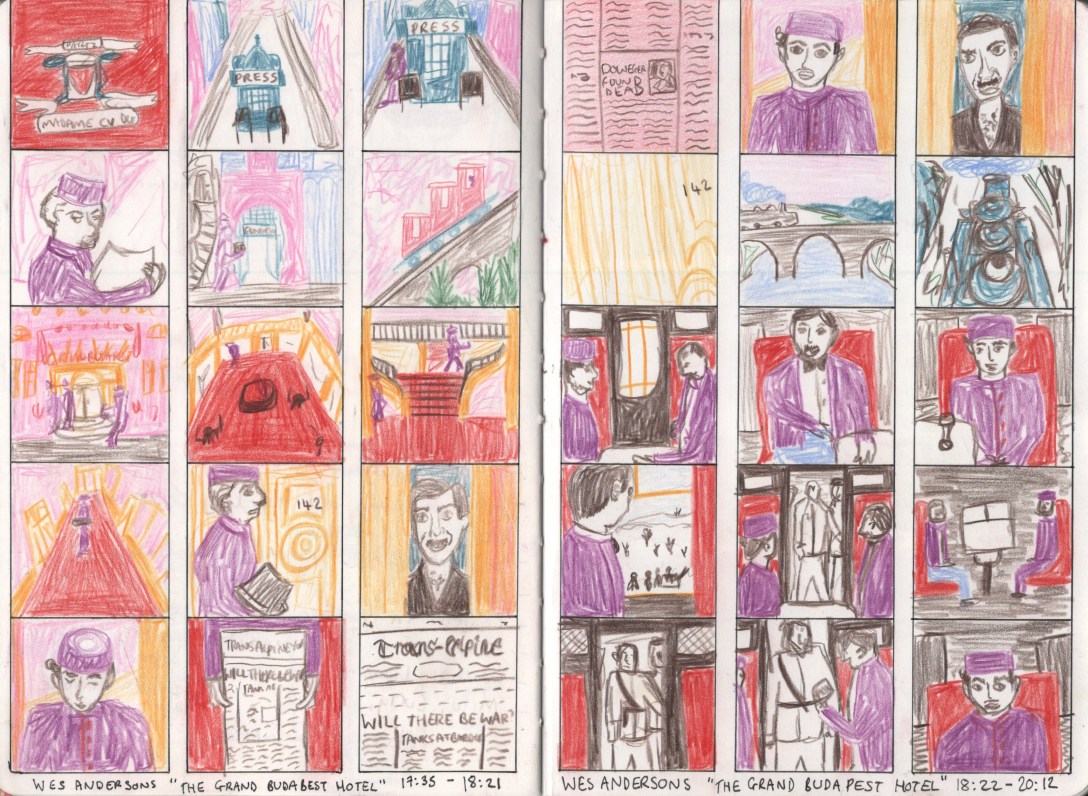
One of my all-time favourite directors is Wes Anderson. I love his art direction especially – his usage of colour, fonts, and design enamour me every time I watch his movies. I get lost in the world he creates and he very much inspires me with his merging of vintage and modern inspiration. I decided to thumbnail a scene from his 2014 feature, The Grand Budapest Hotel, in which the main characters learn of the death of a minor character and rush to her home. You can watch the scene here.
I began by watching the scene a few times – first to make sure it was definitely what I wanted to thumbnail, then again focusing on where the cuts were and where the scenes changed, then once more to figure out which were truly important to the narrative as there were hundreds in the short clip. Jump cuts and sudden, dramatic camera angles are a trademark of Anderson’s, so this was to be expected, and it was hard to narrow down which were of importance. I decided to mark out 30 panes, to begin with, and if I had time for more I could expand. As the film is in a square aspect ratio, my panes are also square.
I was careful when choosing my medium for this – the exercise specifies to draw clear singular lines and blocks of colour, and to focus less on detail, only drawing what is needed to express the scene. As Anderson’s colour palettes are so intrinsic to his films, I knew I had to use colour, so opted for Faber Castel Polychromos coloured pencils. I consciously limited my palette to encourage me to be selective in what I drew. This ended up being a really good choice, and I think the outcome is fantastic.
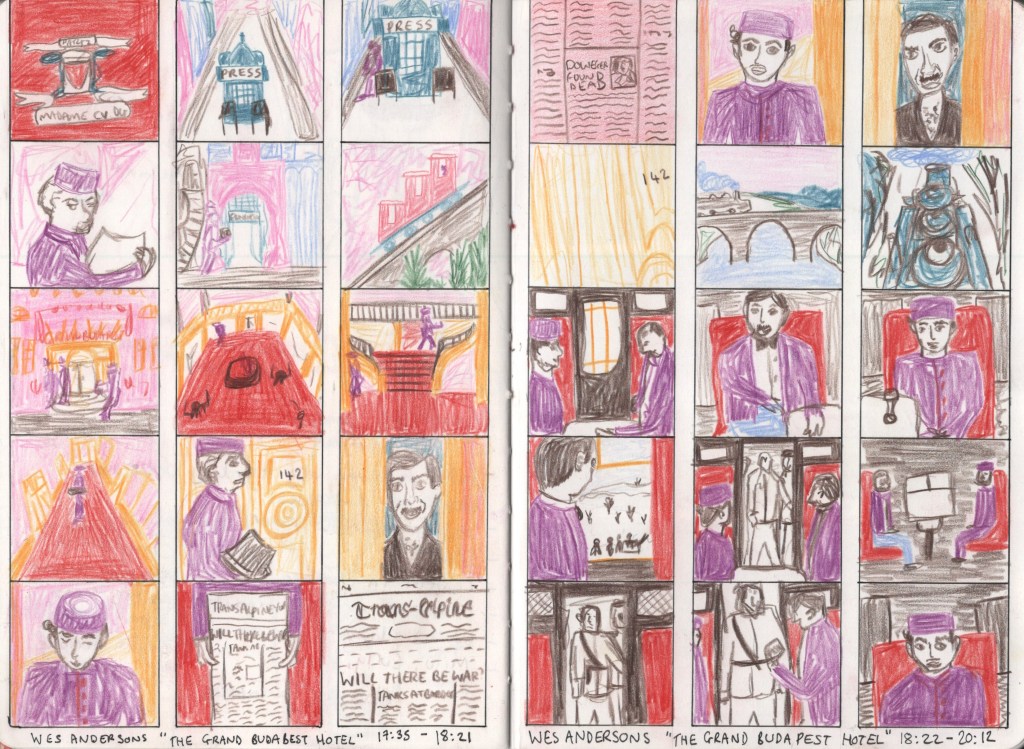
Whilst sketching out each scene, I tried to think of myself as in the reverse position – creating the film rather than referencing from it. ‘What detail is necessary to communicate ‘my’ vision for this scene?‘ I asked myself repeatedly, and, ‘How can I show the action, feelings, and thoughts of the characters?‘. Reflecting on my approach in this way was enormously helpful. It forced me to refine my sketches and narrow down how many of the ‘cuts’ I was thumbnailing, as, most of them were not necessary to document. I found the process really enjoyable and actually some of the most fun I’ve had making art in a while. In the end, I felt like I had captured the essence of the scene perfectly.
To repeat the exercise I chose another favourite media of mine – the TV show Friends. One of my favourite episodes is Season 3 Episode 2, The One Where No One’s Ready. My reasoning for this is that it’s staged in real-time – a real 20-minute long interaction filmed over one take. It’s a beautiful piece of comedy and hugely relatable to most people. Considering the aim of the exercise, I knew I had to study it in more detail, examining how the scenes progress despite being real-time. Once again I watched the episode through, picked a scene I wanted to draw, watched that a handful of times, and then felt ready to start.
This time I drew 20 panes, as the aspect ratio is rectangular, and I felt it was going to be harder to document in general. I was definitely right there. The focus in Friends is completely different to in The Grand Budapest Hotel, one is comedy and heavily focused on characters and their lines, and one is an abstract drama with a focus on environments and artistic direction. It felt like precision and detail were required to accurately frame the scene – but I was trying to work quickly and focus on vague shapes and outlines. On top of this, Netflix would quickly darken the screen and overlay with the title each time I paused. This meant I had to work even faster, or repeatedly stop to get the image back.
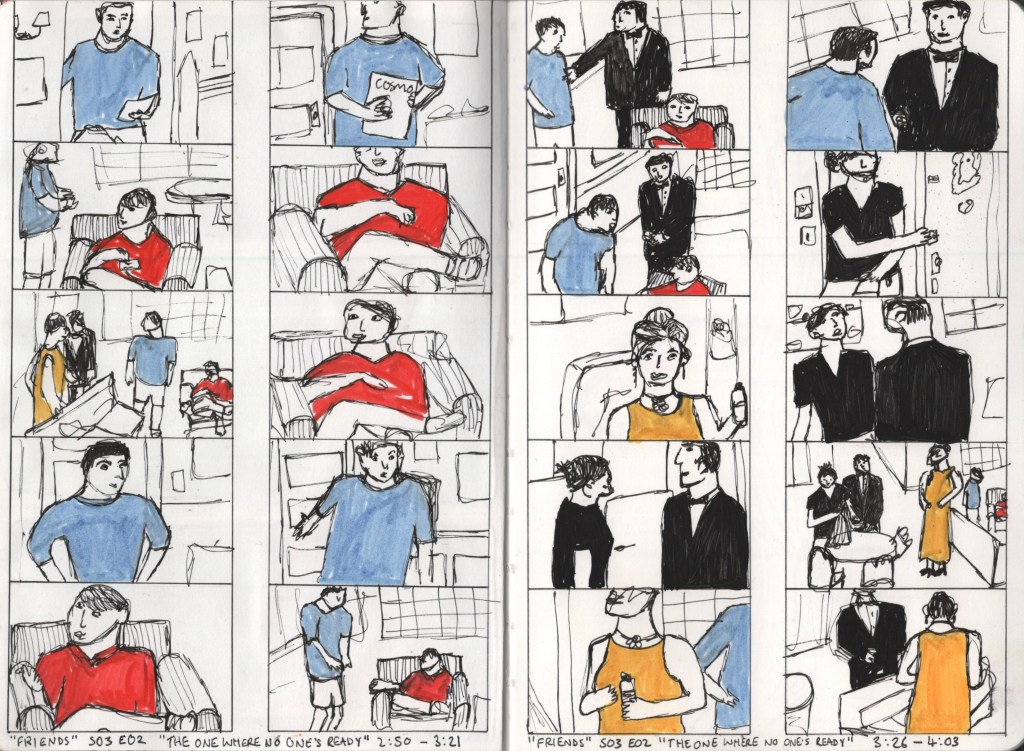
My character proportions were consistently off and I kept drawing too big or too small for the frame. I felt frustrated but persevered, and realised it was better to just capture what I could and show a resemblance of where things were in each scene. I feel like it’s followable as a piece and you can understand what it is, but I don’t think it’s as good as my first attempt. I’d like to repeat this with more sitcom scenes, next time without the constant dimming of the screen, and see how I can improve. Doing this still really helped me to understand how the narrative is structured and how the composition sets the mood, and so much of that comes from thinking critically when watching and studying the scene.
I’m a bit of a film and TV nerd and love good cinematography. This exercise was so exciting for me, to be able to combine my passions, and I realise how easily I could repeat this with more scenes that captivate me. It’s quite a lot of work, though, and time-consuming, so I might alter it to better fit my goals, perhaps only drawing one or two frames. The more I push myself to draw quickly, the more I’m seeing it improve, and this exercise helped me see that clearer. Even the Friends scene is better drawn than I could’ve achieved 6 months ago. I also feel I better understand thumbnailing when it comes to narrative and story structure and will be using that more in future.
 Learning Log