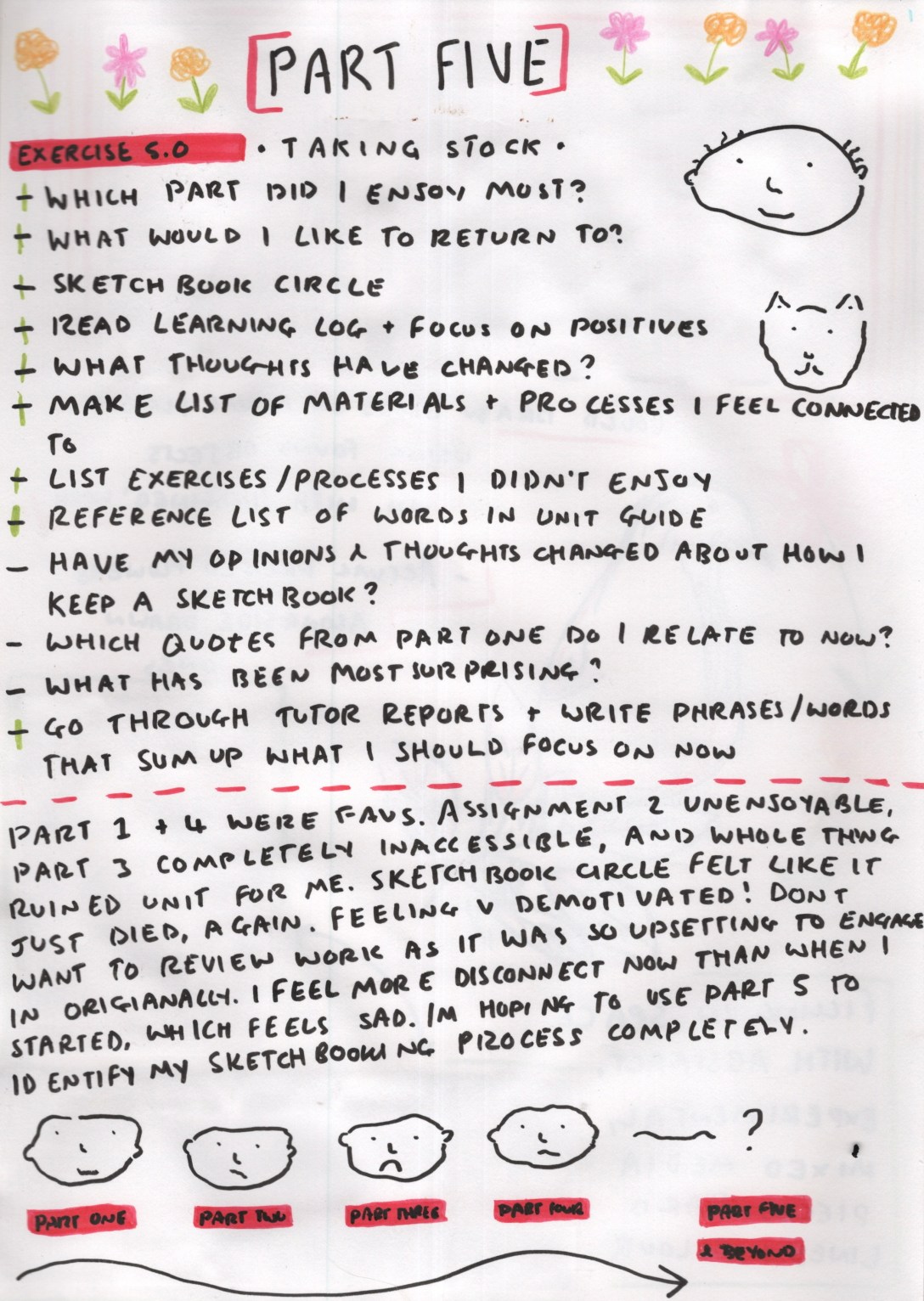
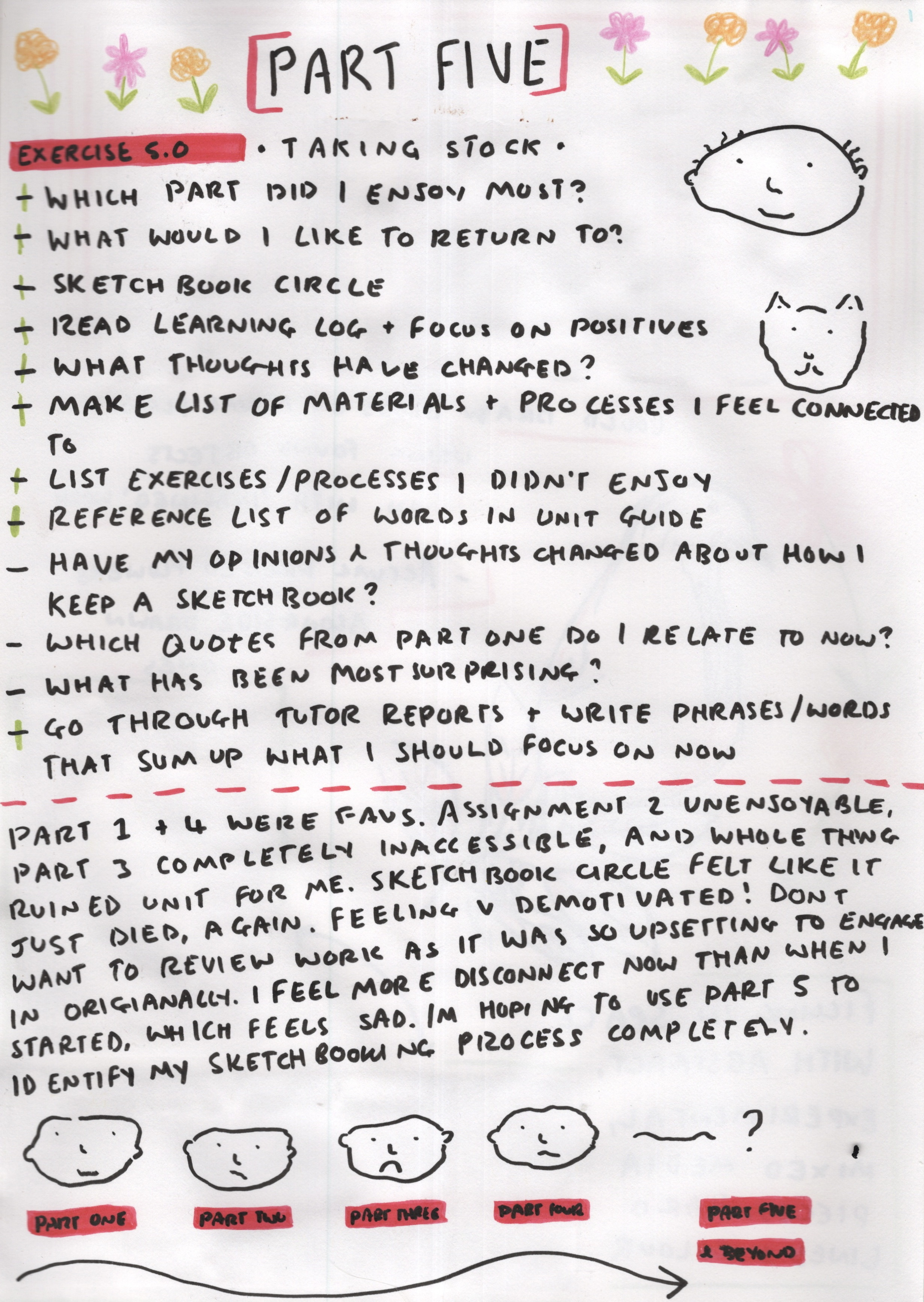
This exercise asked me to go through all of the work created for this unit so far and reflect on my progress, interests, and what I want to do more of. I was asked to look at my sketchbook work (both for the unit and the sketchbook circle), my learning logs, and my tutor feedback – focusing on the most positive aspects of my reflections throughout.
As the introduction for Part 5 says to ‘Start the exercises on pieces of paper or in a new book and make sure that you progress them through towards the assignment work, to construct one bursting, hybrid sketchbook that is a cumulative visual diary.’ I chose to start this exercise on a sheet of A4 cartridge paper. I chose some of my favourite pens and pencils and set them aside, aiming to make visually interesting pages which would then come together as almost a portfolio of my thoughts, feelings, and work in this unit.
I read over the exercise a few times and then started by writing a guideline of things to consider, look back on, and questions to answer. I then went through each point one by one and explored them – mostly referencing my learning log as this features images and videos of my sketchbook work. Underneath this list, I wrote out a brief summary of the unit and how I felt about each part, paired with a small illustration. Part 1 and 4 have been my favourites, and I felt Part 3 almost ruined the unit for me. At this point in my journey, I feel pretty demotivated because of this, and the thought of looking back through my work is daunting. I don’t feel I have produced a body of work that I am proud of, and a lot of the unit has been difficult or upsetting to engage in.
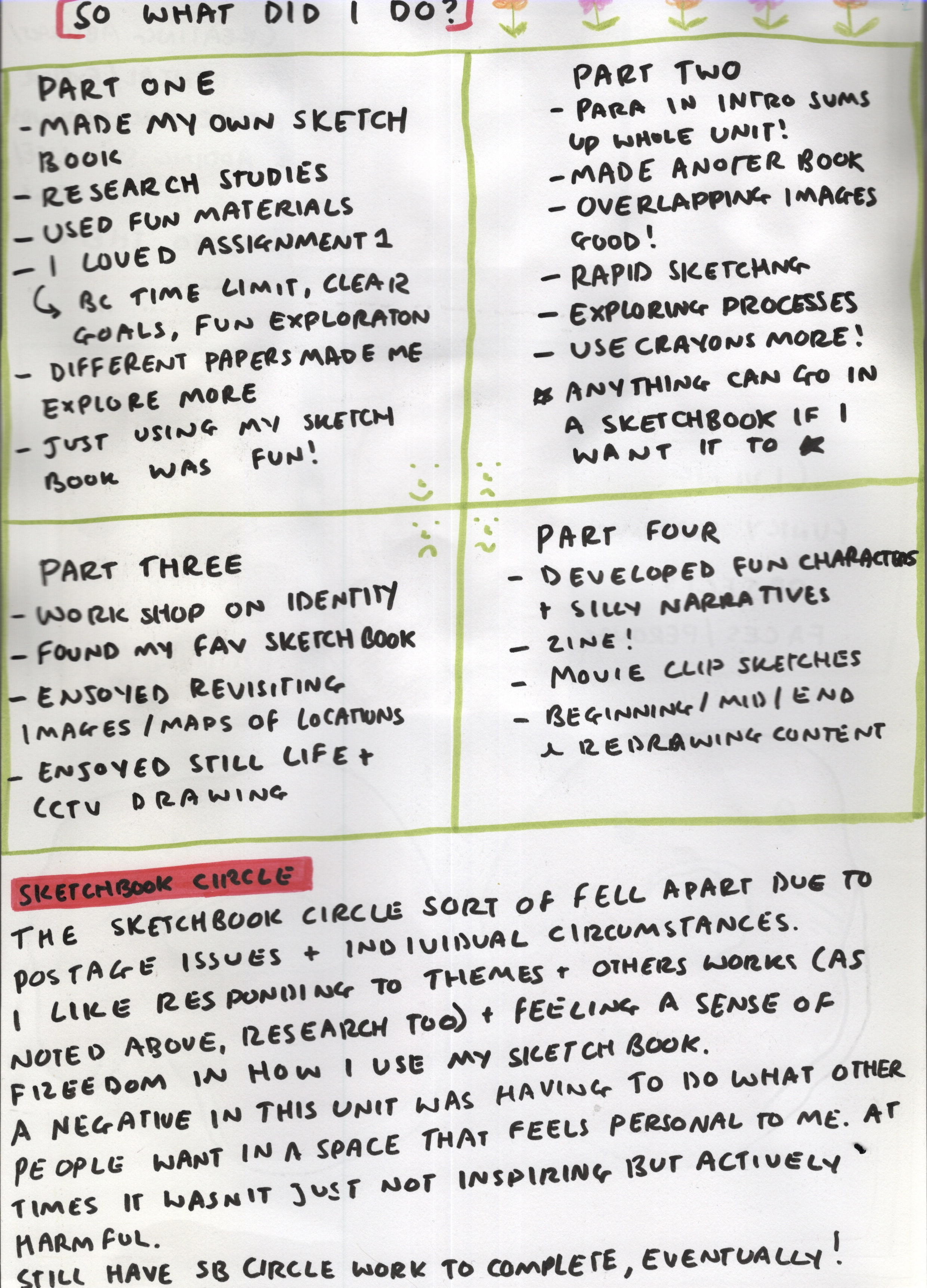
On a new page, I began to identify what I enjoyed in each part of the unit. In Part 1 I enjoyed making my own sketchbook, studying other artists, exploring materials, and found that just using my sketchbook was fun. I particularly enjoyed the assignment, which I reasoned was because it had a time limit, clear goals, and I got to have fun. In Part 2, I made another sketchbook, and I found I enjoyed creating overlapping images, rapid sketching, and exploring new processes. I also repeated in my learning logs throughout Part 2 that ‘anything can go in a sketchbook if I want it to go in’ and I felt that was something I needed reminding of. Often I get caught up in what I’m ‘supposed’ to be putting in my sketchbook, and it stifles my creativity.
Whilst reviewing my learning logs from Part 2, I read a paragraph in my introduction which I felt represented a lot of how I was feeling throughout this unit;
‘My relationship with my sketchbook and the manner in which I use it is always going to be influenced by my mental and physical health, as I’m sure it is for anyone. Because I am not mentally or physically healthy, nor neurotypical, I most likely will not be using my sketchbook in a typical way, nor will I feel comfortable using it in other ways. This isn’t out of an unwillingness to learn, experiment, or grow, but out of a necessity to protect my mental and physical health. There is, for example, a section in the introduction to part 2 which discusses using every snippet of spare time to draw. However, this would be actively dangerous for me. I don’t have ‘spare’ time – all of my days are extremely calculated to ensure I don’t become unwell. What to an ablebodied person is a free moment waiting for the bus is a moment I am grateful to be conserving energy, so I have more later.’
I felt the need to repeat this, and to highlight it. So much of this unit has felt like trying to shove myself into a box I do not fit into, rather than learning ways to create my own box. It has been a real challenge for me, and whilst I feel like I have learned how it is that I want to use my sketchbook and what I want to do going forwards, I feel a hesitation and an unfortunately greater awareness that I don’t ‘fit’.
Part 3 was the biggest contributor to these feelings, as most of it was inaccessible to me. However, I did find things I enjoyed among this. During Part 3 I undertook a workshop with Emma Powell on creative identity, which I found hugely helpful and motivating. I still have the graphic I created on my wall in my studio, and I read over it from time to time. I also discovered my favourite sketchbook, the Shoreditch Sketcher, and had fun revisiting places I have been in person via google maps and my own photographic library. I jotted down that I love still life drawing, too, as I always enjoy finding opportunities to do this.
During Part 4 I got to develop characters and narratives that I really enjoyed, create a whole zine from scratch, draw from my favourite movies, and discovered the joy of redrawing and recreating content that I may not have considered prior. Part 4 was really fun for me, and working towards a brief was something I had missed very much.
At the bottom of the second page, I wrote some thoughts on the sketchbook circle. This is my second sketchbook circle, and unfortunately it went similarly to my first, where due to timing, postage, and individual circumstances, it sort of just fell apart halfway through. Nonetheless, I really enjoy responding to themes and others’ work – it sort of feels similar to when I respond to research – and feeling more free in how I use my sketchbook. Seeing how much more I preferred the sketchbook circle helped me identify why I struggled with a lot of this unit: that doing what other people want in a space that feels personal to me is really hard, and at times it was actively harmful. I didn’t want to put things that were so upsetting in a place I felt I should feel joy and connection with.
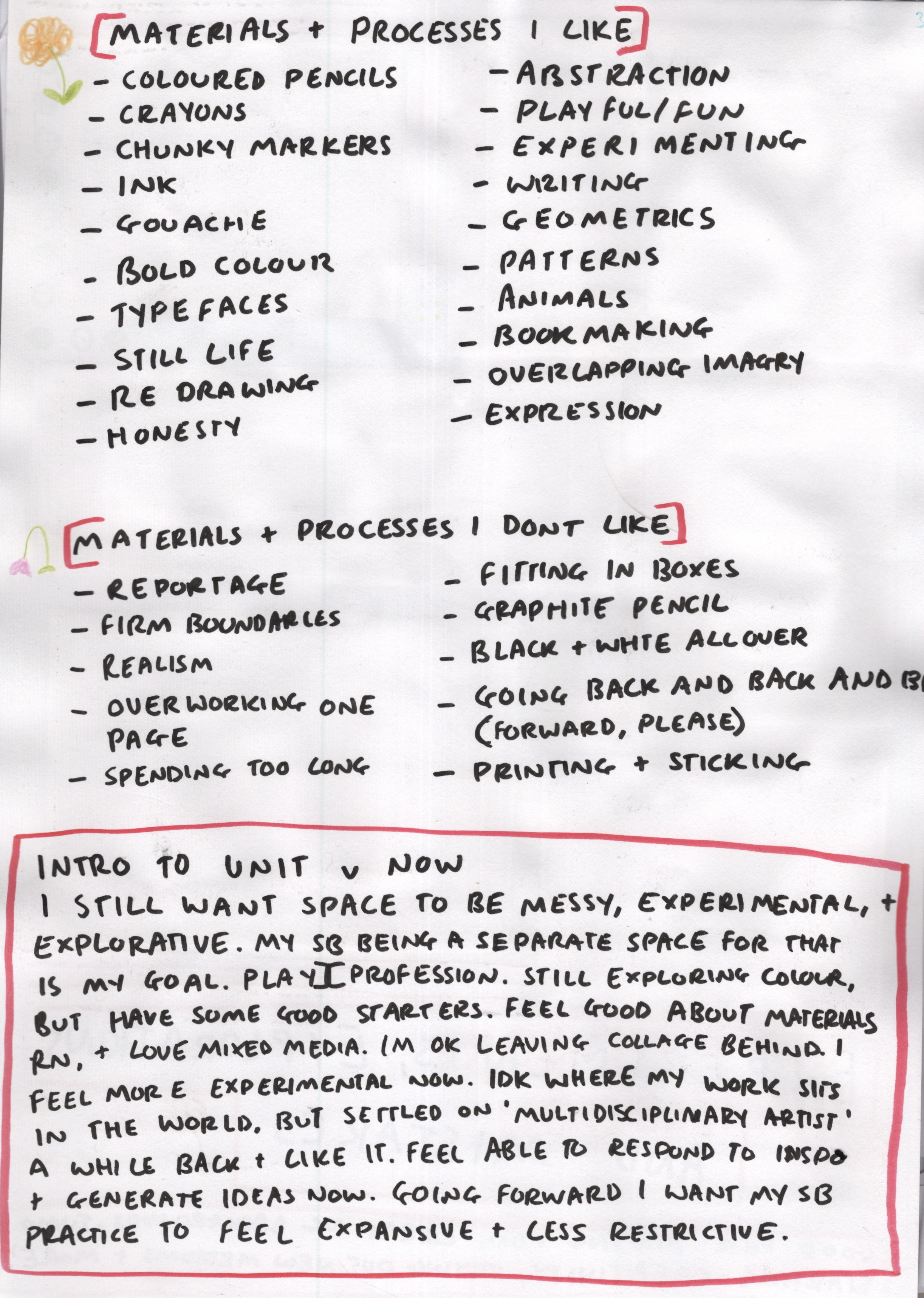
On page 3 I started thinking about the materials and processes I like and dislike. I found that I lean towards bold colour, playful and experimental work, abstraction, patterns and typography, and expressing myself honestly. I don’t enjoy firm boundaries, spending too long on one thing at a time, going back over my work constantly, and using ‘boring’ materials even just to sketch. Having this list is really useful not just for my sketchbook development, but also in considering my other work as a designer.
I then went back to my introduction to the unit that I wrote a year ago. I wrote this from a very excited and optimistic place – detailing my hopes and dreams for this unit. I thought it would be interesting to see what I did accomplish, how my thoughts have changed, and what I want to do still from that log. At this point, it was becoming clear to me that I want my sketchbook to be a separate space for my messy, explorative, and experimental side. I want it to be somewhere I can ‘splurge’ my thoughts and creative energy, hoping to channel it so I can better use it when approaching briefs.
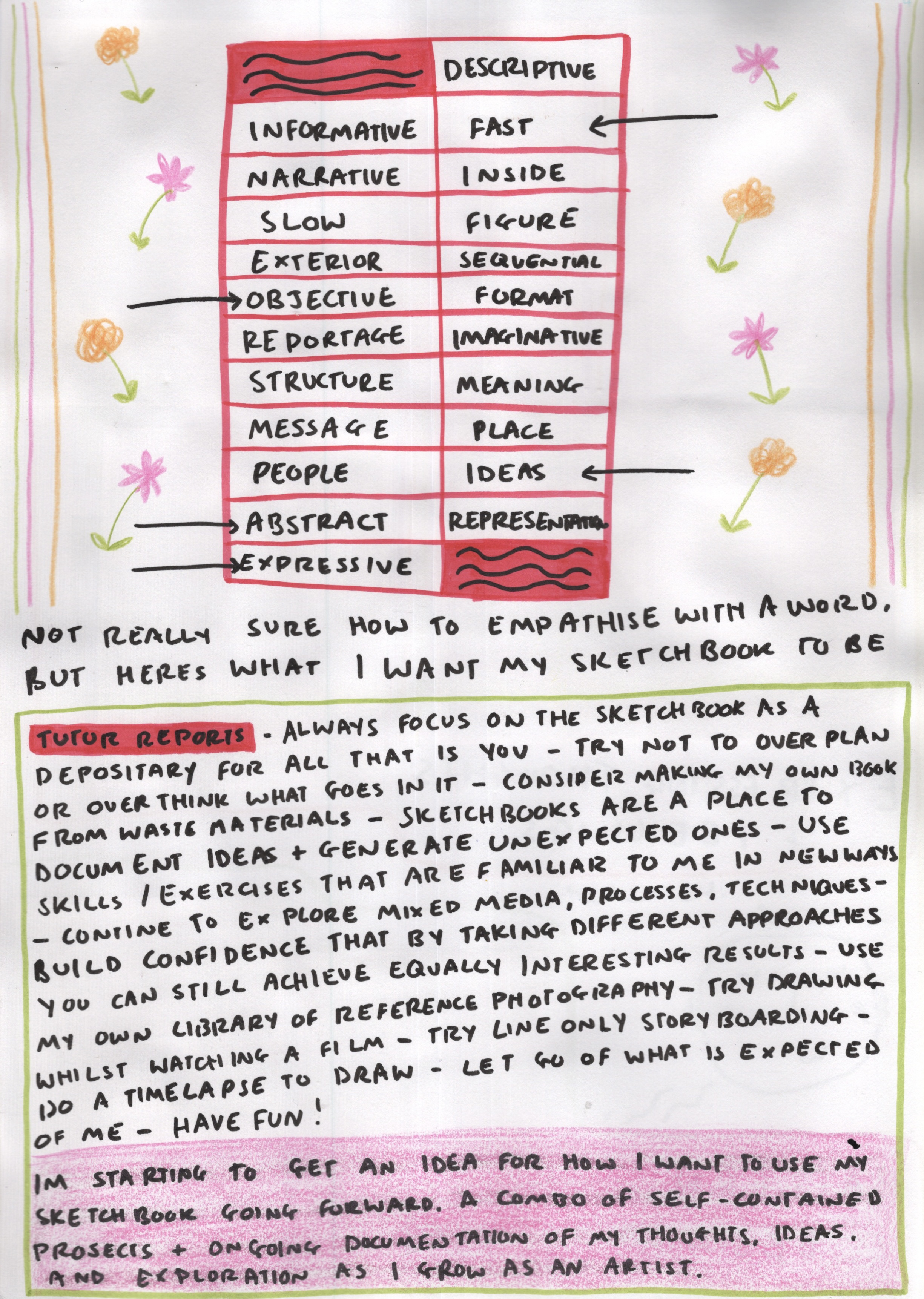
This exercise provided a list of descriptors and asked me to identify which I empathised with. I began page 4 with this, but I found the concept of ‘empathising with a word’ hard to get my head around. I picked words I felt related to how I want to use my sketchbook: objective, abstract, expressive, fast, and ideas. I like how these words sort of sum up my feelings and attitude to my sketchbook.
Next, I went through my tutor reports and wrote down phrases I felt I wanted to act on or otherwise take forwards. I felt that many of these phrases pointed towards a need to build confidence and let go a little in my sketchbook. I feel disappointed that I haven’t been able to achieve this, but as my experience with the sketchbook circle shows, I’m not sure if this is an issue with my approach or if it’s that I have found the exercises and assignments restrictive. My tutor had a lot of great suggestions which I hope to continue with or come back to later on in my artistic journey.
I felt that at this point I had exhausted my options with reflecting on my work. I summed up my explorations with a short statement: I’m starting to get an idea of how I want to use my sketchbook going forward. A combo of self-contained projects and ongoing documentation of my thoughts, ideas, and exploration as I grow as an artist. One thing stood out to me – I do not want the intention of my sketchbook to be that it directly influences the rest of my work as a designer. I love the ability to be free, creative, and explorative in my sketchbook, and I would like to undergo projects that remain personal and just for me.
The work I want to share with the rest of the world as a Visual Communicator I would rather be self-contained, too. Of course, I will use a sketchbook to explore responses to a brief, but I think this will be in more direct ways, and perhaps in a separate sketchbook. My ‘experimental’ sketchbook will surely impact how I engage with the rest of my work as I learn what my interests are, how I want to draw certain things or figure out how to add abstraction to more professional pieces. But for now, I’m happy with having two sides to my artistic coin, as it were.
At the beginning of this unit, I was asked to draw my relationship with my sketchbook. Reflecting on this illustration, I feel it has changed somewhat. The sketchbook is still in isolation, but not disconnected, and not less interesting than everything else I could be doing. Instead, it’s an escape from reality, and a place to let go.
When I started this exercise I wrote that ‘I feel more disconnect now than when I started, which feels sad. I’m hoping to use Part 5 to identify my sketchbooking process completely’. I feel that I achieved that, and I found this exercise incredibly useful. Going back and thinking about everything I have done has been enjoyable, and focusing on the positives has helped me to see that this unit was not just doom and gloom. I have learned so much, perhaps just not in the ways I expected to. I also had a lot of fun creating my paper ‘sketchbook’. I used it almost as a learning log, which was useful too, as it made writing this entry a lot easier. I may continue doing this in future units – fun notetaking makes for fun studying! I am now looking forward to planning and carrying out my final assignment.
 Learning Log