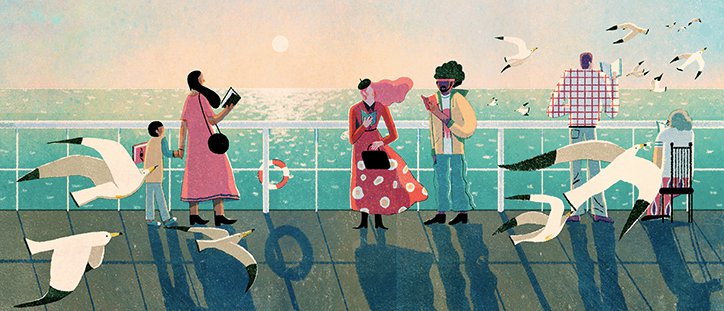
For this research task I was asked to investigate one of five listed illustrators, considering their visual language, how they make work, and what connections exist between their sketchbooks and illustrative style.
I don’t typically present my research in my sketchbook, preferring to make rough notes in a notebook and then type up more coherent thoughts to my learning log. In keeping with the approach to Part 5, though, I decided to lay out my thoughts on an A4 sheet of paper, using the same design style as in Exercise 5.0. I began by writing out bullet points for what I needed to do for this task. Then, I briefly looked at each of the five illustrators before deciding to investigate Lisk Feng further. Whilst looking through her website and a handful of interviews found online, I took some notes, then listed some key words I felt reflected the visual language in her work.
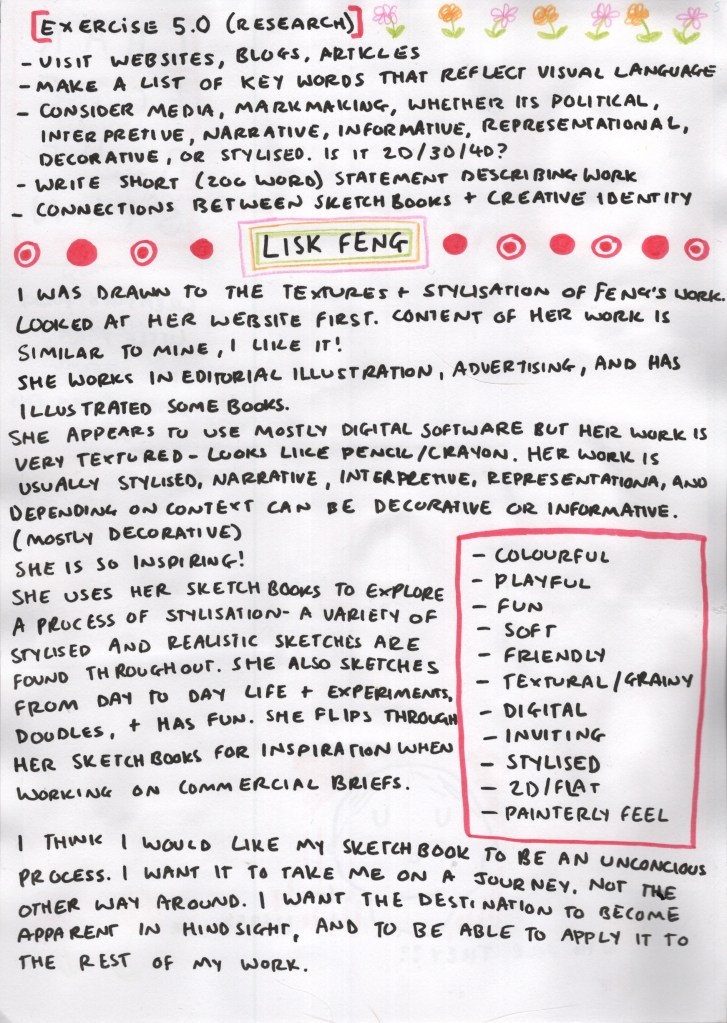
I found Feng’s work very inspiring. She has worked in many different areas of illustration, some of which I am interested in working in myself – such as advertising and editorial. She has a very playful, childlike style, and places emphasis on using textures throughout her work. Whilst her style is somewhat different to mine, this aligns with how I want to work, and seeing her success makes me feel like I could easily head in a similar direction. She has a very distinctive artistic voice in all of her work, which can be seen in the colours she chooses to use, how the same or similar textures are brought into pieces, and the consistency in her characterisation.
I listed some key words to describe Feng’s visual language:
- Colourful
- Playful
- Fun
- Soft
- Friendly
- Textural/Grainy
- Digital
- Inviting
- Stylised
- 2D/Flat
- Painterly feel
Feng’s work is inviting and homely – it feels like a familiar world which you have been welcomed into, even if it’s brand new to the viewer. Her usage of softer colours and gentle textures enhances this, and her simplistic friendly characters could be anyone you know.

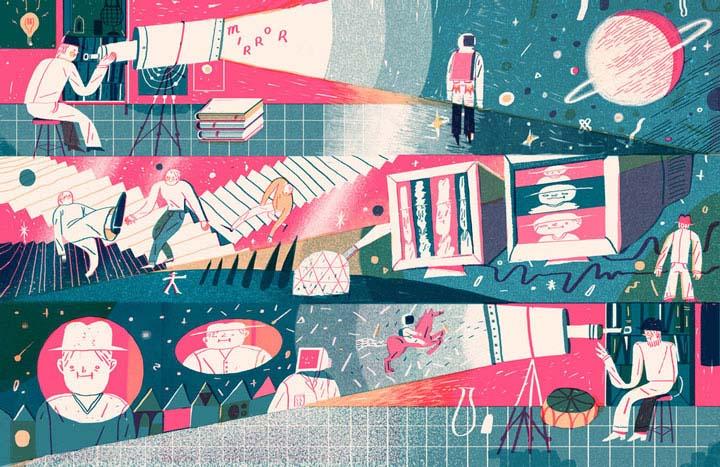
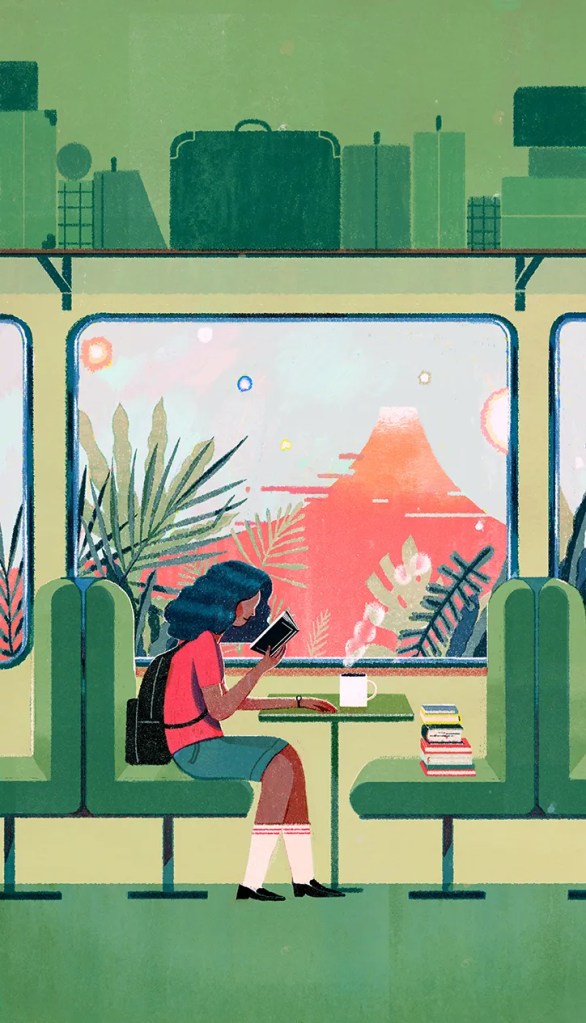
From reviewing Feng’s portfolio, and reading a handful of interviews about her use of sketchbooks, I was able to identify something I want from my own sketchbook experience – ‘I think I would like my sketchbook to be an unconscious process. I want it to take me on a journey, not the other way around. I want the destination to become apparent in hindsight, and to be able to apply it to the rest of my work.’
Looking at accomplished illustrators and designers brings me a lot of comfort, especially when I see them engaging in mediums in similar ways to how I do. I feel on the ‘outside’ of everything often, and like I can’t possibly be successful due to that. I worry that my interests are too varied or weird and that means I won’t be able to work with big clients, or maybe I just won’t be well enough to. I feel inspired after researching for this task, and every exercise is leading me closer to knowing how I want to use my sketchbook as a designer.
 Learning Log