The second sketchbook in this circle presented a lot of new challenges to me. The unit guide for Illustration Sketchbooks explains that one of the uses of sketchbook circles is responding to and being inspired by the previous artwork in the sketchbook. I really wanted to focus on this and build off of the first ten pages but found myself feeling restricted and confined to these rules. In the last sketchbook circle, each participant selected a specific topic within the overarching theme of ‘the everyday’, which made it quite easy to build off previous work.
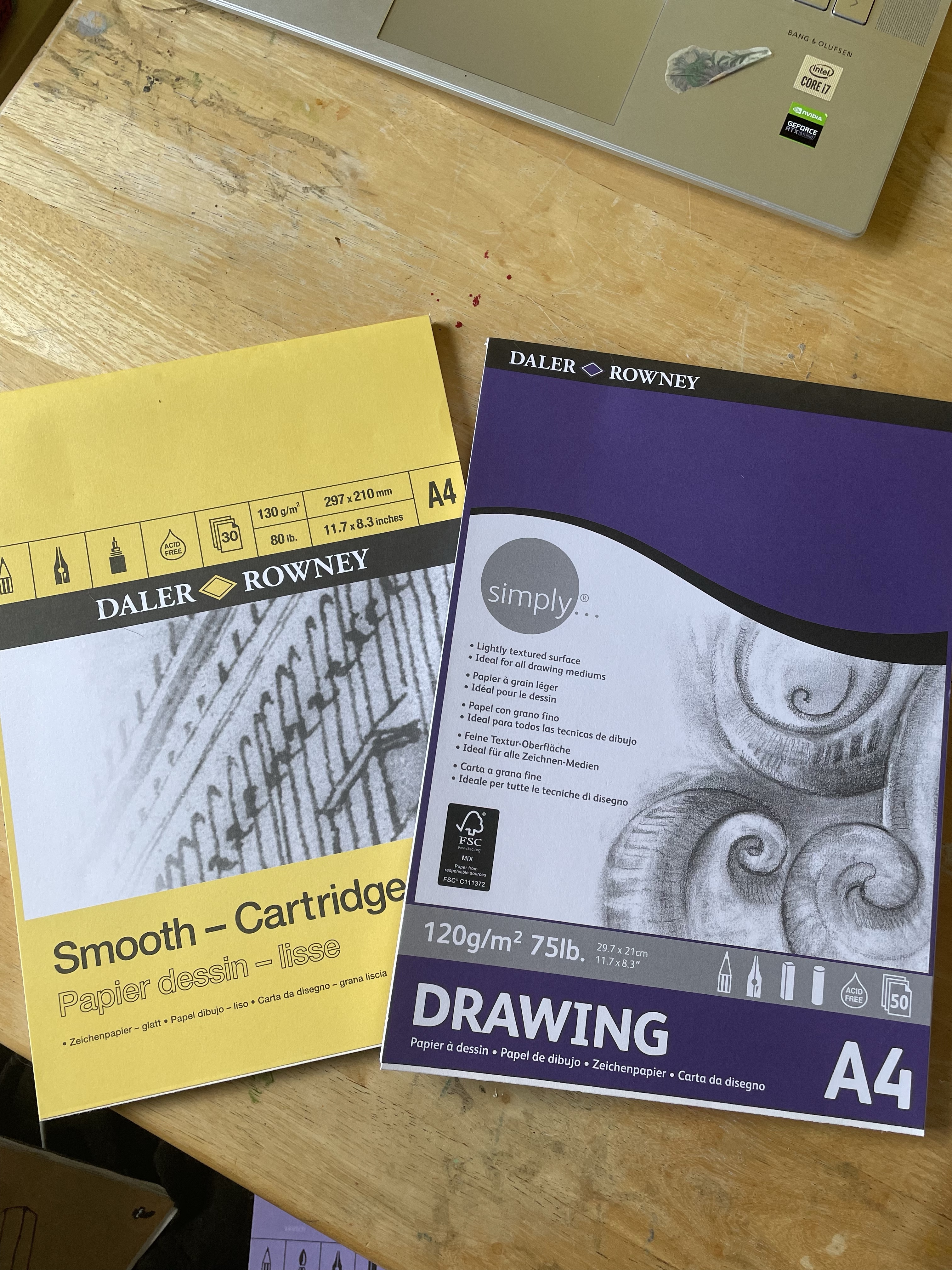
Working in this sketchbook also confirmed that I need sketchbooks with heavier paper to be happy! The paper was really thin, and this added to my feeling constrained. Any ideas I had or wanted to explore felt stuck behind a barrier of ‘I can only use dry mediums’, making it difficult to make progress. As you can see, I did overcome this and found ways to experiment with wet media throughout my ten pages.
I’m really happy with the results of my pages. I feel like it isn’t obvious how much I struggled, which surprises me, though it shows how far I’ve already come in using my sketchbook. After a few days of trying to fit into this narrow box of ‘everything I create must respond to the previous pages’, I loosened up a lot and created some work I’m really proud of. I sort of feel sad to be letting it go! I did respond to the previous work, but I also let my own responses inspire me, and I just went where I felt I should go with the work.
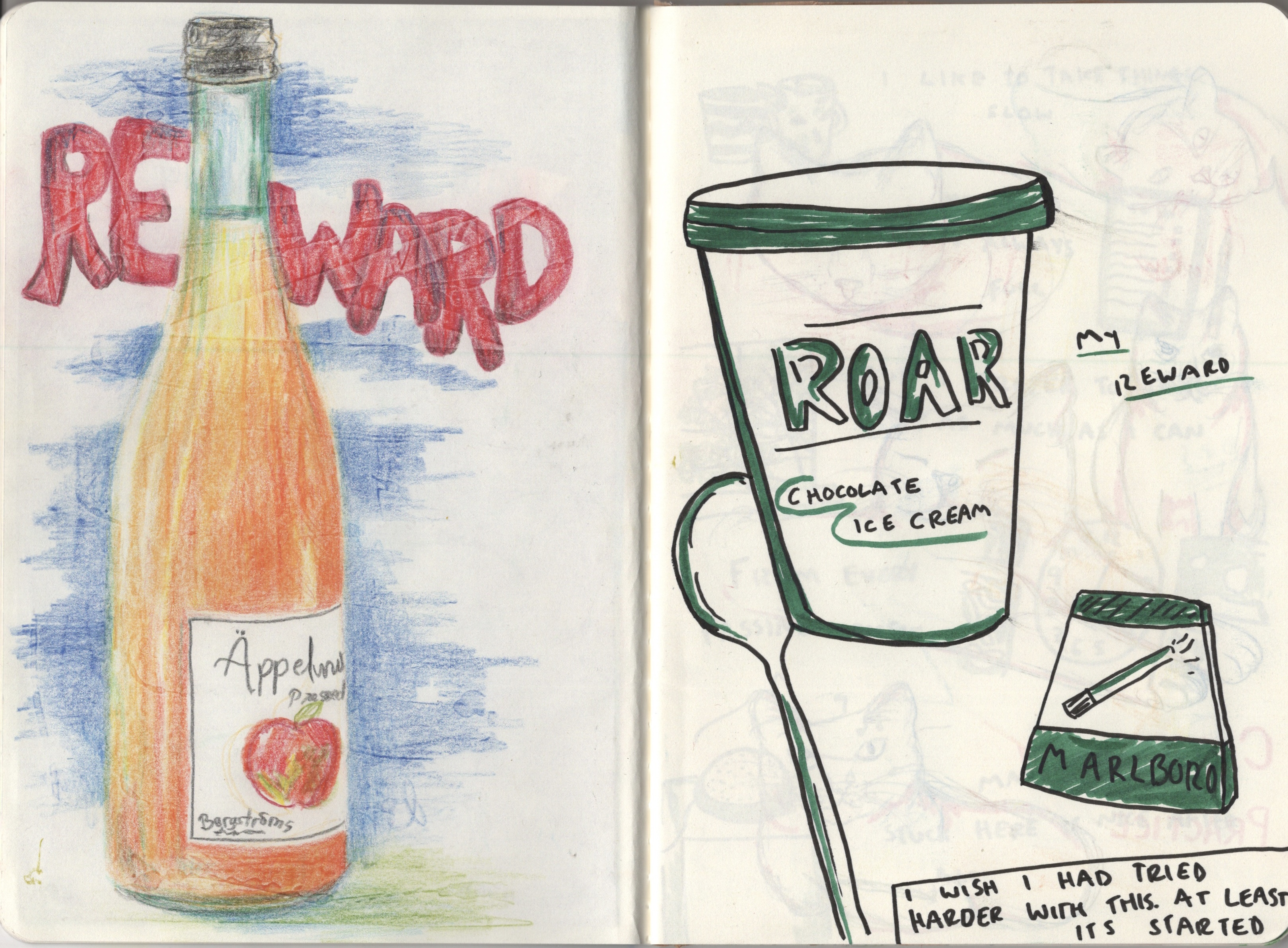
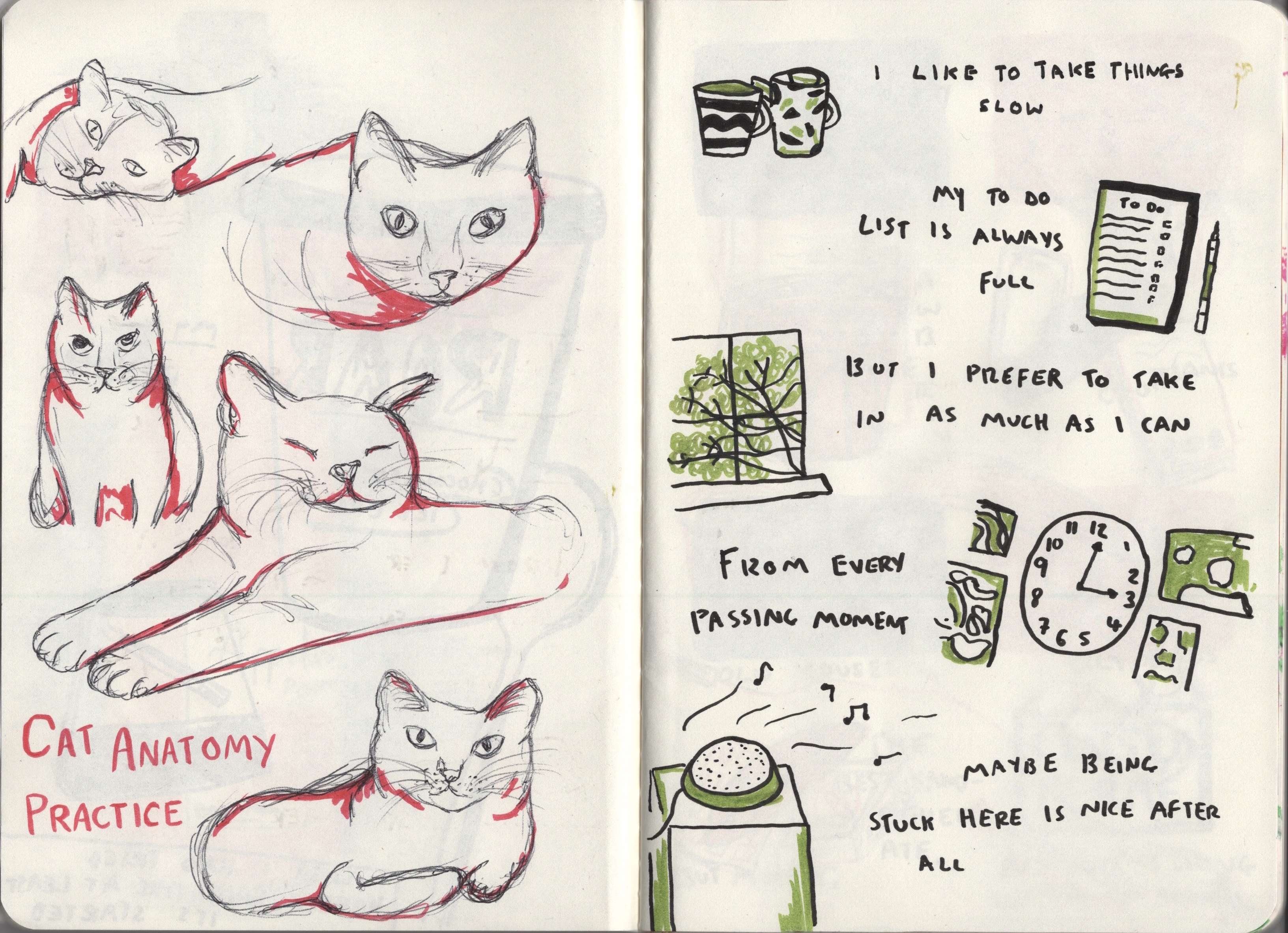
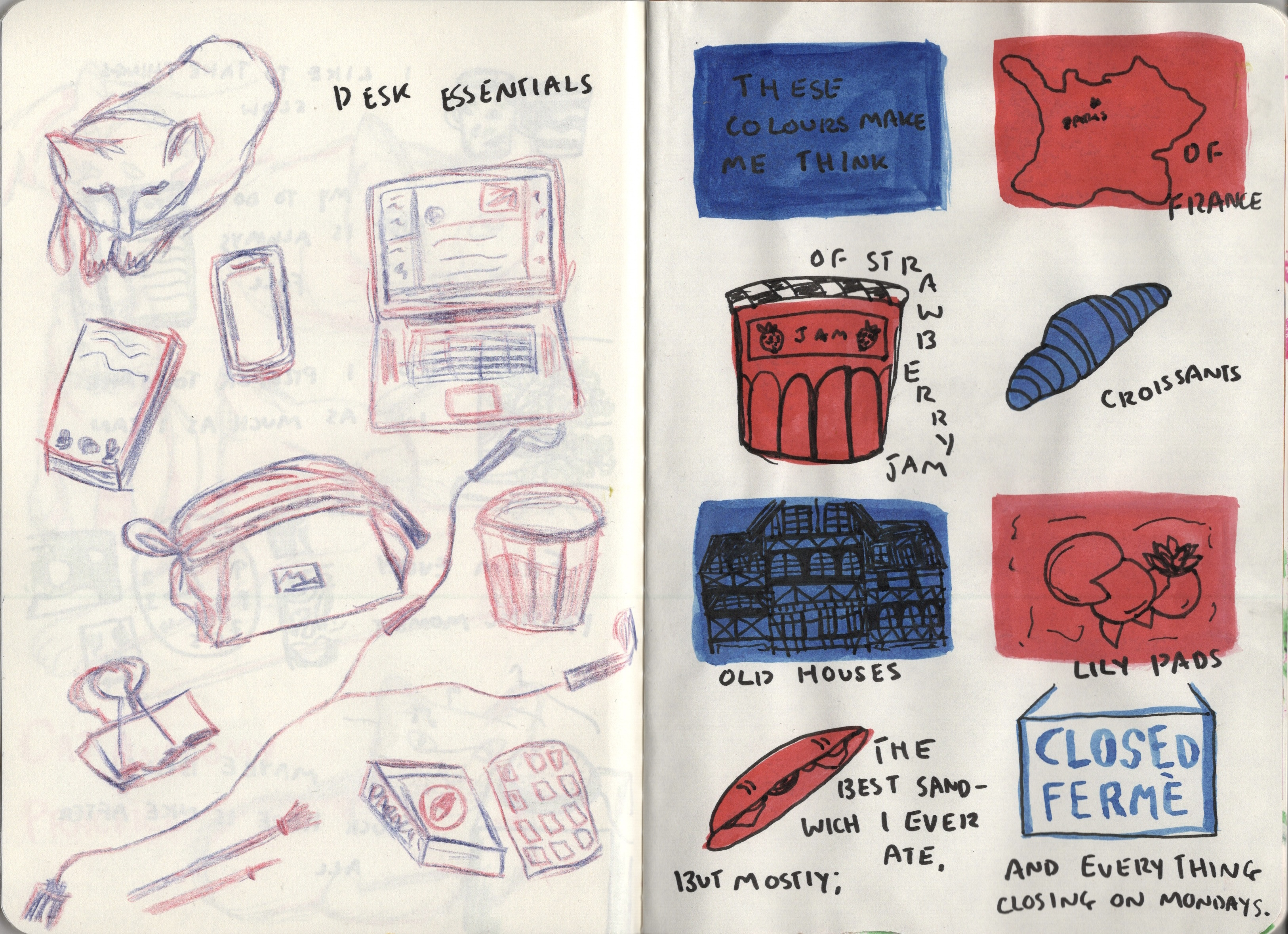
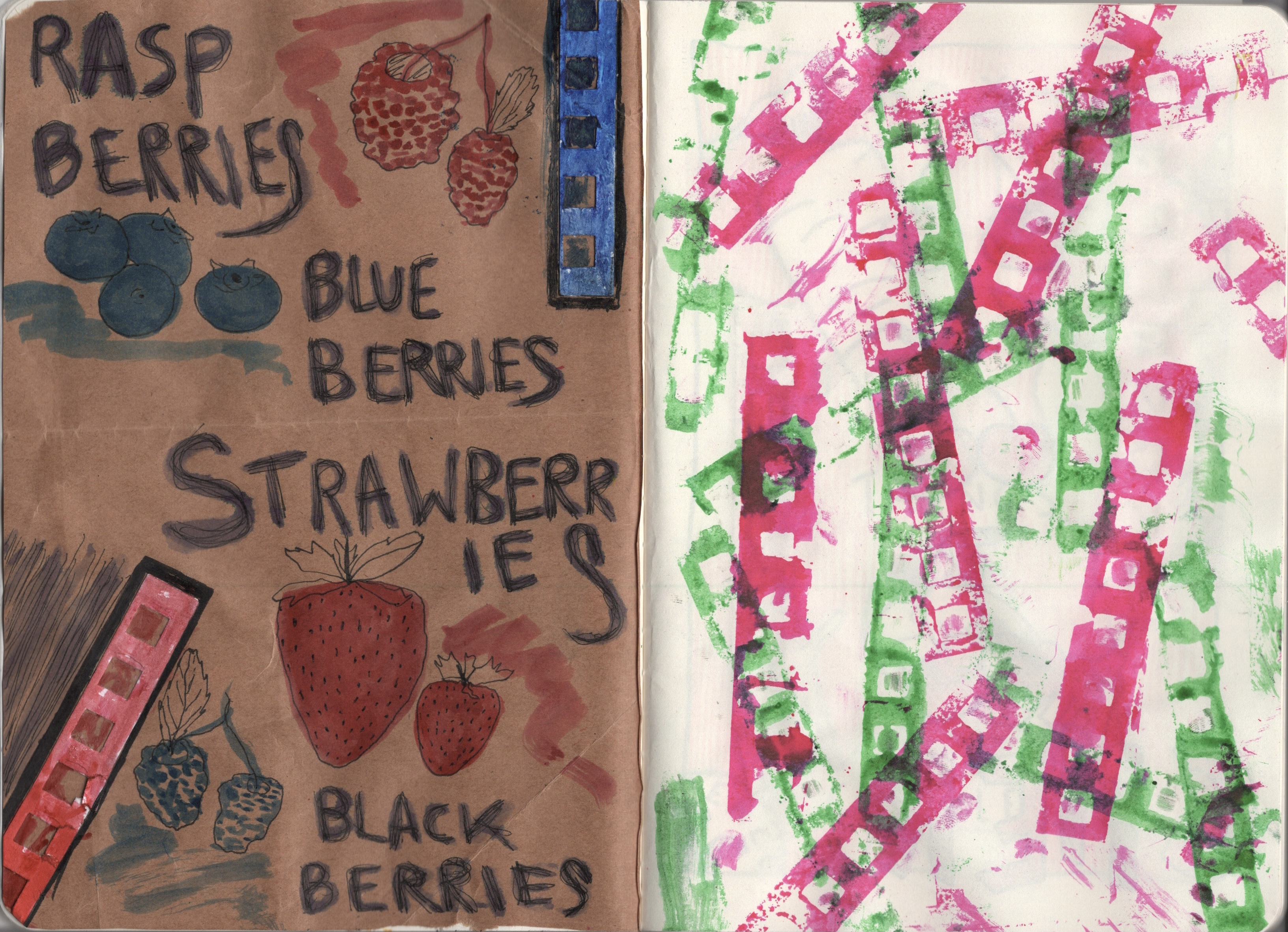
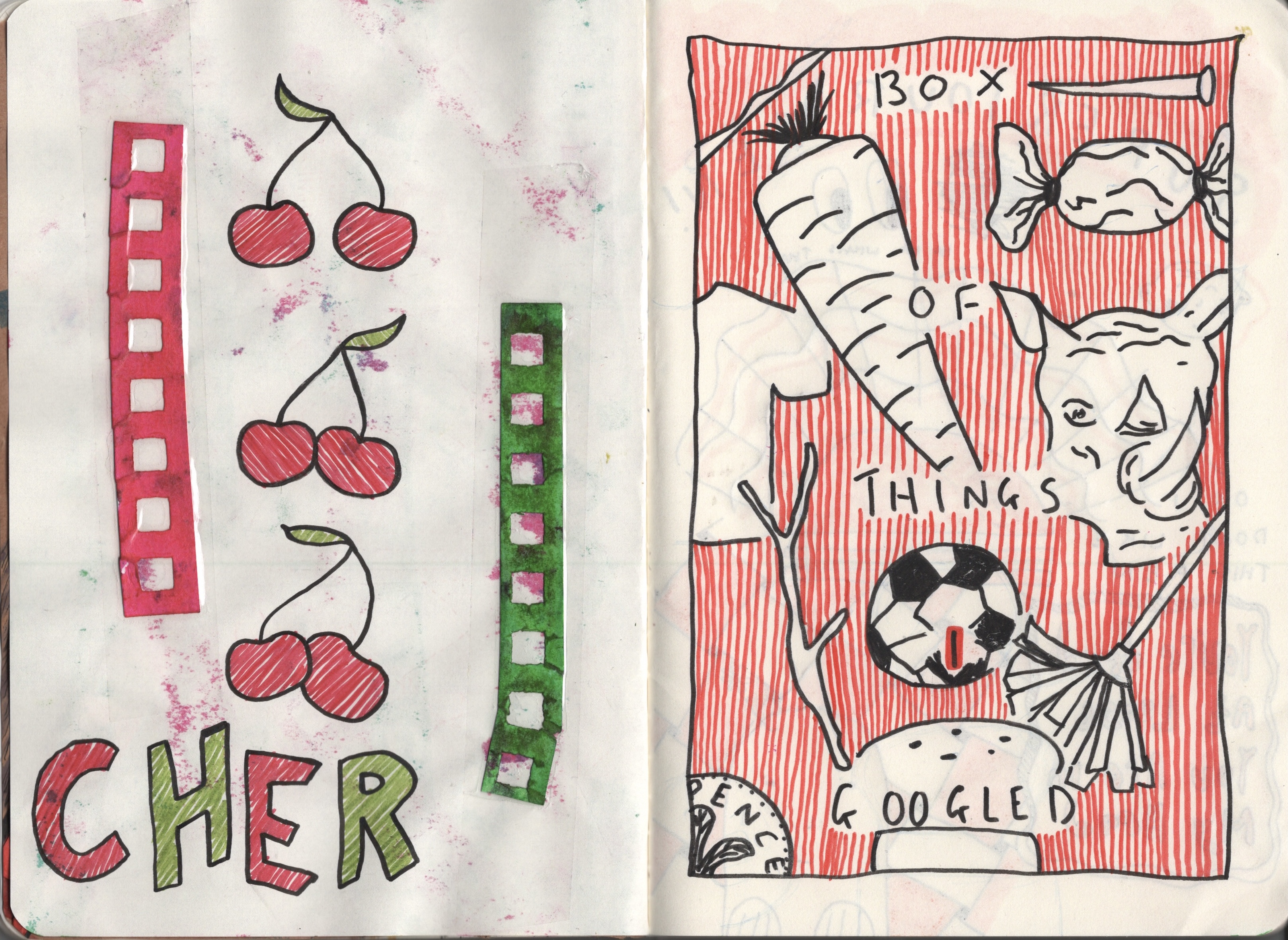
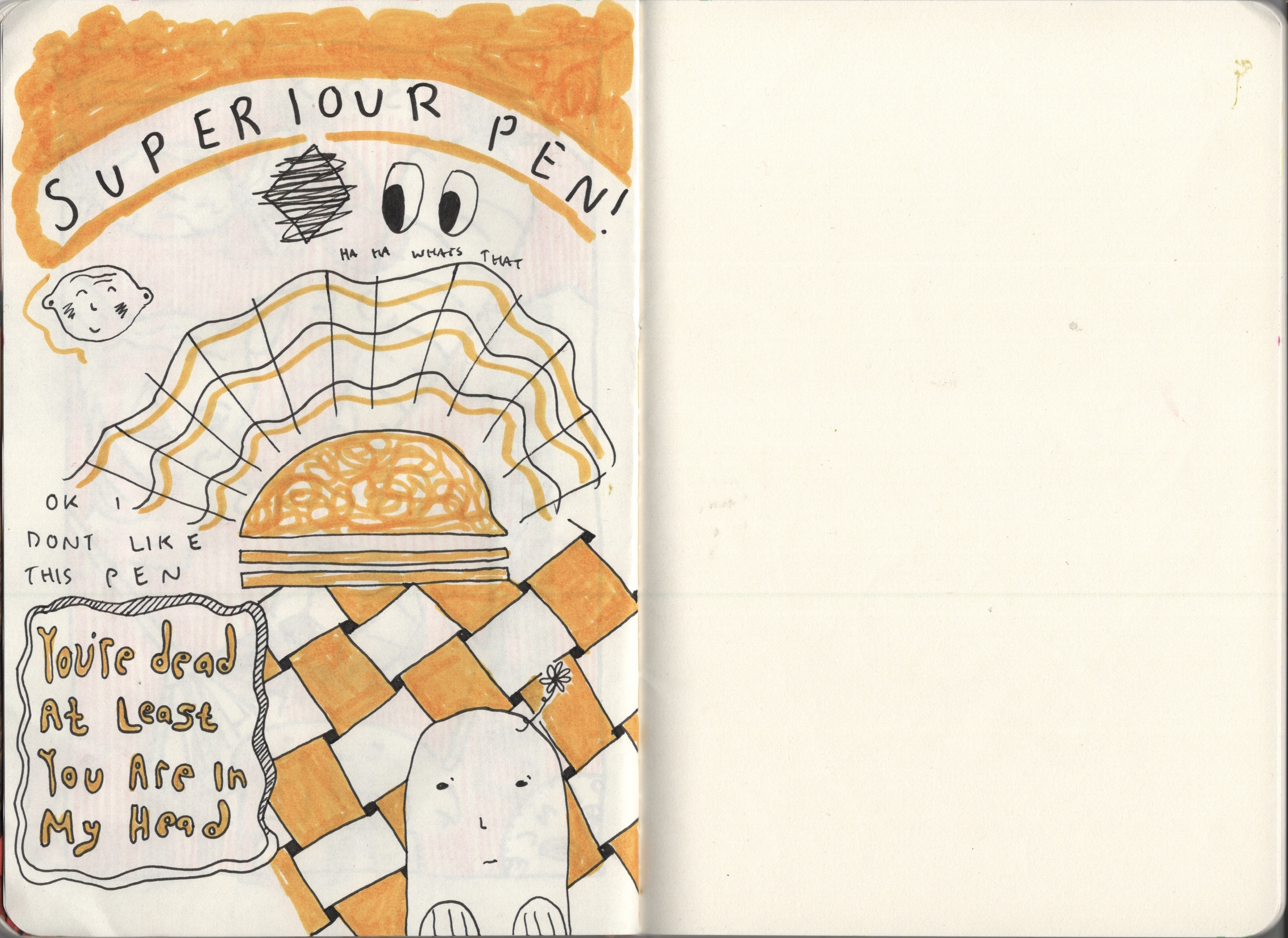
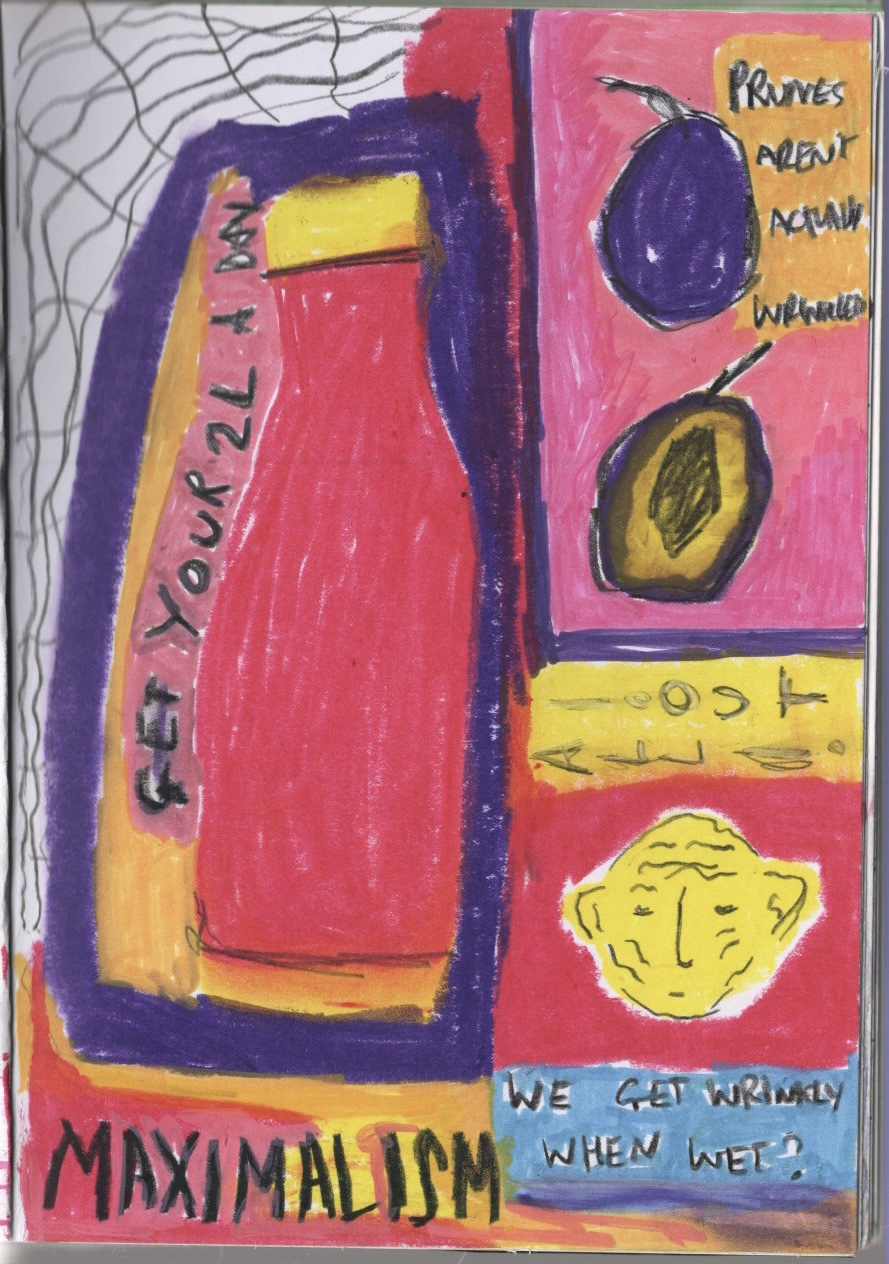
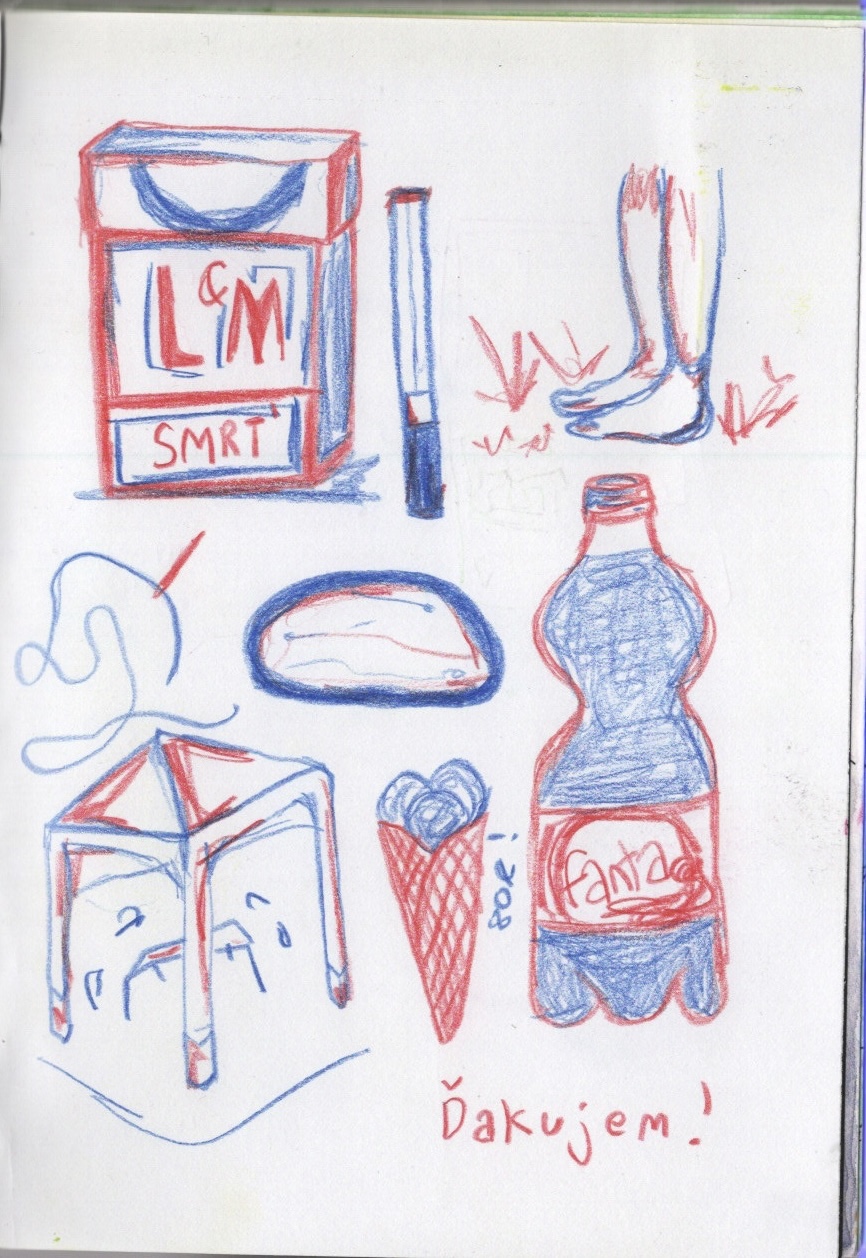
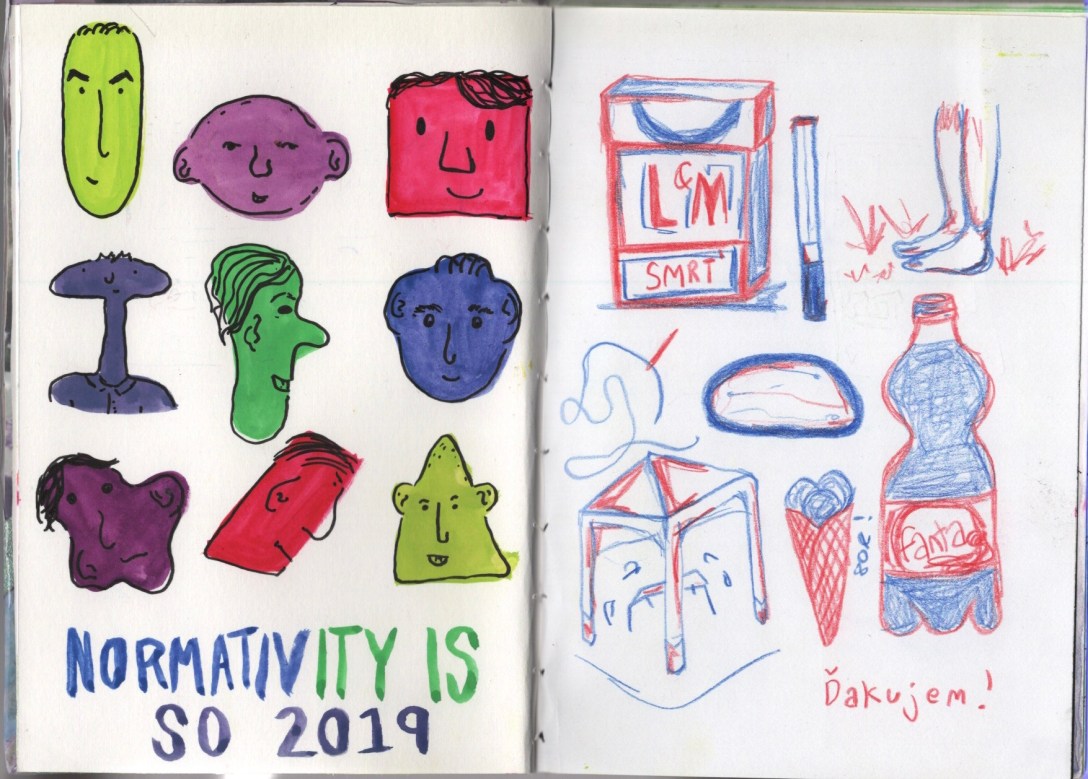
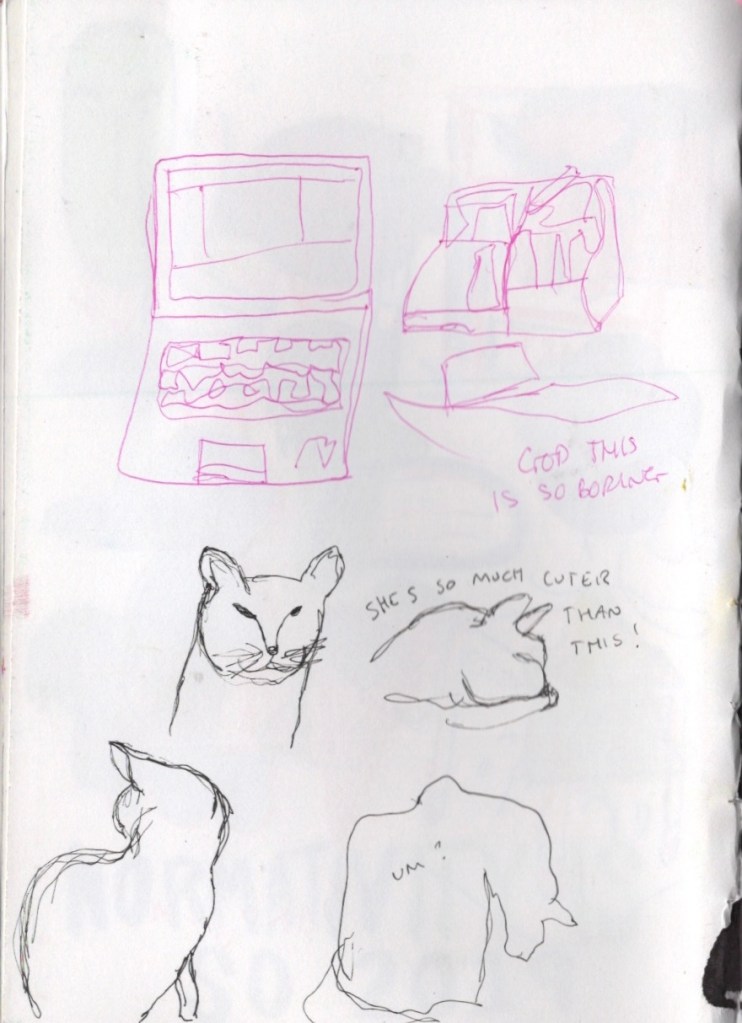
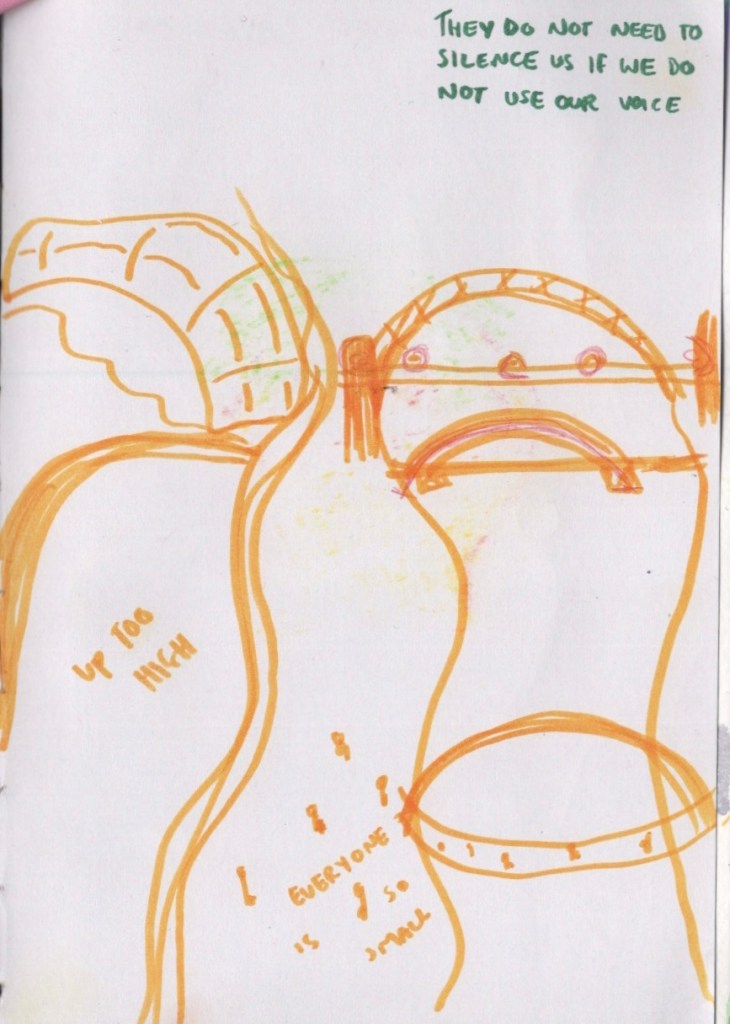
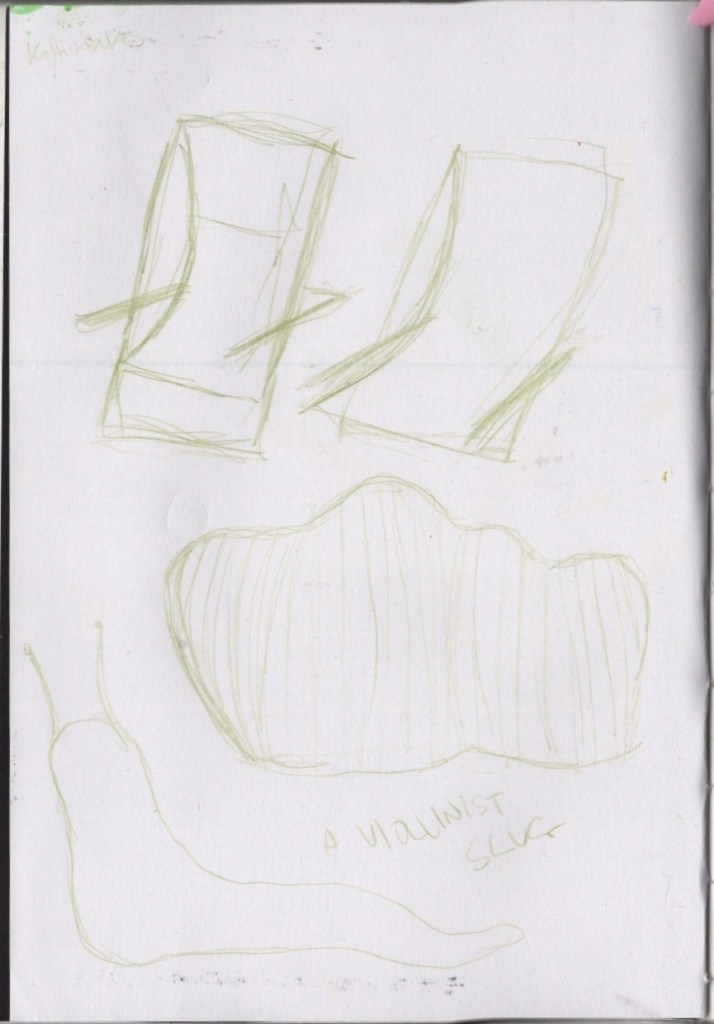
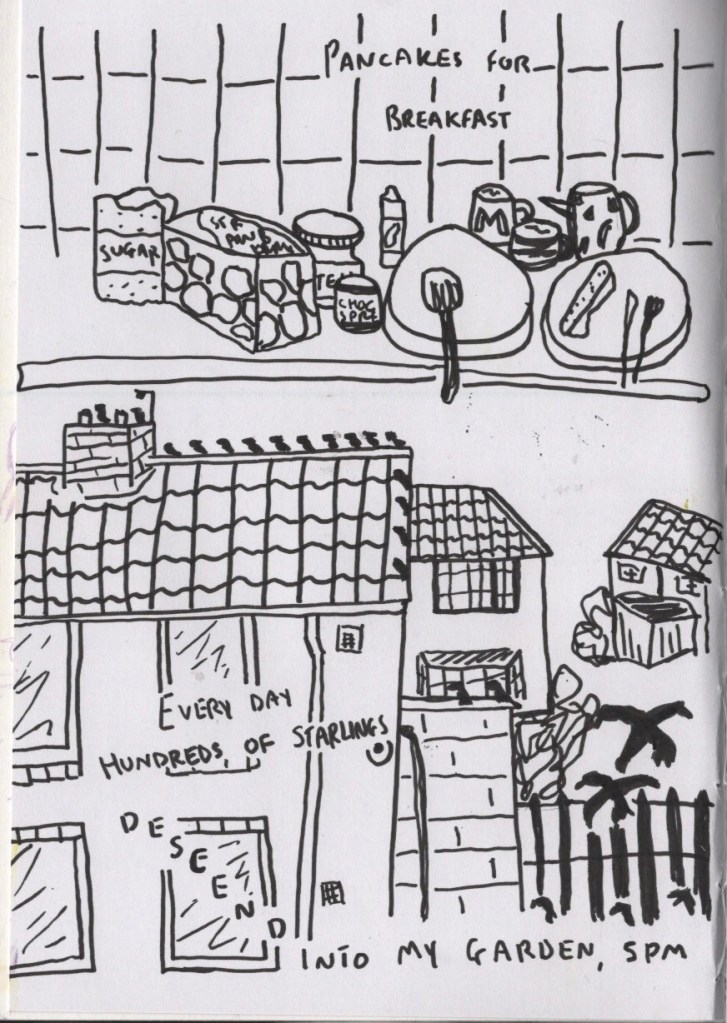
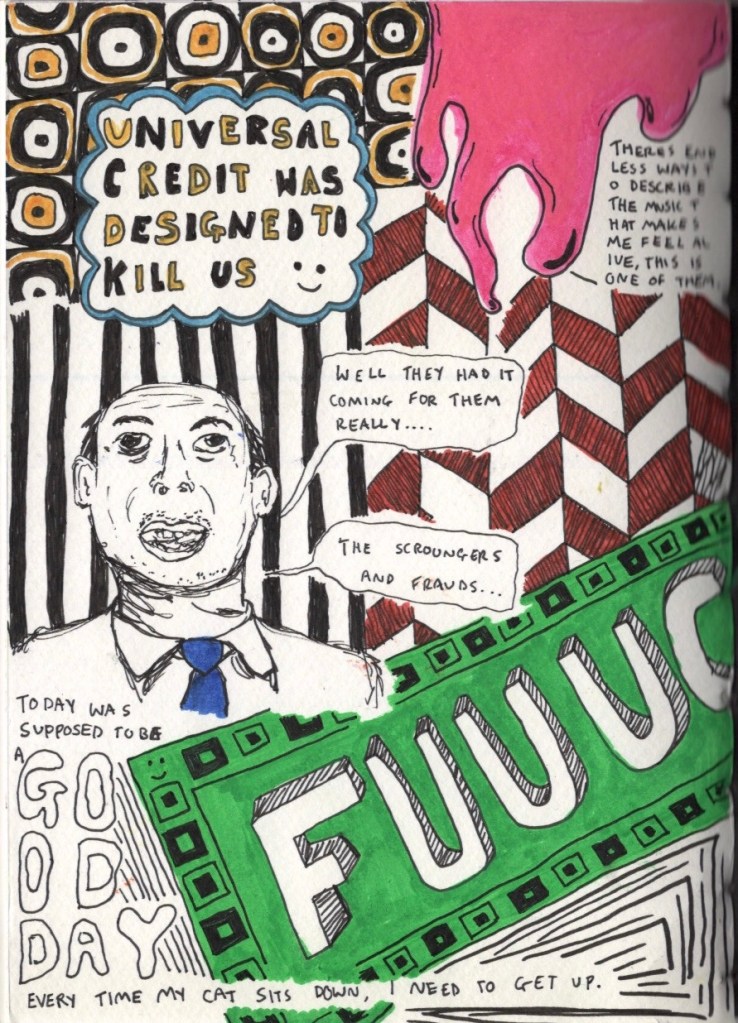
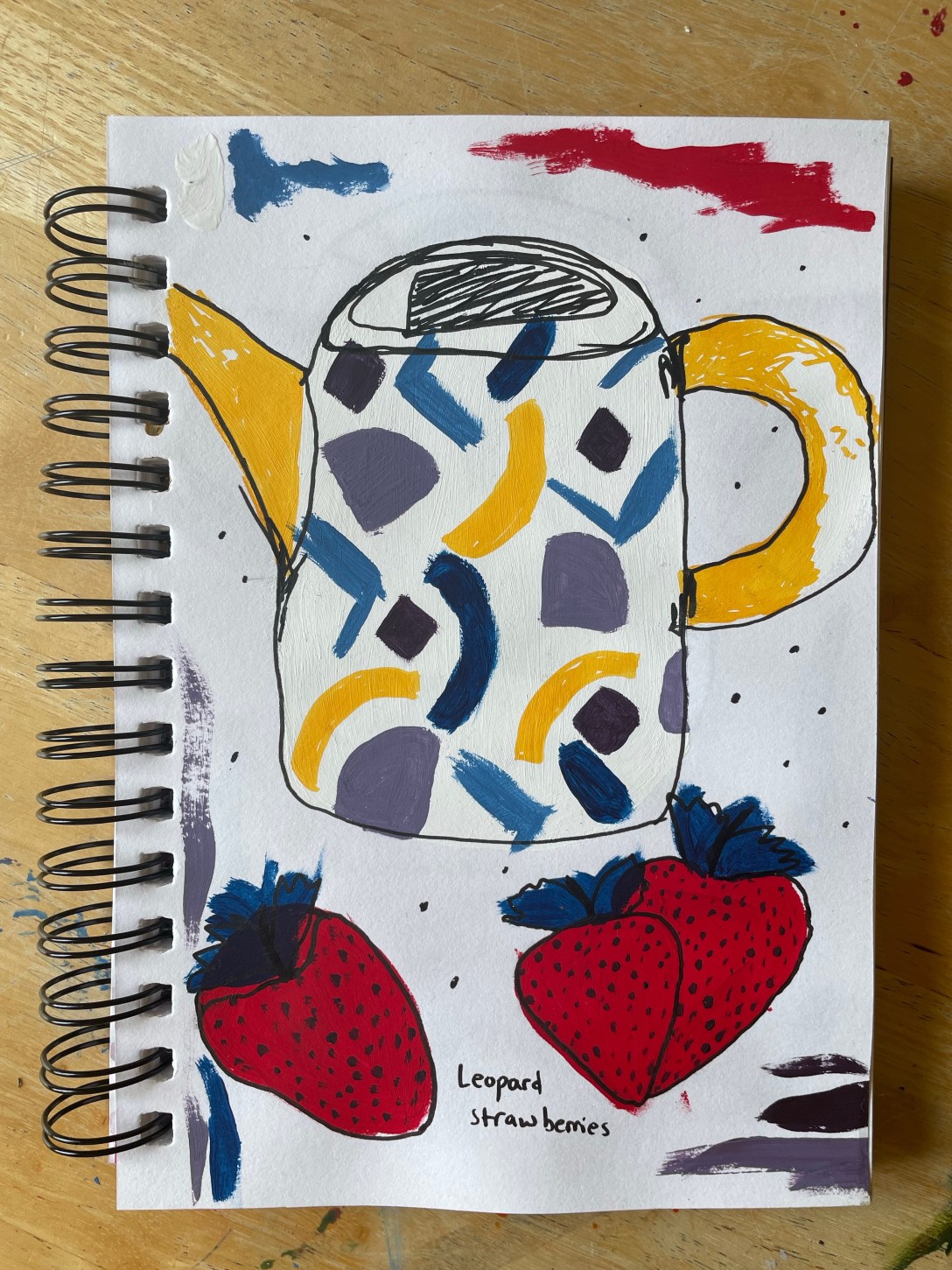
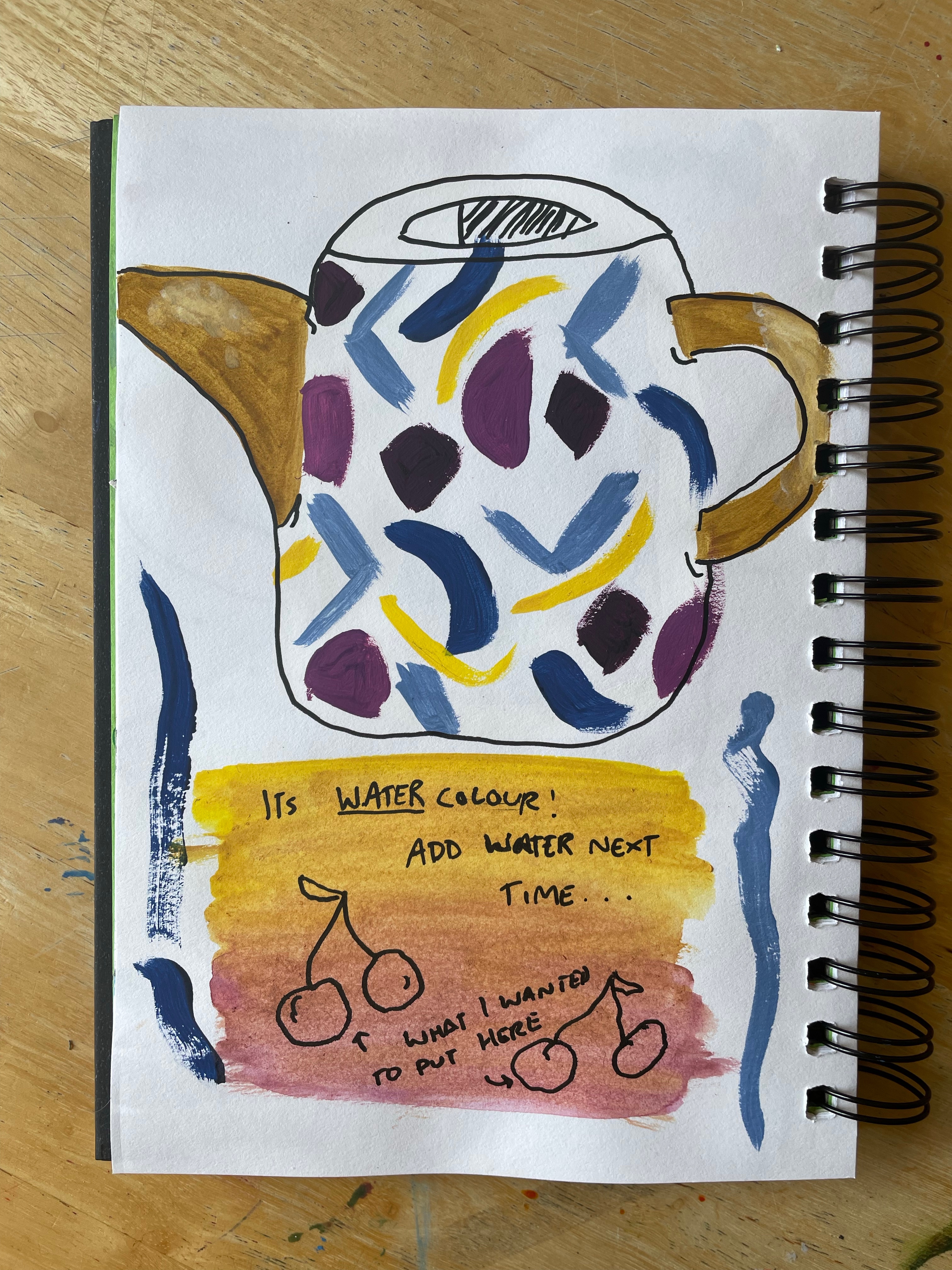
My 10 pages for this sketchbook – the first page is by the previous artist
I tried a lot of new techniques that I really love – especially using the paper cut offs as stamps, and the ‘box of objects’ and it’s background. I’m happy with my progress here and my ability to create freely.
For my first assignment, I was asked to produce a sketchbook building on the work undertaken throughout part one on the theme of ‘the everyday‘. I had to visually respond to my theme, recording my work in a sketchbook, using any medium and working in any way I’d like. The sketchbook did not need to be finished but could be an ongoing work in progress.
The exercises throughout part one had given me a great deal to think about. I had spent time considering how I wanted to change my relationship with my sketchbook, the kinds of sketchbooks I wanted to work in, and the sort of work I wanted to produce. I had thought extensively about what the everyday meant to me and the varying ways I could visually explore this. I tried to collate these thoughts a little and plan some goals for my sketchbook in order to begin this assignment. This acted as a reference point for my sketchbook to grow from. It included snippets of ideas I’d had, areas of art I wanted to develop, and ways I wanted to improve.
Initial list of ideas and goals for this sketchbook
As I had decided in Exercise 1.0 to use my handmade sketchbook throughout part one, I was ready to start without much thought. I also decided early on that as well as tackling the idea of the everyday from different perspectives – I would simply use my sketchbook every day. This would be my everyday explored through art from a much more abstract point of view. It also meant that I could be a little more free and absent-minded about some of my pages without having to consider how it relates to the overarching theme.
I then got to work. I tried to incorporate my sketchbook into my daily life – just making art whilst living and exploring whatever was on my mind that day. Some days all I did was sit and work in my sketchbook whilst watching YouTube videos, some days I barely picked it up other than to note an idea down. But my goal to have a sketchbook that felt closer to me was reached. My sketchbook became a part of my everyday, and I felt more connected to it by the end. You can see a flip-through of my sketchbook below.
Whilst I didn’t manage to achieve everything I set out to, I still feel like I have learned an enormous amount in the process. Not only have I started perceiving the everyday through a new lens, but I have also started considering what parts of my everyday I want to share and how I could do this. For example, two of the pages in my sketchbook focus on my experiences with derealisation and depersonalisation disorder, an area I hadn’t previously considered focusing on in my visual exploration. These pieces also lead me to having discussions with my friends about how much of my experience with mental illness was ‘too much’ to share – not because I’m uncomfortable sharing it, but because I don’t want my work to be inappropriate for academic contexts.
Having a list of goals and plans for the sketchbook was helpful as it gave me a place to go back to if I ever felt stuck or lost for inspiration. However, it also felt like a lot of pressure, especially the specific ideas I wanted to explore. A vague goal such as ‘create characters’ or ‘explore colour options’ was much less stressful as I could do this in any way I wanted, whereas ‘good, bad, ugly’ or ‘frog cowboys’ – ideas that stemmed from conversations that I wanted to illustrate – ended up causing a mental block. I think this is because I was envisioning something more akin to a finalised illustration, and it felt like too much work to explore. In future, I think sketching out these ideas as they come up rather than listing them to explore later would help with this.
As you’ll notice, there are several empty pages in my sketchbook – both throughout the middle and right at the end. This is due to the fact my sketchbook is made up of many different types of paper. I didn’t want to use the high-quality acrylic or watercolour paper to do quick timed sketches or nonsensical drawings, so I often skipped a few pages to find a suitable paper for my goal. I would then go back and use the page for painting or earmark it for a specific idea I wanted to explore. This then discouraged me from using the page for anything else as I really wanted to use it for that idea. I also found that I just didn’t like using the black paper as it was quite restrictive in how I could use it.
Because of this, the sketchbook is literally unfinished, as it has room within it for more drawings and exploration of ideas and concepts that were left untouched. I have been considering, however, whether the sketchbook would ever be finished, even if every page was ‘done’. I don’t know if there’s an answer. Before completing a sketchbook, I often find a page that I don’t think is quite finished yet and add something new to it, but I like the idea of it being ‘done’ at some point. I guess I just haven’t figured out what that point is yet.
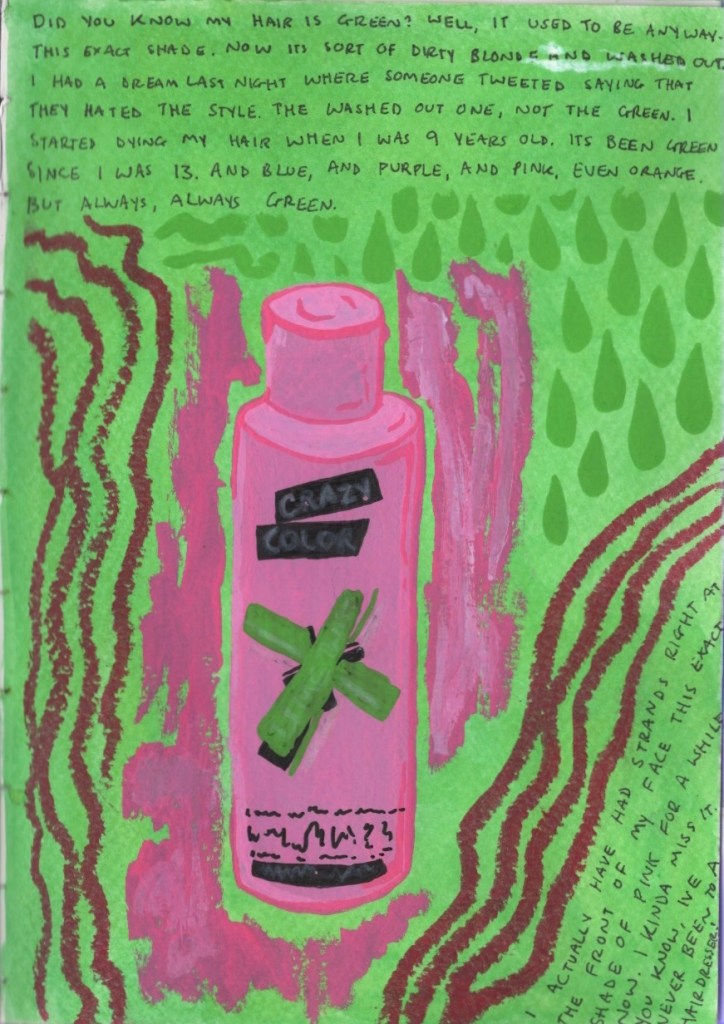
As for the sketchbook theme, I both appreciated and hated having to stick to it. For the first few days, I felt really restricted in what I was ‘allowed’ to put into my sketchbook, but over time I realised that anything that goes in there is allowed and could be relevant to the theme of the everyday. It’s such a broad and generalised theme that rambling about the colour of my hair is still referencing it! I did do some focused pages, such as taking pictures of everyday moments and painting them, drawing daily things that happen to me, and painting an assortment of everyday objects. Overall, though, this has taught me that I prefer not to have a specific theme for my sketchbooks.
Above I have displayed a selection of my favourite pages. I don’t want to break down how and why I feel this way about every page as I feel I’ll be here forever, but I wanted to set them aside as my ‘top picks’. I either like the art itself, the colours, and the aesthetics of the page, or it was a page I really enjoyed creating and therefore feel positively towards. There are of course pages I dislike, too, which you can see below. My feelings towards these pages are similar, either based on the art itself or my feelings when creating it.
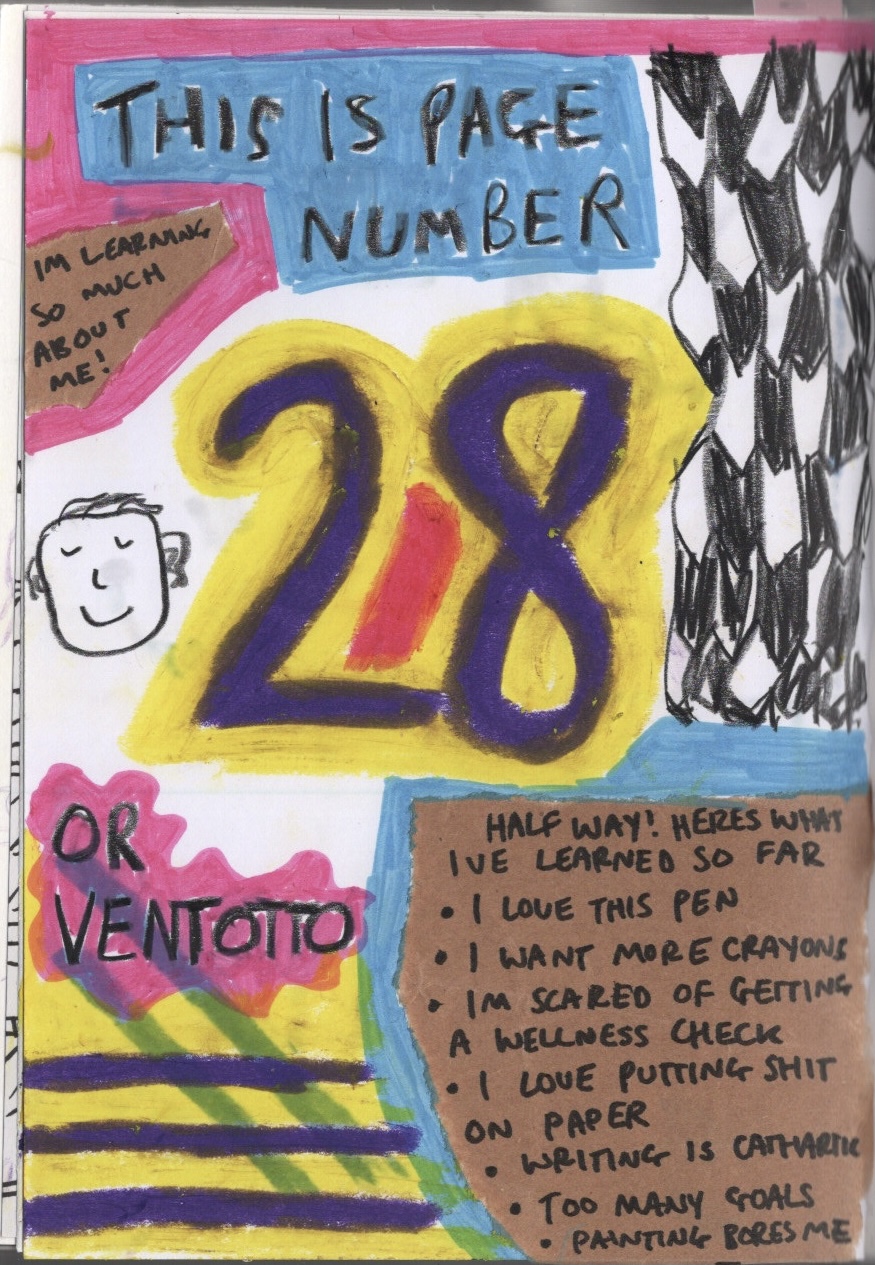
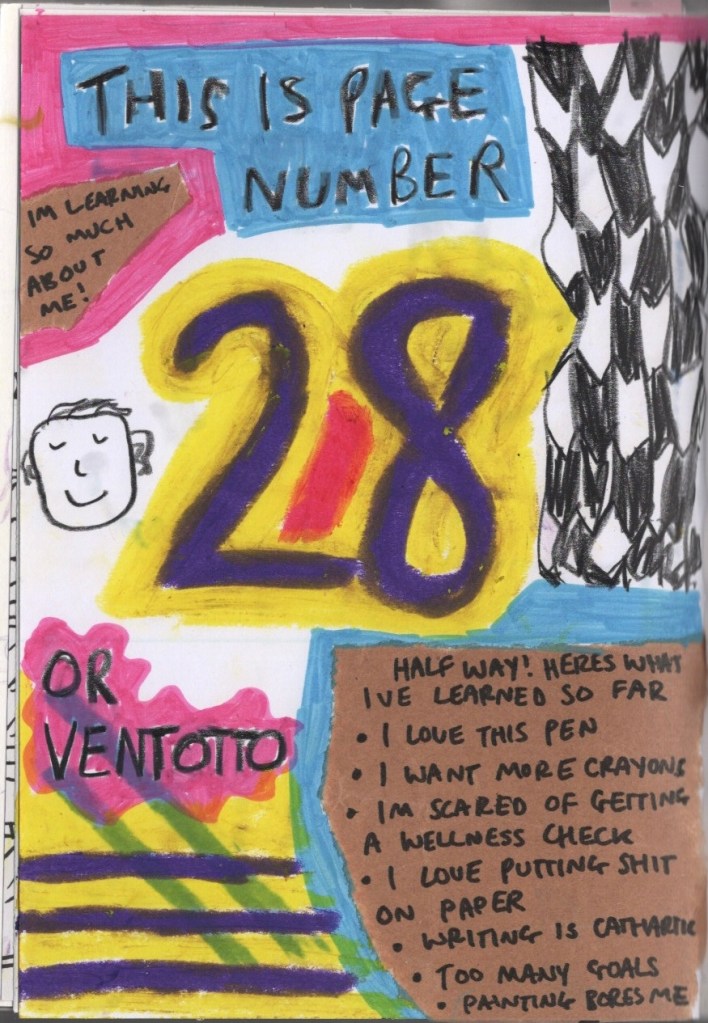
Seeing these pages together helps me identify what I want to do more of going forwards and what I want to do differently. I dislike it when my work feels rushed, lazy, or unfinished. I like using lots of colour and bold black lines. I have discovered the joy of using a 1.0 fineliner – something I had never done prior to using this sketchbook. I like being playful, fun, and exploratory in my sketchbook pages. I also especially like it when a page allows me to explore my thoughts and feelings either generically or on a certain topic. On my ‘page 28’ piece, you can see a list of things I felt I had learned by the time I got to filling out this page. I mention that ‘painting is boring’ – and that’s a big takeaway for me here. I love painting, but waiting for it to dry is a difficult endeavour for me. I think I will be painting less in future, at least in my sketchbook.
On sharing my work: I have shared bits and pieces here and there from my sketchbook with my friends on social media or with other OCA students. I intend to also post the video of my sketchbook flip through above and ask for feedback or just for people to see it. I would like to post more of my work on social media, but I struggle to keep up with it and the high energy output it demands. I’m trying to find a way to make it easier for myself to do this, but it’s proving difficult. However, I have also joined a sketchbook circle for this year, which you can find out more about here. I participated in one last year and found it quite fun! I am about to start working on my second sketchbook for the circle now. I find this is a great way to share my work as I don’t have to be present for the viewing process. Once posted, my work is ‘gone’, and I can focus on something else.
I’m delighted with the body of work produced for this assignment, even the pages I don’t like as much. I feel as though they address the theme appropriately and have helped me identify where I want to go next. Using my learning log to investigate my feelings around using a sketchbook has been hugely beneficial too. As I said on page 28, I’m learning so much about myself! I have genuinely loved working in my sketchbook every day and making it more of a staple part of my life – I’m ending part one with as much enthusiasm and excitement as I started with, if not more.
This exercise was focused on answering the question ‘to hide or not to hide?‘ I was asked to think about how I felt about my own work and how much of it I was comfortable sharing with the world. I was then asked to research ways I could hide my work within my sketchbook and use these methods to add the work from Exercise 1.2 to my sketchbook.
I really struggled with this exercise as I have no real desire to hide any of my work. I am entirely comfortable with putting everything out there into the world, and I’m not too fond of fiddly hands-on type stuff. At most, I might add an envelope or pocket to my book to store paint swatches or collage pieces, but I don’t ever see myself wanting to hide my work. Even the thought of painting over something I don’t like or concealing it with post-it notes – both popular ways of hiding work the artist dislikes – is unappealing to me. Thankfully, a lot of this unit is about your own relationship with sketchbooks, so I spent some time unpacking these feelings.
Firstly, my sketchbooks are mine, and they exist for my benefit only. If someone dislikes what I’m doing in my sketchbook, that doesn’t matter because I did it for me. As long as I feel good about the content in my sketchbook, that’s all that matters to me. I also have an odd relationship with the concept of ‘privacy’, which I’m certain stems from being autistic. I don’t see any of my thoughts as private, and I would be comfortable sharing any of them with anybody, including total strangers. Where the line is drawn for me is other people’s comfort – I don’t want another person to feel upset, uncomfortable, or like they know too much about a situation. So, in general day to day life, I share my thoughts according to other people’s comfort levels.
That’s just in everyday life, though, and not in my artwork. On some level, I’m interested in challenging the discomfort people might feel around knowing too much about another person. I’m curious as to why we hold these standards and what drives these feelings. If someone feels uncomfortable looking at my artwork, I’d hope they could question why and learn some things about themselves. Although, I never want to harm anyone, and for that reason, I am in the habit of adding trigger warnings and disclosures to anything I produce that might cause harm. However, the bottom line in my artwork is that I create for myself, not for the public eye.
I have experienced many traumatic and distressing instances throughout my life – abuse, cancer, chronic and mental illness, among other things – and I find it quite therapeutic to be open about these things. These ‘personal’ experiences and the feelings I have to go with them feel very normal and mundane to me. There isn’t much I haven’t experienced, and I think this also makes me feel a bit less like there’s a hierarchy of ‘public’ and ‘private’ things. Openly sharing my feelings brings me comfort, and I also hope that in doing so, other people feel comforted and less alone. I know that despite feeling isolated, I am never alone in the feelings and thoughts I have. Someone in the world will be feeling the same things – and knowing this has helped me through many hard times.
Even if I don’t like a piece of work or made a huge mistake, I still want that to be accessible to myself or anyone else. There is too much perfection in the art world. Artists need to see other artists failures. If we don’t, we continue perpetuating the idea that perfection is the standard within the industry, with no room for growth. I also can learn from my own mistakes, go back and change or add to them, redevelop them, or simply find inspiration from them. I would be robbing myself of that opportunity if I covered or hid it. I also find that almost every time I show my ‘failures’ to other people, they can’t see how it’s a failure – they find joy in the piece.
Another thing I consider is that what I put into my work isn’t necessarily what other people see in it. How we view any media we engage with – be it music, TV shows, games, or art – is influenced by our own experiences and ways of seeing the world. This is what makes concepts such as the Rorschach inkblot test so pivotal to understanding the workings of people’s brains. Even if I did feel a piece of work was deeply personal, how each individual viewer interprets it could be wildly different and have no connection to my initial intention. This, in a way, brings an automatic hidden element to literally every piece of artwork in existence.
Overall, I think there is an enormous amount of beauty in vulnerability. When I see artists bare their all, it makes me feel seen, heard, and understood, even if they’re discussing topics I can’t relate to. The act of being human is enough to feel connected to another person – and by exposing all, you are baring your humanity.
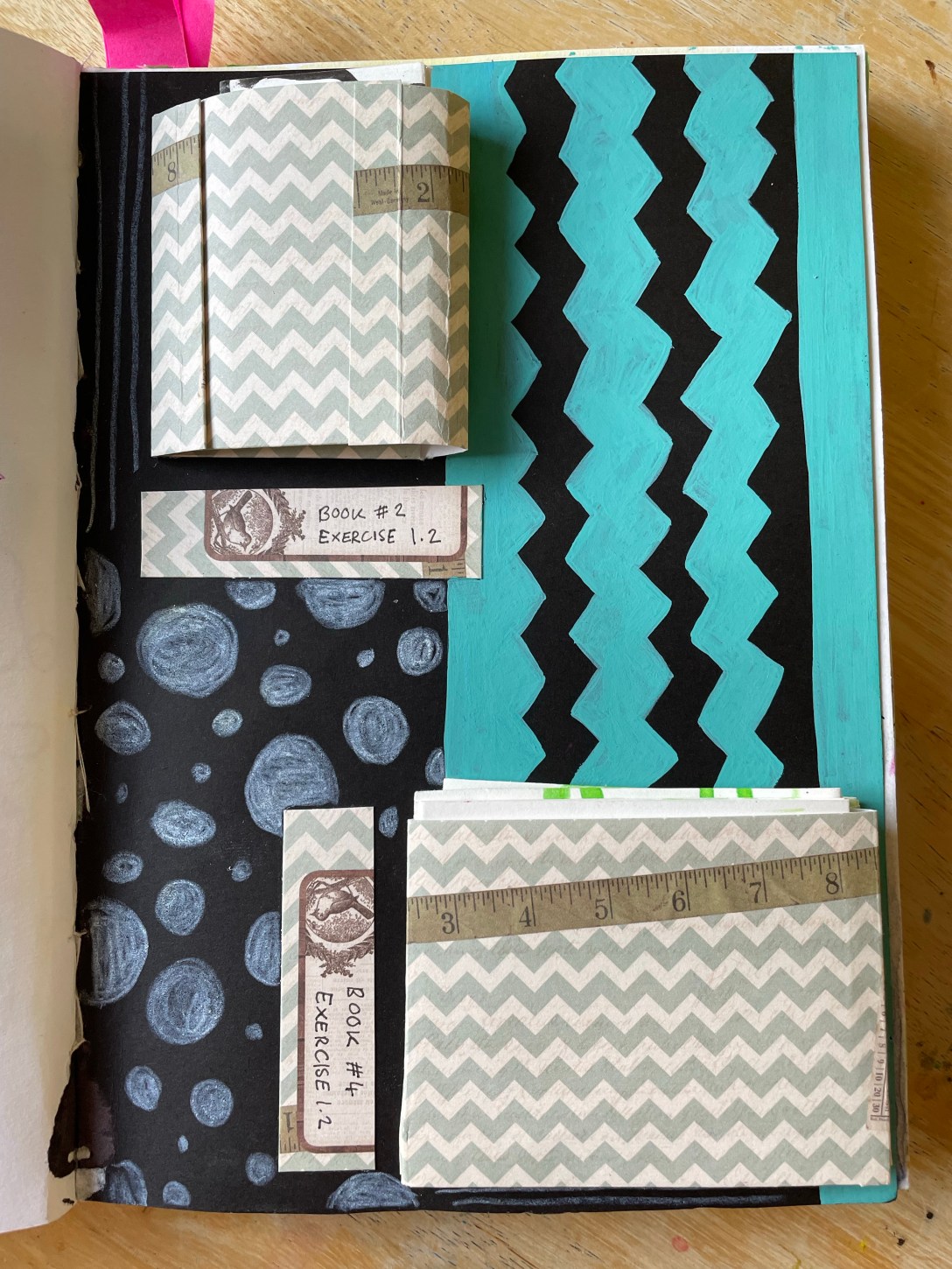
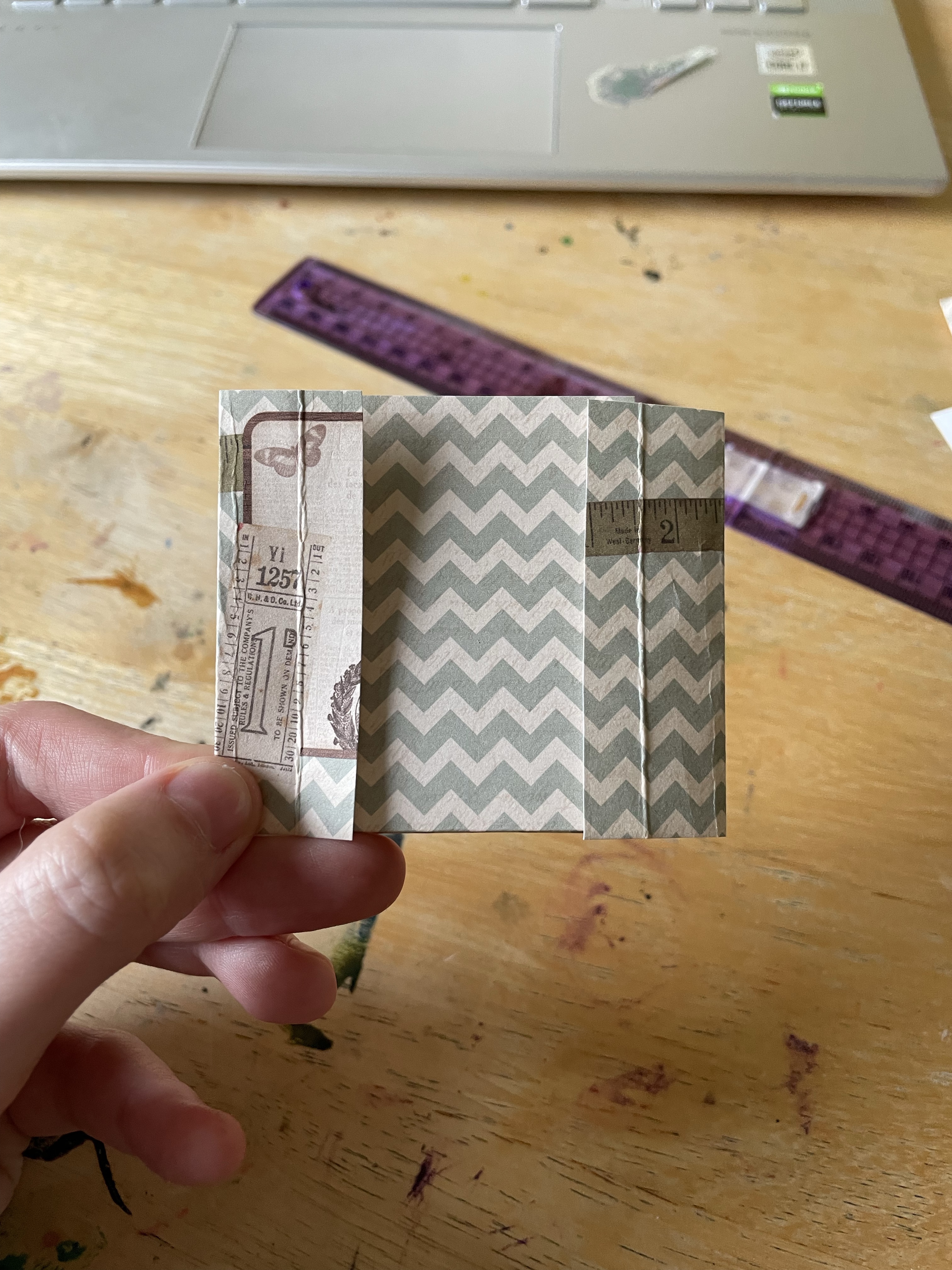
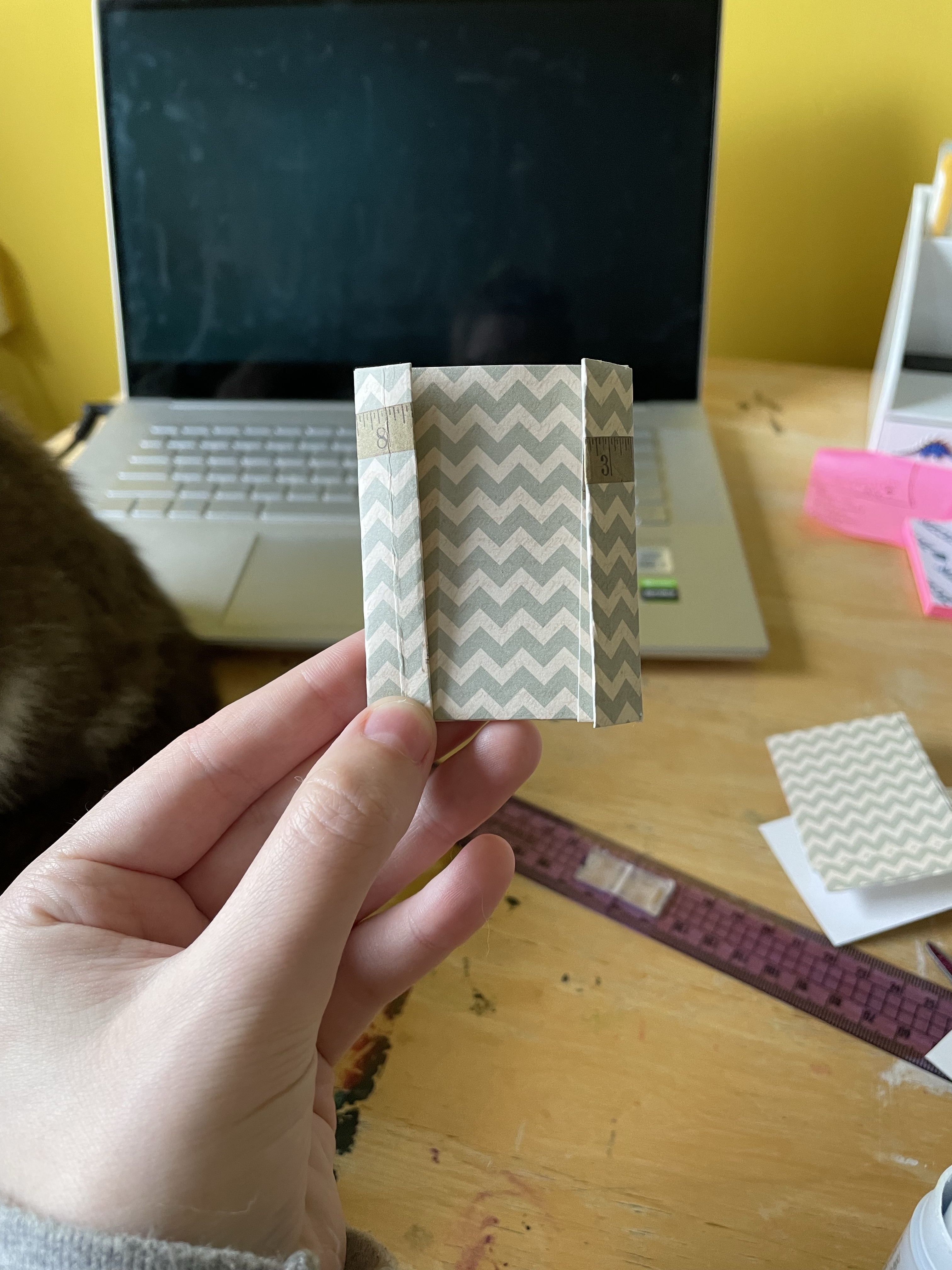
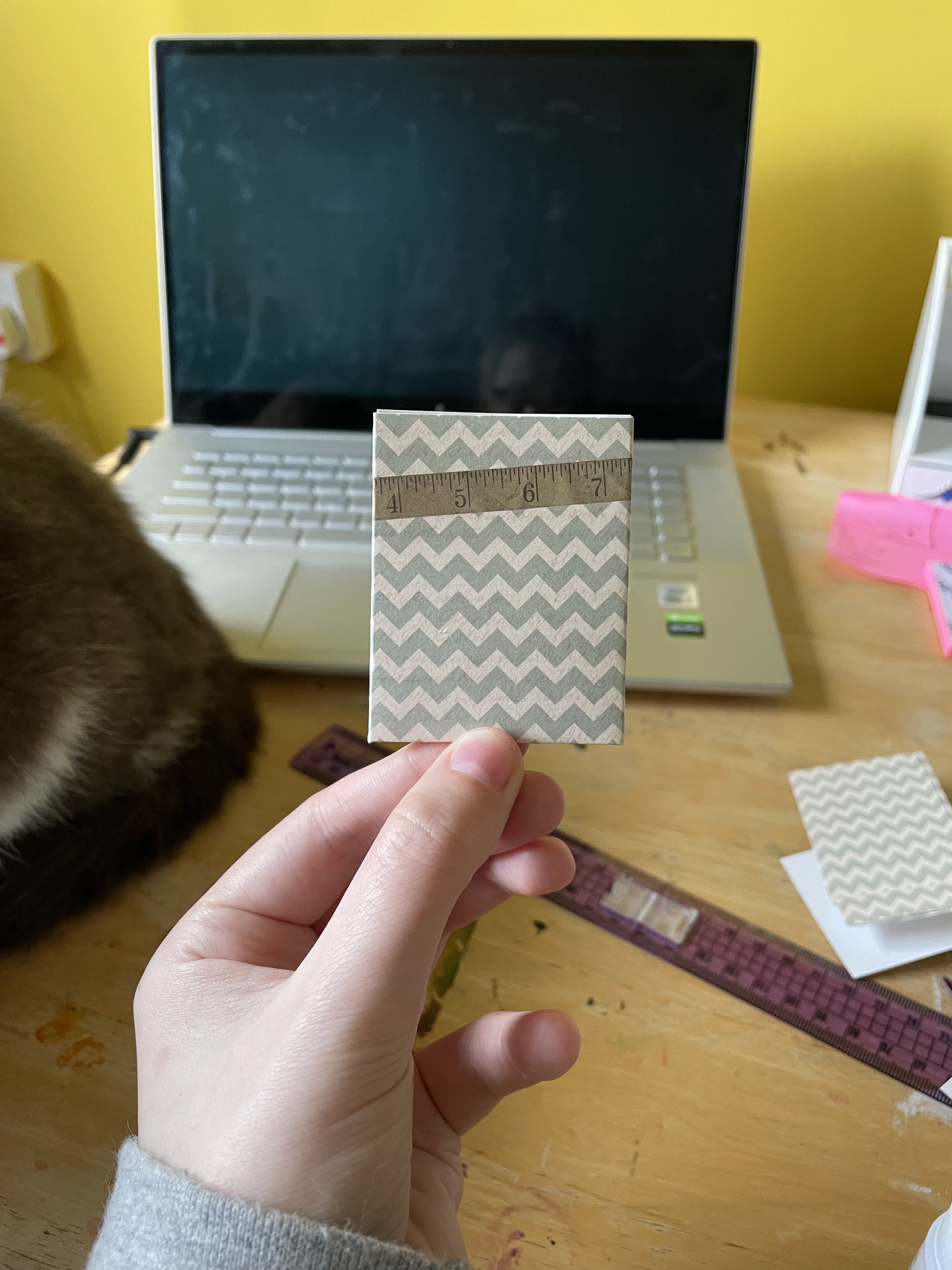
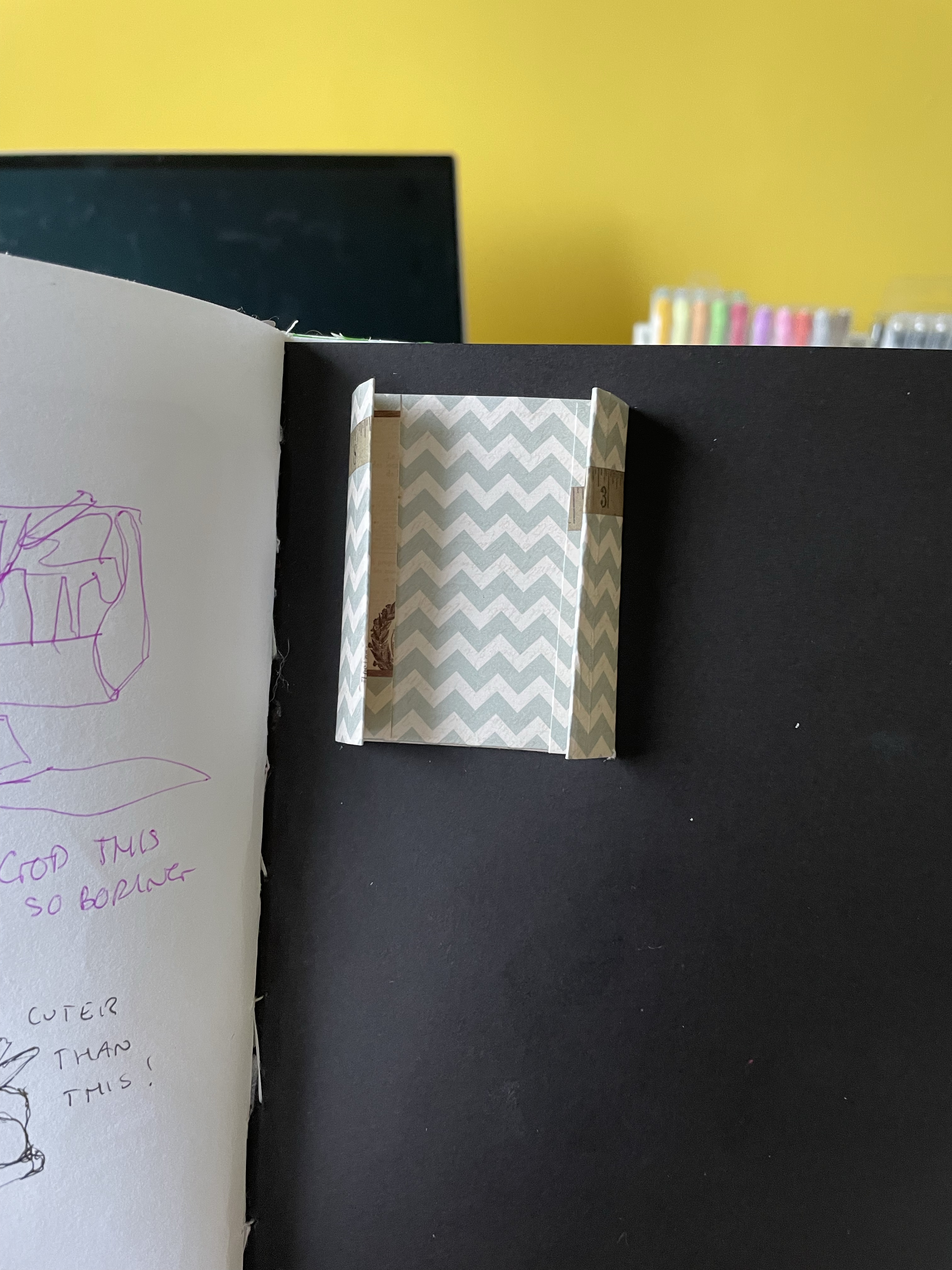
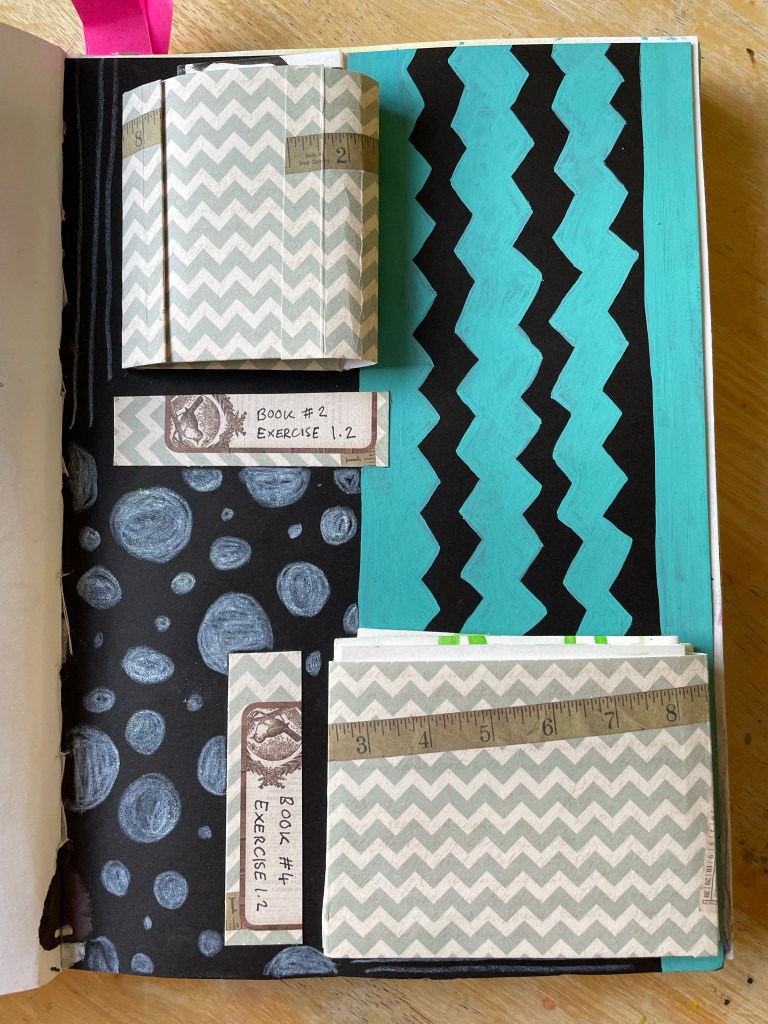
As the goal for this exercise was also to store the books made in Exercise 1.2, I did do some brief research on adding pockets to my sketchbook. I looked over the Pinterest board provided in the unit material, and I discussed with other OCA students how they approached this exercise. I didn’t sketch out any initial concepts. Instead, I started out by playing around with paper directly and seeing how I could make the pockets work. I wanted to make pouches that could collapse easily if I removed the books inside.
The second book I made was much better than the first – I think I learned quite a bit from the process. I would happily add another one of these to my sketchbook if necessary. Sadly, I forgot to take photos of the process of making the second pouch. When the books are in the pockets, my sketchbook is really bulky and difficult to work in. Annoyingly, I have to remove the books in order to use it comfortably. This is part of why I dislike adding everything into one sketchbook. I’m glad I made something that works for the job, though.
Upon reflection, I have considered that it’s pretty cool that I speak Italian and can, therefore, ‘hide’ thoughts in my work by using another language – but still be baring all. However, I don’t know how I feel about doing this intentionally to hide things. I’m grateful for this exercise as it has made me think deeply about my connection to my art and why I feel so comfortable, maybe even driven, to being so open.
This exercise was focused on getting comfortable with the process of working very quickly, making lots of mistakes, and moving on from it. It was broken up into two sections – the first involved making four very quick drawings of my surroundings, and the second involved cutting up those drawings to make into books. The goal of this process was to challenge any preconceived beliefs that sketchbooks are places where work should be perfect, finished, and free of error.
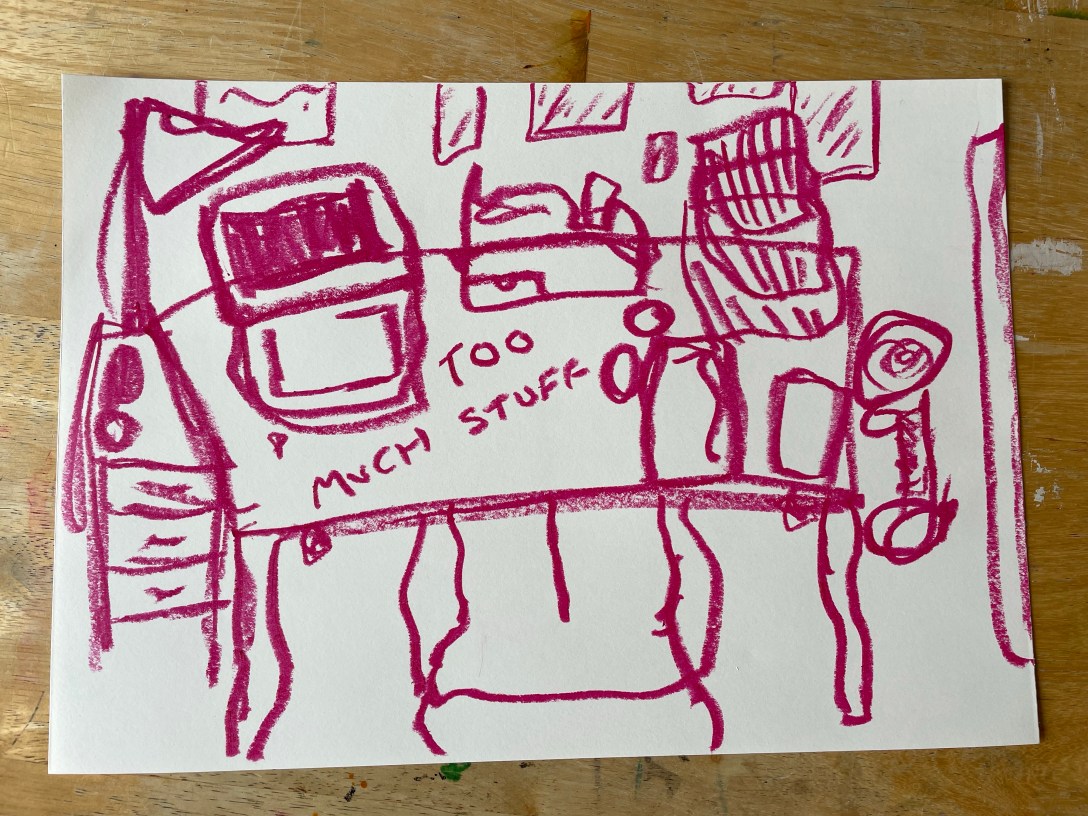
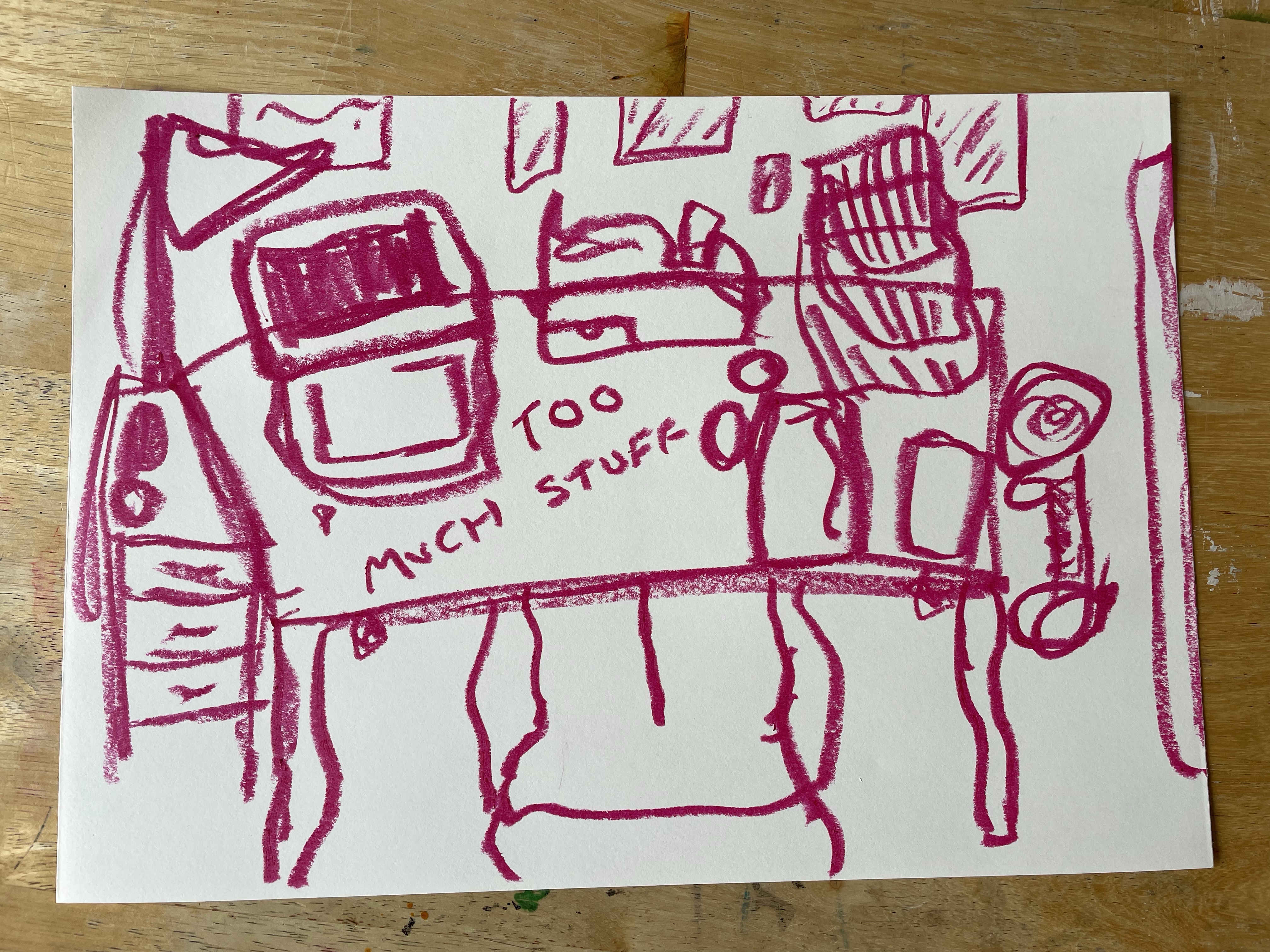
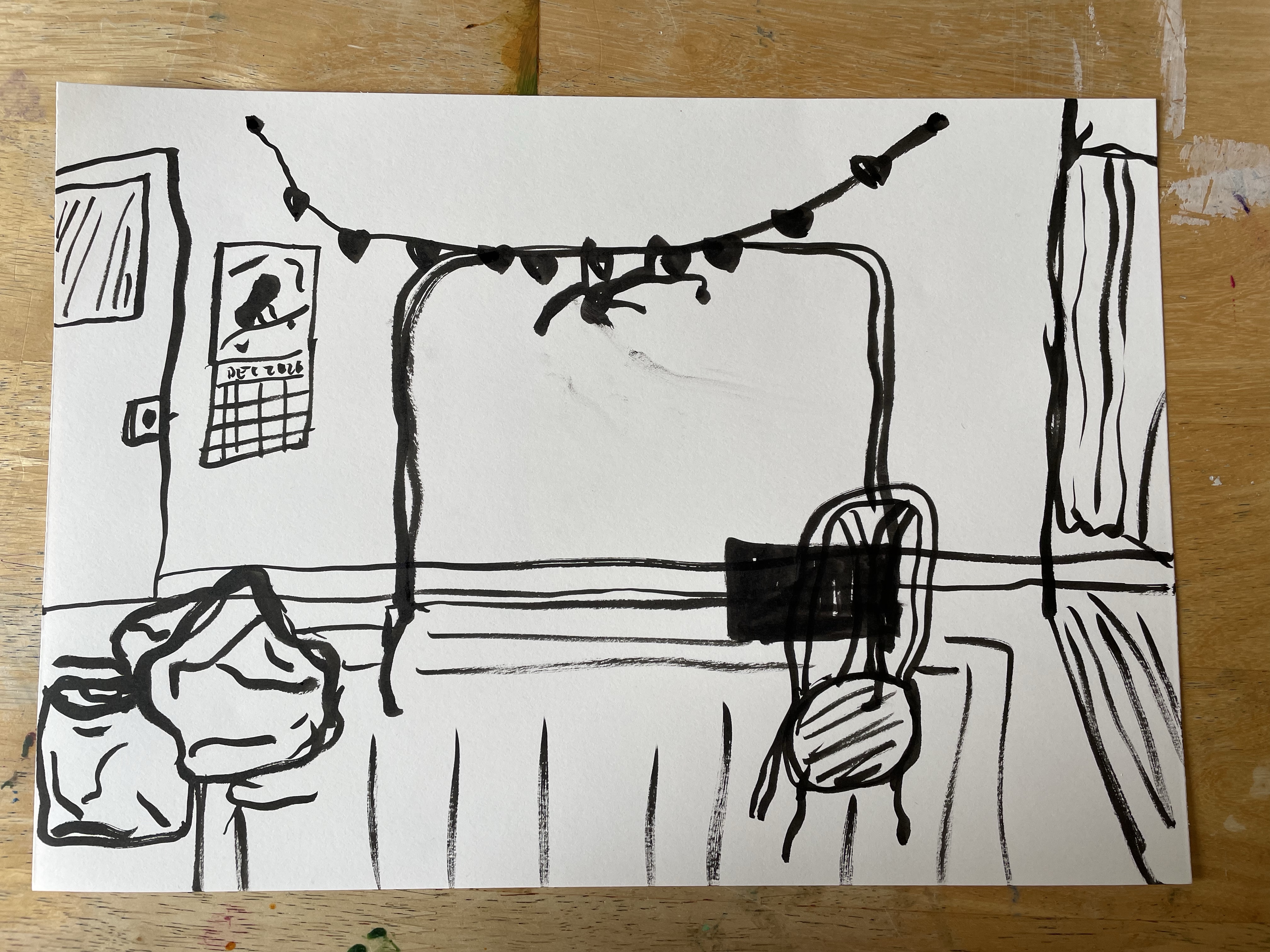
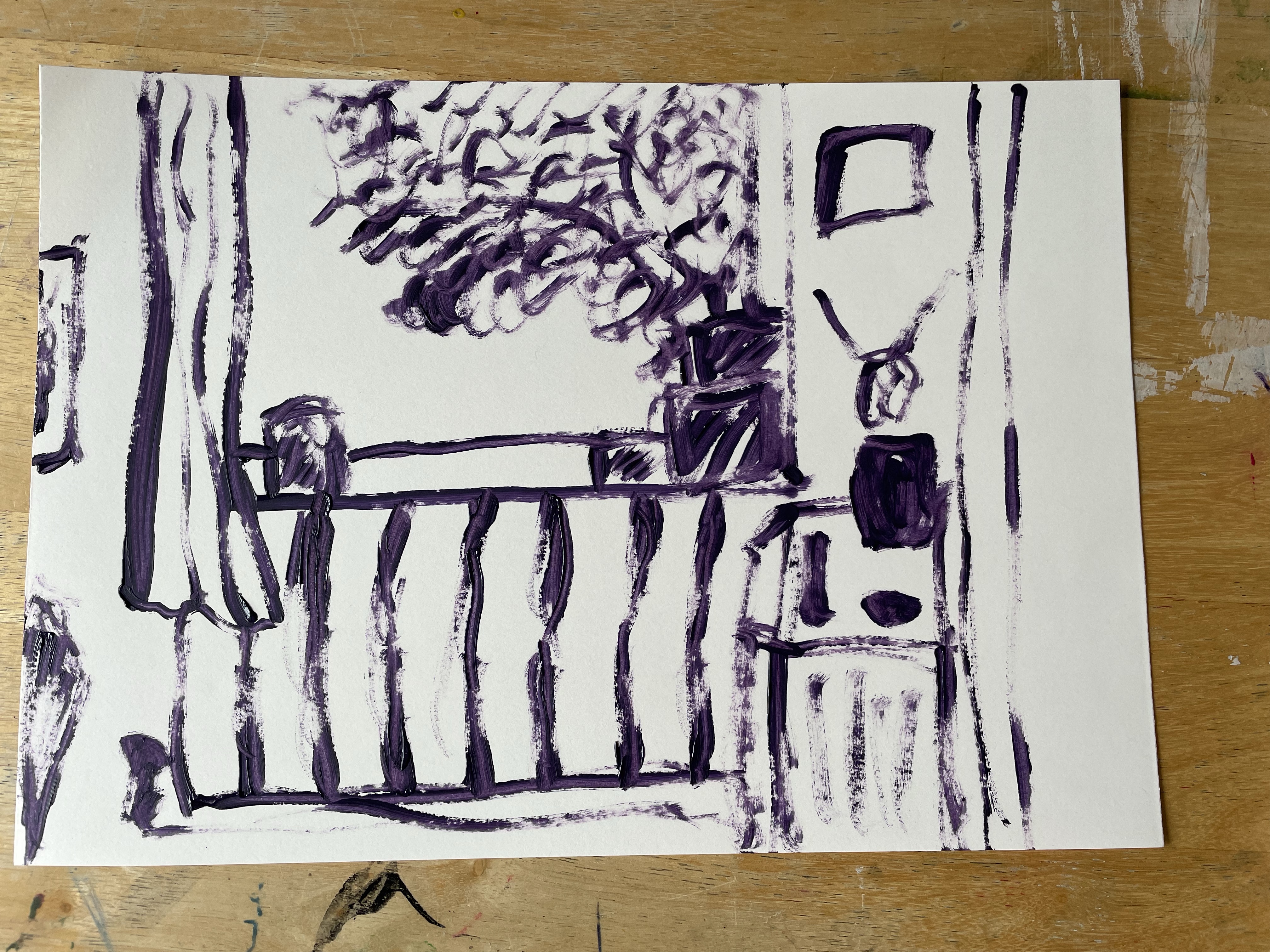
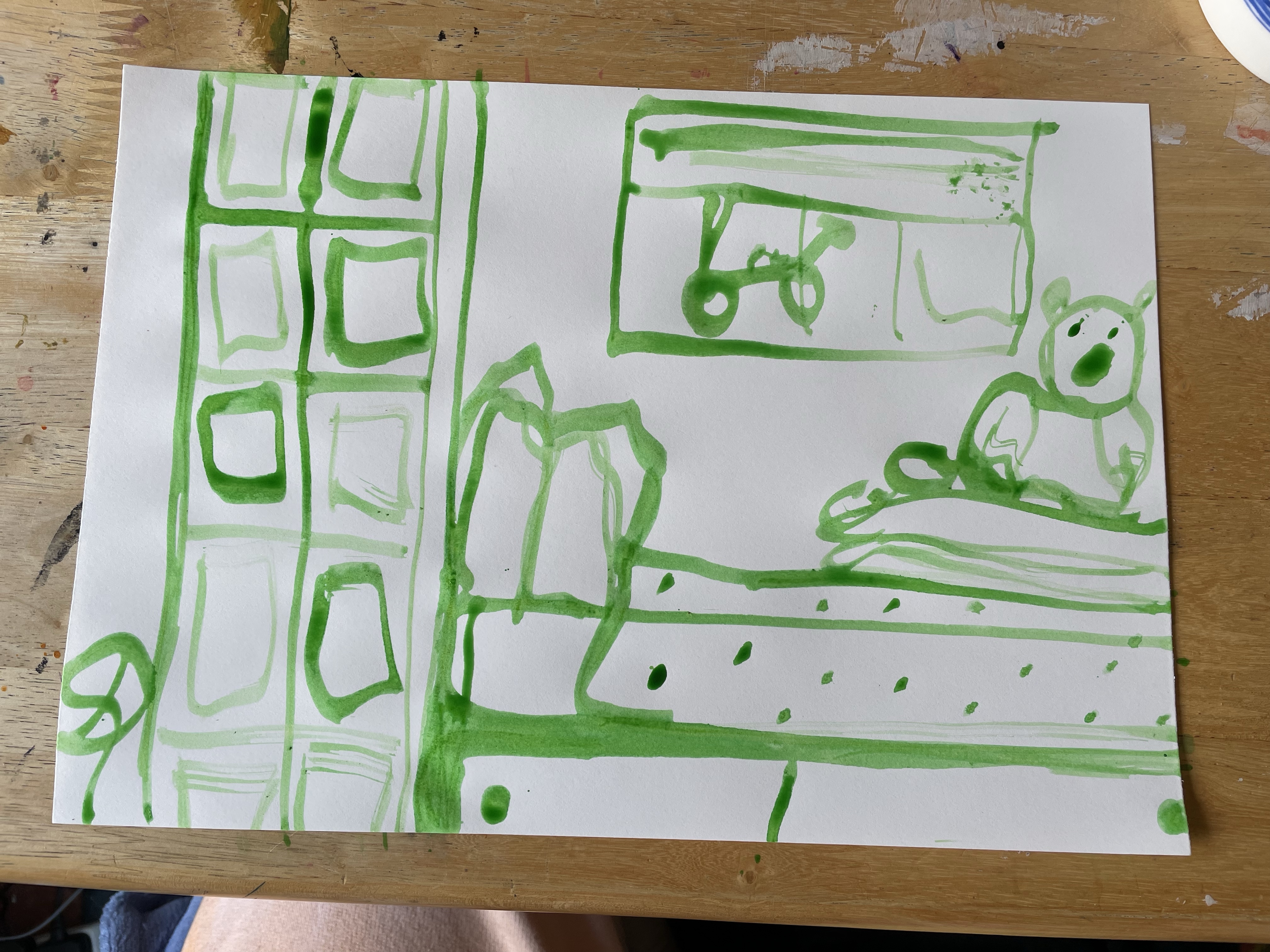
For the first part of the exercise, I was asked to gather four sheets of paper and four different drawing materials. It was noted that these could be conventional or unconventional, but I was encouraged to choose tools out of my comfort zone. I was then asked to draw, very quickly, what was in front of me, then what was behind me, then what was to my left and right. The exercise recommended working loose and fluidly, spending no longer than 5 minutes on each drawing. I had to fill the whole page during this time, capturing the essence of what I could see.
There was a clarification that for the purpose of this exercise, the word ‘draw’ referred simply to any kind of markmaking. I could ‘draw’ whatever I wanted. It could be literally what was in front of me or abstract and gestural, maybe including words describing what I saw, or it could be emotional – communicating how I feel about my surroundings.
I thought somewhat carefully about the materials I chose. I did want to branch out and try some unconventional drawing tools, but I was also concerned I would be preoccupied with how they work rather than with the purpose of the exercise. Whilst looking through my art supplies, I spotted a pencil case full of old makeup that I set aside a few months back. I had intended to use these in my art and have never gotten around to experimenting with them. I decided to choose a lipstick from this selection as it fit the requirements for this exercise perfectly. I then grabbed a cork and a random bottle of India ink, which I have also been saving to combine for some time. I’m very intrigued by the porous properties of the cork and how this might interact with water-based colourants.
Throughout my process of selecting materials, I kept picking up and putting back down a Pentel ink brush pen I have. It felt too conventional of a tool to be working with, despite the fact I was drawn to it and was very uncomfortable working with it. I eventually got over myself and added it to the list of tools to use. It was appropriate in my mind as it wasn’t in my comfort zone, and it, in theory, is a very fluid and dynamic markmaking tool. I also decided to use an art crayon, as this is possibly the most fluid of all the materials I own. It glides across the page with extreme ease and leaves bold, intense lines. It’s a brilliant tool to use to just let go a little.
I chose to use four sheets of cartridge paper for this exercise. It’s slightly off-white in colour, smooth in texture, and a nice medium weight. I needed it to take the India ink and the lipstick without buckling, but I didn’t want to use something overly heavy as I was aware of the folding required later on. I then got to work drawing. I started with the art crayon as it felt like a good way to introduce myself to the exercise and to working fluidly. I set a timer for 5 minutes and drew what was in front of me. I was not drawing exactly what I could see, nor was I drawing everything. I chose to draw what I felt was visually interesting and eliminate what didn’t fit. I very quickly had filled the whole page and realised my timer was only half-finished! I had expected 5 minutes to feel very quick.
The first two drawings using an art crayon and ink brush pen
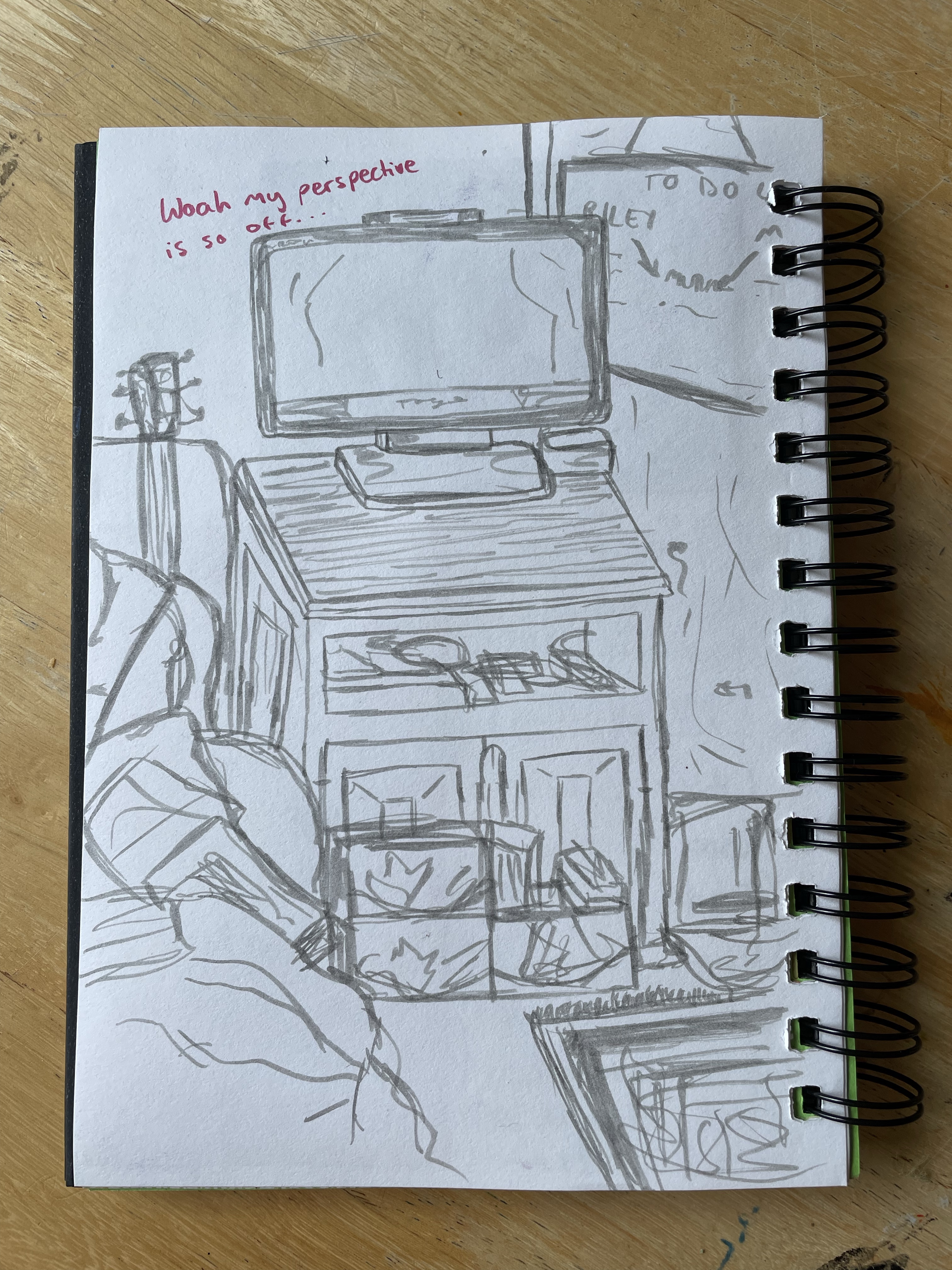
I then moved on to using the brush pen and drawing what was behind me. Again, I set a timer and worked to fill the page. This was where I really started to feel the mistakes coming through. Everything was overlapping and out of place, and the perspective is really off. It doesn’t look too much like what was behind me, but at the same time, it captures all of the key elements perfectly. I also really enjoy the way I captured the textures of some of the components.
I carried on, next to the lipstick, which was surprisingly fun to use! I drew what was to my left this time. Interestingly I drew this on a much larger scale, which may be down to the material I was using. Once again, I could see all of the mistakes coming through, which was beginning to frustrate me. In retrospect, however, I can see so much that inspires me that I’d like to try out again. The last thing I used was the cork and India ink combo. This drawing is probably the ‘worst’ one, objectively. It’s definitely the one I like the least and the one I wish I could do again.
Firstly, the cork was not at all absorbent despite my hopes. I guess it has a waterproof coating as it’s meant to be a bottle stop, or maybe I just don’t understand how cork works. This made it really hard to use as a tool! The ink was dripping off it, and I constantly needed to add more to get any pigment. Secondly, the fact that this was a wet medium actually made it harder to work quickly. That feels counterintuitive, as wet mediums are very loose and fluid, so maybe it was a combination of that and the cork as a tool, but it was difficult to achieve any sort of definition in my lines. Adding texture or pattern was impossible as it just blurred into one.
The second two drawings using lipstick and a cork with India ink
I was then asked to think about how this process made me feel. At the time I wrote that I felt liberated, curious, inspired, frustrated, and disappointed. I felt liberated by the freedom of the process and by not having to worry about the outcome, curious about the materials I was using and how I could push them further, inspired by both the process itself and the outcome of it, frustrated by the mistakes I was making and the fact that it even bothered me in the first place, and disappointed mainly by the fact the cork and ink idea was so far from what I had hoped. Ironically, despite being so crushed by this, I think that piece is the most successful in this exercise. It’s the one with the most mistakes, which was the goal!
I then moved on to the bookmaking activity. There were four different bookmaking techniques outlined, one for each drawing made. The exercise recommends trying them on spare paper before starting on the drawings, but as the exercise is about making mistakes, and because I’m quite confident in my ability to accurately do what was required, I started straight on the drawings.
Overall I enjoyed this part of the exercise as it was nice to see the bookmaking process work out and to see how it impacted the drawings. However, I found it hard to make the fourth book. I had gotten quite attached to the drawing I had made, and I really loved how it looked. Cutting it in half and destroying the thing I was so happy with felt upsetting. I had intentionally chosen to not think about which drawing I used for which book as I wanted to push myself out of my comfort zone – and it worked. I feel comforted by the fact I have a photo of the image prior to cutting it up, but I still wish I hadn’t.
Video flip through of the four books made during this exercise
Above, you can see a flip through of the four books that I decided to film. I thought this would be the best way to document the finished pieces, as they’re quite difficult to photograph! I have now secured them with bulldog clips ahead of Exercise 1.3. I was asked some questions to help me reflect on the process and see how creating books like this could benefit my creative process.
Can you work in it again with another mark-making implement or colour? Or, do you want to leave it as it is? I am intrigued about how doing this would impact the overall piece when the books are unfolded. I like how each individual page tells its own little story and how each has its own unique qualities. There are some places where I feel the page may benefit from another colour, texture, or element of markmaking and some areas where I love how it looks now. This process helps you see things you may not have seen before and allows you to be inspired by things you may not have seen if you’d only been looking at the full image. I like leaving that alone, just to let my mind play with what’s there. So really, I guess my answer is maybe, depending on the page and/or purpose. I definitely would like to try to at least see how it changes the full image.
Are other ideas sparked from looking at each page? Are you reminded of something else? This is quite a big question – the short answer is ‘yes’. I could probably sit and dissect all of the pages of every book and go into how I would change them or the ideas they spark, but that would take forever. They really do help, though, to inspire me, even as books of textures or lines that look interesting. The main idea that sparked from all of this is to create an intentional book where each page is its own self-contained piece of artwork, yet when opened up, there’s a whole new piece visible.
Which format do you prefer? I think my favourite format is number 3, the very tiny book I made. I would like to make a miniature sketchbook using this method at some point, just to have fun with it. Maybe I will make a pocket texture book or pattern library. Who knows!
Overall, this exercise pushed me out of my comfort zone and gave me loads of ideas that I want to further explore. I’m also impressed with my ability to let go and allow the artwork to just come to me – for my conscious mind to ‘check out’ and my subconscious to work the drawing. I feel more comfortable now with making mistakes – and perhaps most surprisingly – more comfortable with cutting things up. I hope to feel less precious about my art and maybe more comfortable with the act of intentionally destroying it as I go on with this unit.
For this exercise, I had to consider my current relationship with my sketchbook and how I’d like it to evolve. I was asked a series of questions and then prompted to read a selection of answers from OCA staff and students to the same questions. I then had to visually respond to the question, ‘What is your relationship with your sketchbook?’
To start with, I thought about my answers to the questions asked in the exercise.
Do you already keep a sketchbook? Yes, but I don’t use it as much as I’d like to
Is it an extension of you? I guess in some ways. My kneejerk reaction is to say no, as physically it’s very much not. It’s not always at arm’s length, and I usually store my ideas and thoughts in other ways, such as in notes on my phone. Mentally, I guess, it is an extension of me, as I share elements of my brain in it.
Does it feel like a best friend? Not really, no.
Is it just a functional object that holds your ideas? Yes, for now, that’s how it has been. I’d like it to be more like an extension of myself, though, or an ongoing project that I consistently add bits to.
Are you scared of your sketchbook? Nope. I have overcome a lot of the fears I once had around using my sketchbook.
AmI being too functional in my sketchbooks? Not so much anymore. I definitely used to be, and I have spent some time pushing myself past that.
Am I being too emotional in my sketchbooks? I don’t think I’m being emotional enough! I don’t know how to communicate my emotions artistically yet, but I’m trying to work towards it.
Do I need to be more attached to my sketchbook or less attached? I feel like I have a good balance here. I think some pages I’ll feel more attached to than others based on how I use them or the purpose of the page, but I quite like my attachment to my sketchbook right now.
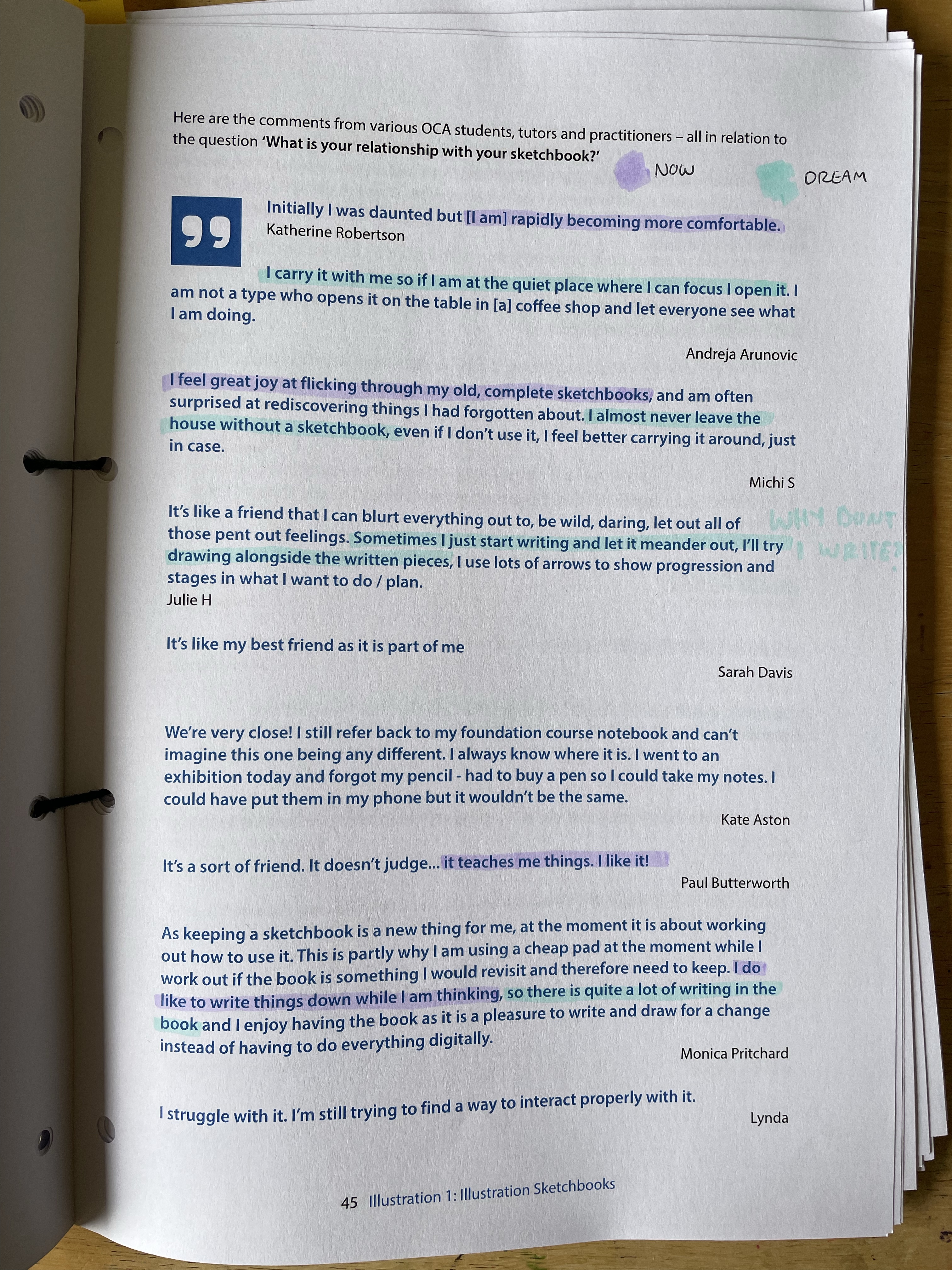
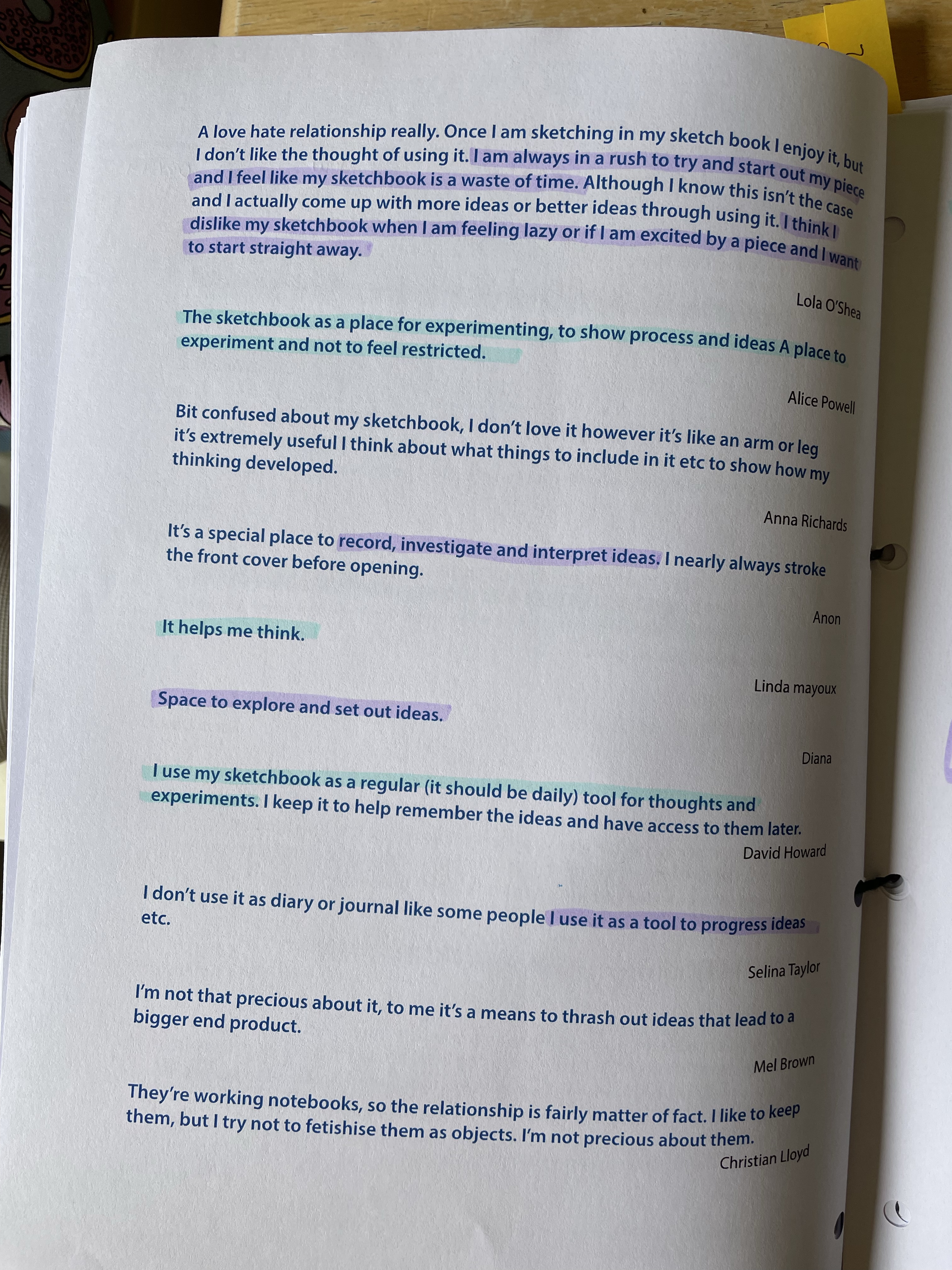
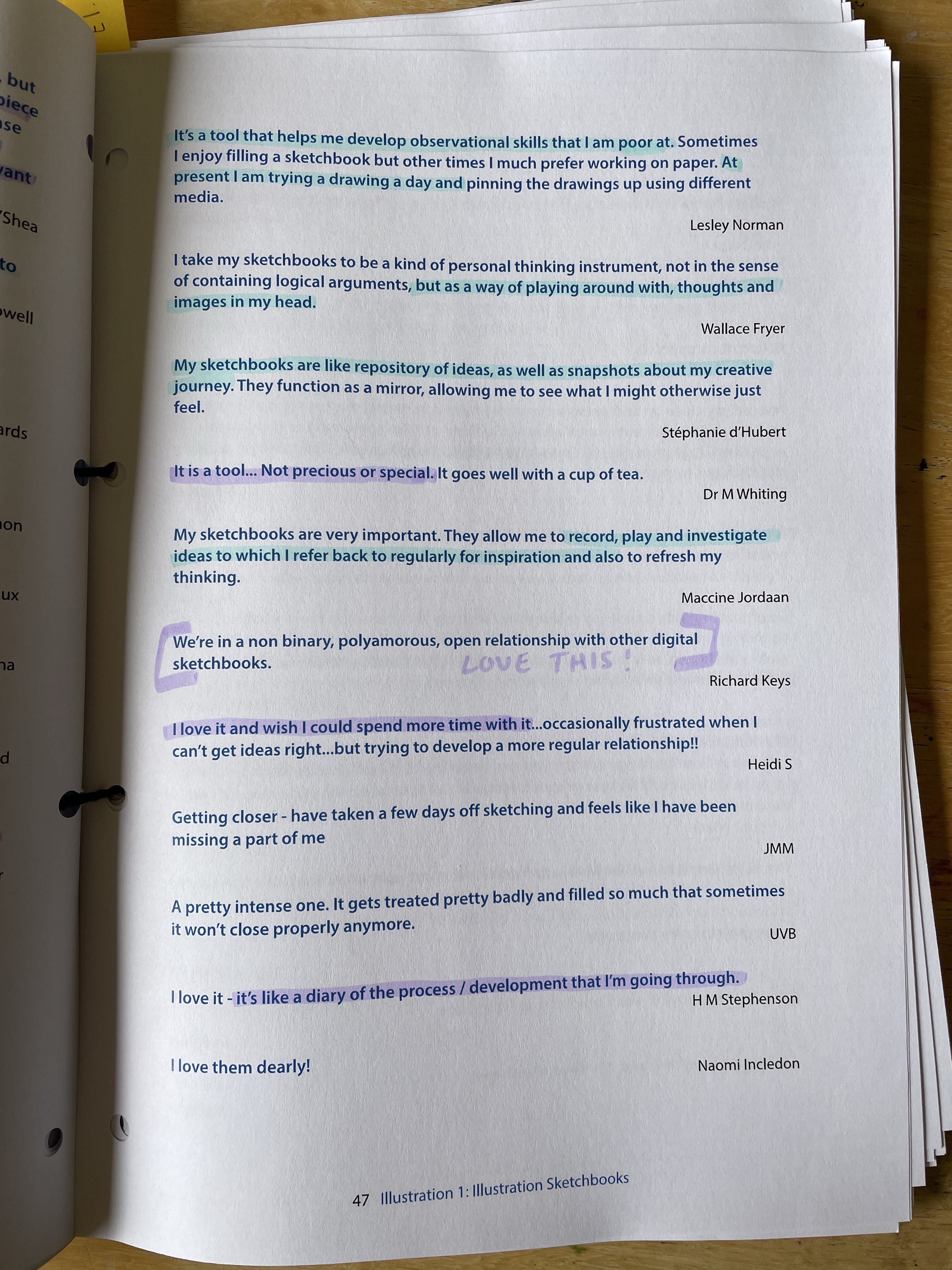
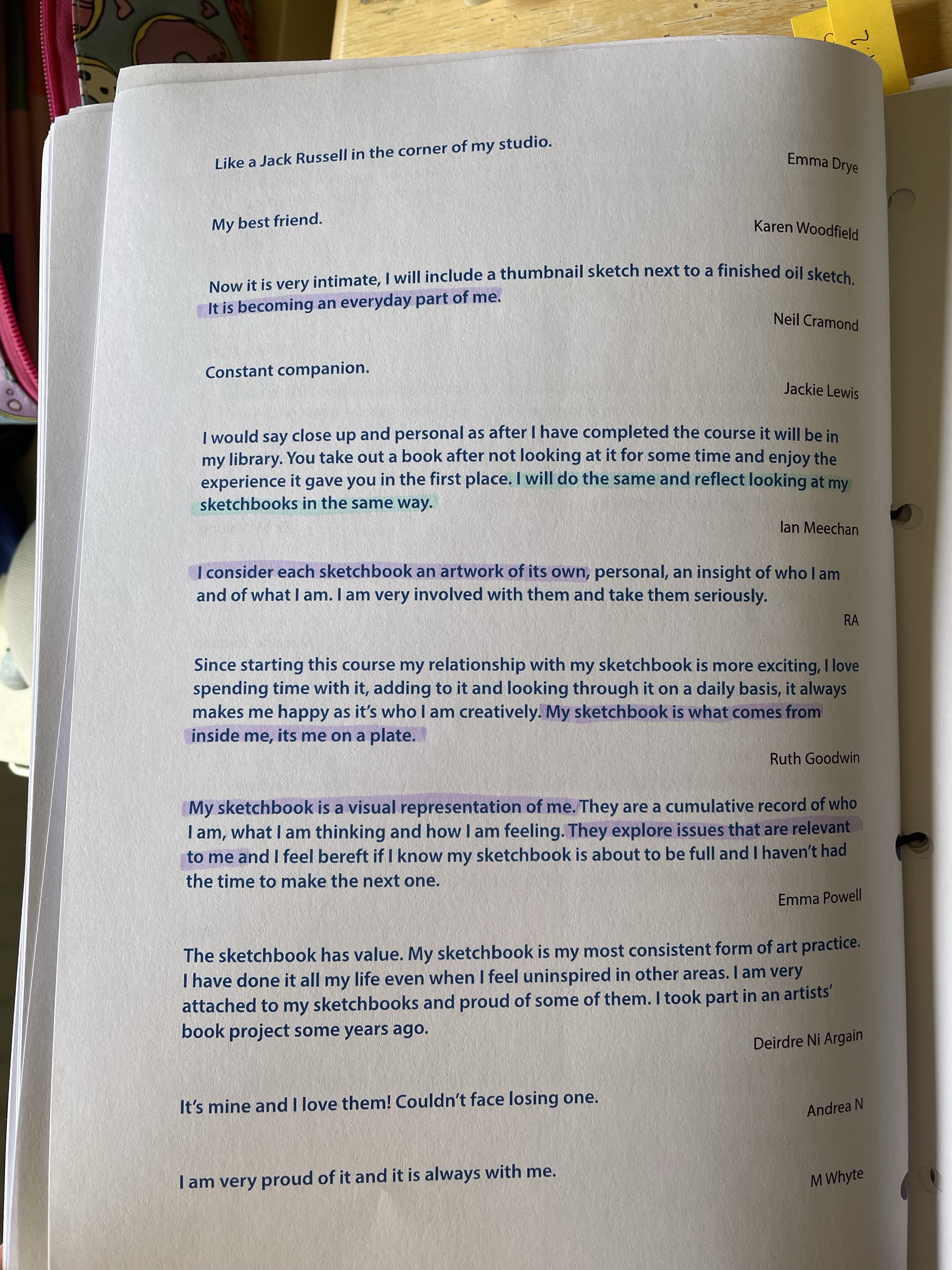
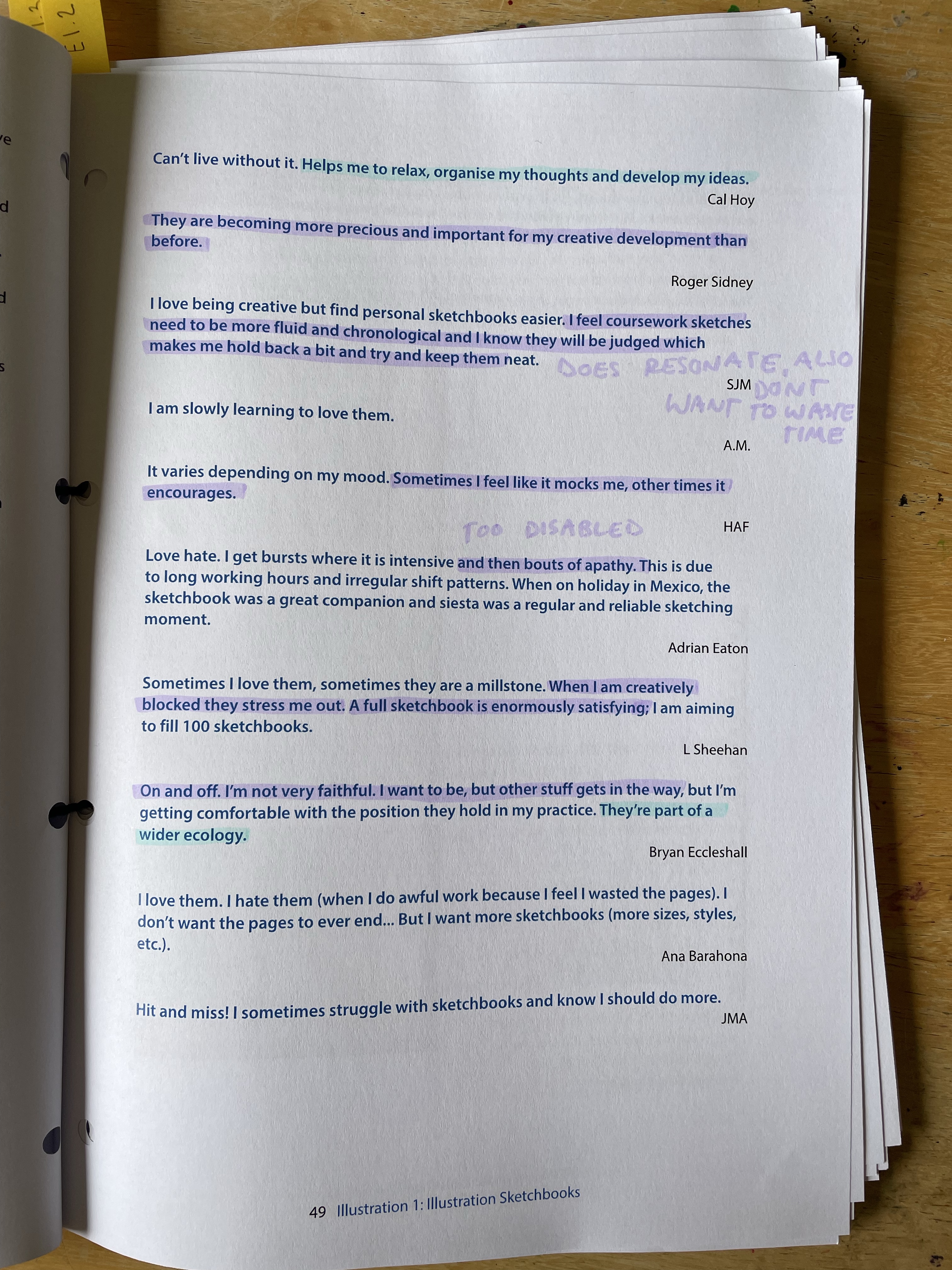
Next, I read over the answers from OCA staff and students and highlighted firstly the things I felt applied to my current relationship with sketchbooks, and secondly the things I aspired to relate to. I related to a lot of snippets of answers, and reading through them gave me a lot to think about. I found there wasn’t as much I wanted to apply to my sketchbook process going forwards, however, this helped me single out really clearly what it is I want to change.
Highlighted sections of the answers from OCA staff and students
Currently, I really enjoy using my sketchbook, but it isn’t habitual, nor does it feel particularly natural. As I mentioned above, I don’t find myself reaching for it nearly as often as I’d like. I actually have lists upon lists in my phone of things I’d like to explore or ideas to sketch out that never end up taking fruition as they’re buried in between shopping lists and important reminders. Every time I use my sketchbook, it is intentional rather than casual. I seek it out because I need to let go of creative energy, or because I need to thumbnail a response to a brief, or because I feel like studying something I struggle drawing.
This isn’t an inherently bad way to use a sketchbook, but it’s not one I’m overly happy with. Right now, it feels as if there’s a disconnect between me and my sketchbook. It’s distant and detached, a solid ‘thing’ with no real integration in my life. One of the answers I most resonated was by Lola O’Shea, who said ‘I am always in a rush to try and start out my piece and I feel like my sketchbook is a waste of time’ and that ‘I think I dislike my sketchbook when I am feeling lazy or if I am excited by a piece and I want to start straight away’. This really stood out to me as it’s often my issue with using my sketchbook. It feels boring and pointless a lot of the time, and often I find myself procrastinating it as long as I possibly can.
Most of the highlighted portions for how I currently feel discuss using the sketchbook as a tool, as something to process ideas in, to learn from, and to go back over once completed. The idea of having a bookshelf full of completed sketchbooks that I can use as my own reference material when exploring future projects is appealing to me. In order to make this possible, I feel I need to stop having such a casual and detached relationship with my sketchbook.
First off, I want to use my sketchbook every day where possible. I have many reservations around this as the nature of my chronic illnesses means my energy is very precious and carefully managed. I am concerned that by trying to use my sketchbook every day, I will be limiting what other things I have energy for or unnecessarily using that energy on sketching when I should be focused on other things. After some thought, I realised that it would be interesting to see what I create when I put as much energy as I have to spare into my work. It won’t be ‘good’ per se, but it could create an interesting commentary on life as a chronically ill person.
Secondly, I want to take my sketchbook everywhere I go and try to remember to get it out of my bag and actually use it. I want to start developing a habit of going to my sketchbook whenever I have an idea, rather than writing it down in my phone. I think this also ties into my energy levels – I’m afraid that the energy needed to draw/sketch out a thought or idea is greater than the energy it takes to write a note in my phone. I could instead be using that energy to cook food for myself or socialise.
I also want to use my sketchbook to achieve long and short term goals, such as those outlined in my introduction to this unit. I want my sketchbooks to be a catalogue of my artistic development and progress and be easily accessible for me to go back through and learn from. I’d also like to maybe write more in my sketchbooks. This feels almost taboo to me. I am naturally a writer, and I can verbalise my thoughts and feelings rapidly and with great comprehension. I always have a notebook with me, and I have pages upon pages of scrap paper filled with notes all over my home. I often struggle with translating those notes into visual representations, so I have constricted myself to not write in my sketchbooks where possible.
Whilst growing up, I’m pretty sure that I was discouraged by art tutors from writing in my work, perhaps because I did tend towards it over visual representation, and I have internalised it as ‘writing in my sketchbook is bad’. My current relationship with text in my art is pretty good, I enjoy typography, and I do incorporate words and language into my art currently, but I never just write. I don’t know if I would like to always write in my sketchbooks, but I’d like to remove the feeling that it’s ‘bad’ or ‘wrong’ to do so. I could easily write pages upon pages in my sketchbook some days, maybe doing so would actually encourage and propagate art.
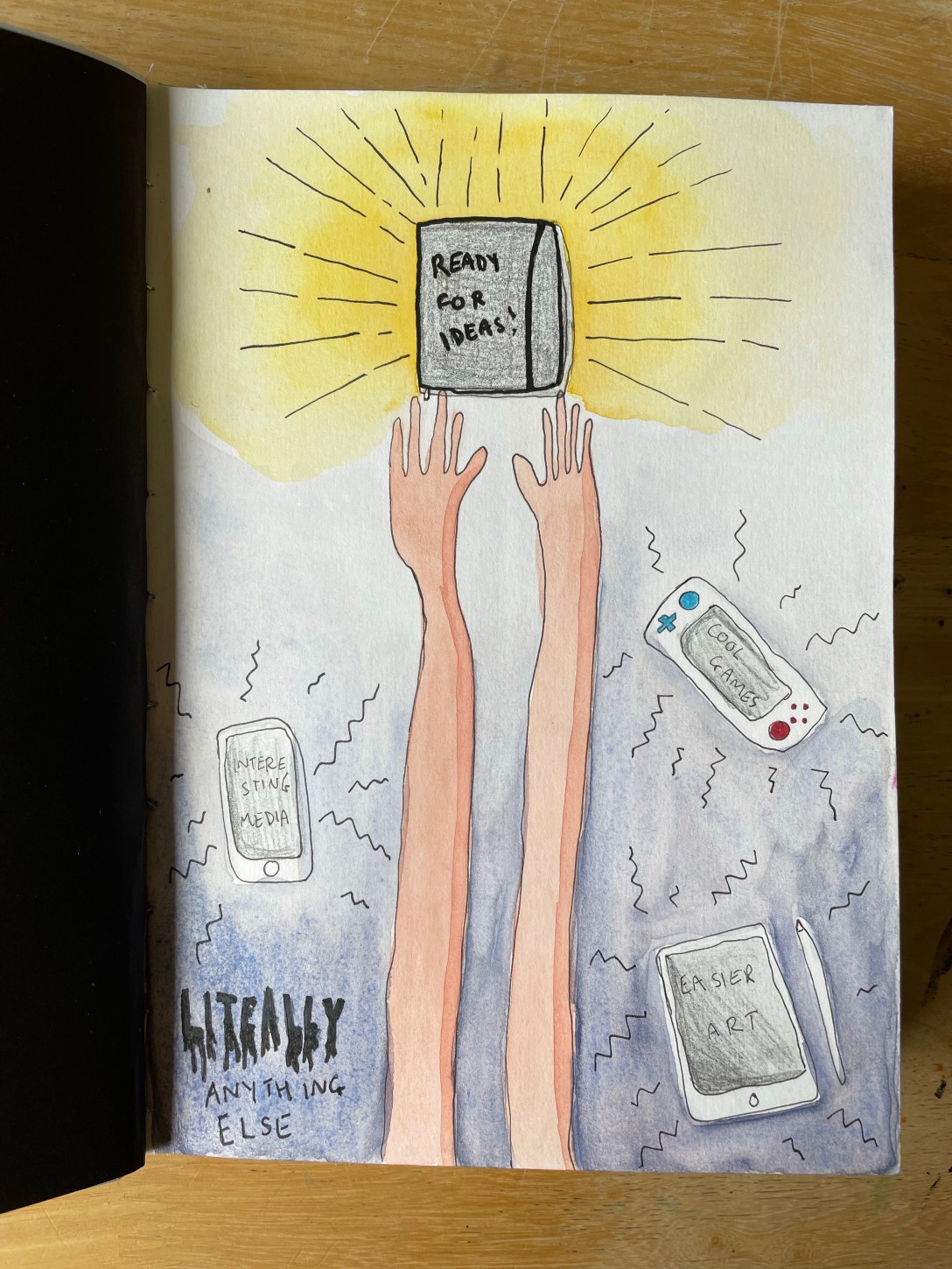
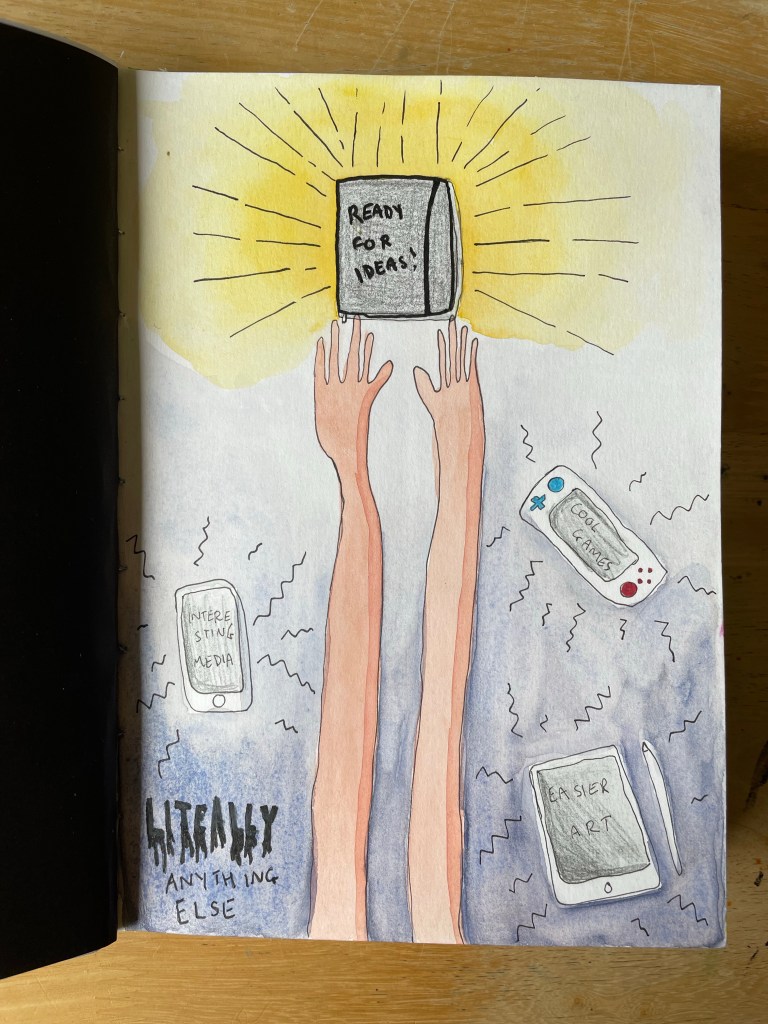
A visual response to the question ‘what is your relationship with your sketchbook?’
I spent a lot of time mulling all of this over and found myself quite inspired when it came to creating my visual response. At the time, I was feeling extremely detached from my sketchbook, and I had very little motivation to actually create. The piece I have ended up with is a pretty brilliant representation of my relationship with my sketchbook as it stands. It feels far away, impossible to reach, and there are just so many other more interesting things I could be doing instead. Reaching for it is sometimes a battle, but it’s one I’m slowly overcoming.
This exercise has made me feel even more excited about this unit. Identifying these feelings and how I want to work as an artist is really eye-opening and useful. I’m also surprised at my ability to visually respond so easily to this prompt, as I jumped straight in with a fineliner and watercolour and created something I’m happy with. I hope that over time I’m able to have a more entangled relationship with my sketchbook.
As a part of Exercise 1.0, I decided to make my own sketchbook to use during part 1. I have had experience doing this in the past – when I was younger, I made a couple of sketchbooks with my mum, and during Key Steps in Illustration, I made a sketchbook for Exercise 8. The sketchbooks I made as a child were stitched and bound using cardboard, but the one made in KSI was rougher and simply tied together using wool through punched holes. I am fascinated with the art of bookbinding; it seems mesmerising and beautiful the way it all comes together. I spend a lot of time watching videos of bookbinders at work, and I was itching to give this a go myself.
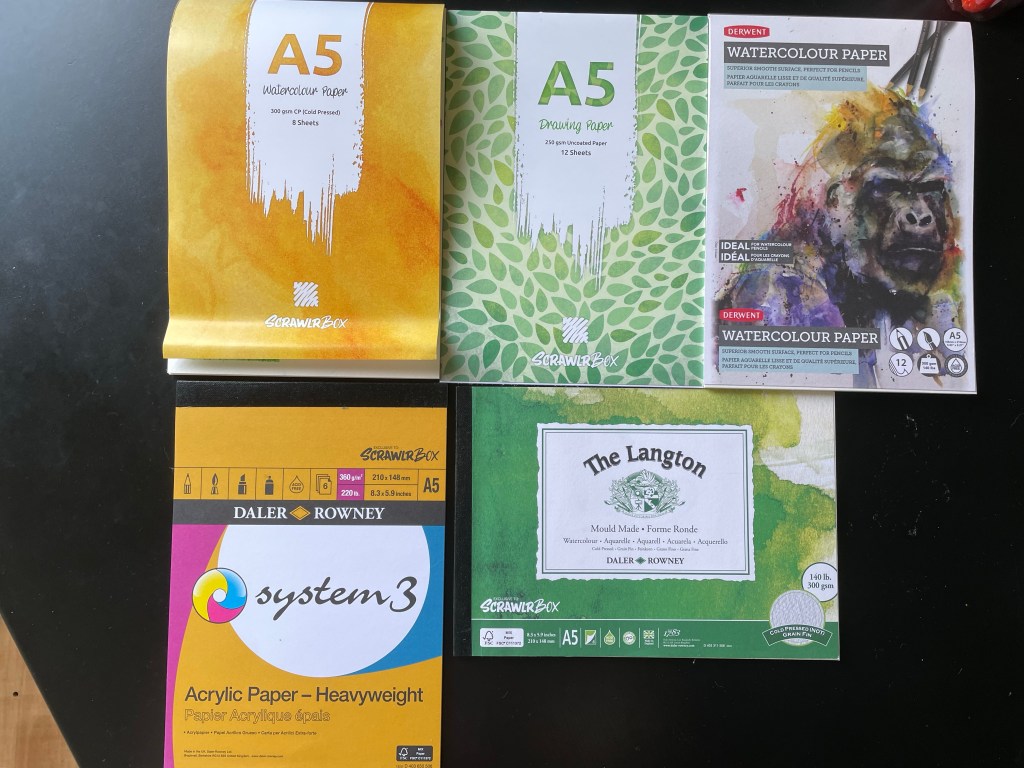
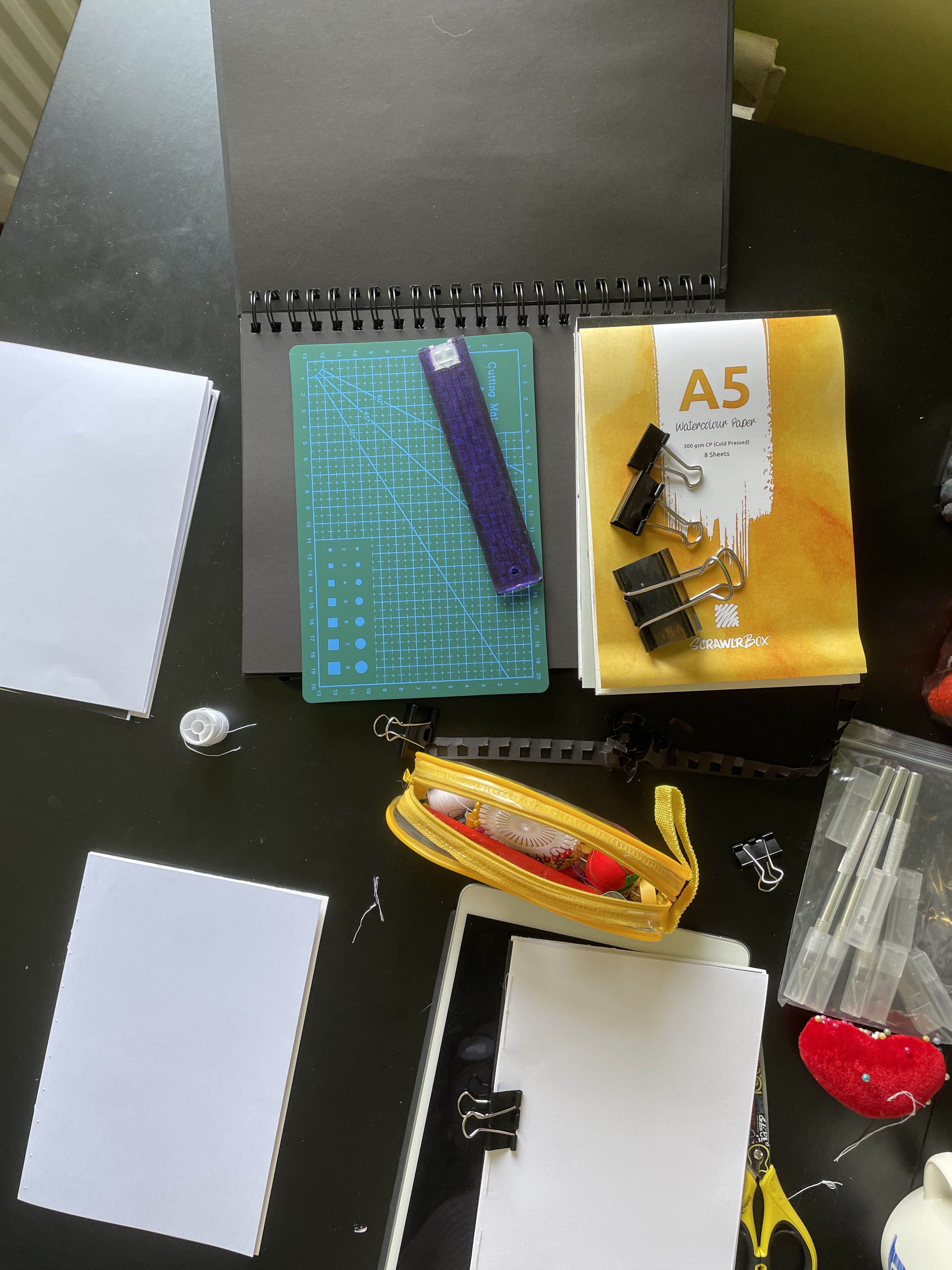
I have accumulated many different types of paper throughout the past year or so to try out and use in my art. The least used of these are the A5 sample pads I have received as part of a Scrawlrbox subscription – each box includes a handful of art supplies and a surface to use them on. As these are sample pads, they are small in dimension, and there are only 8-12 pages in each. I have felt reluctant to ‘waste’ the paper, resulting in them collecting dust. A few weeks before I set out to make this book, I wondered what I could do to use the paper. I decided to take a page from each of the pads and use those to make my own book!
5 of the 6 pads of paper I used in my sketchbook – the sixth did not have a cover so I left it out of the image
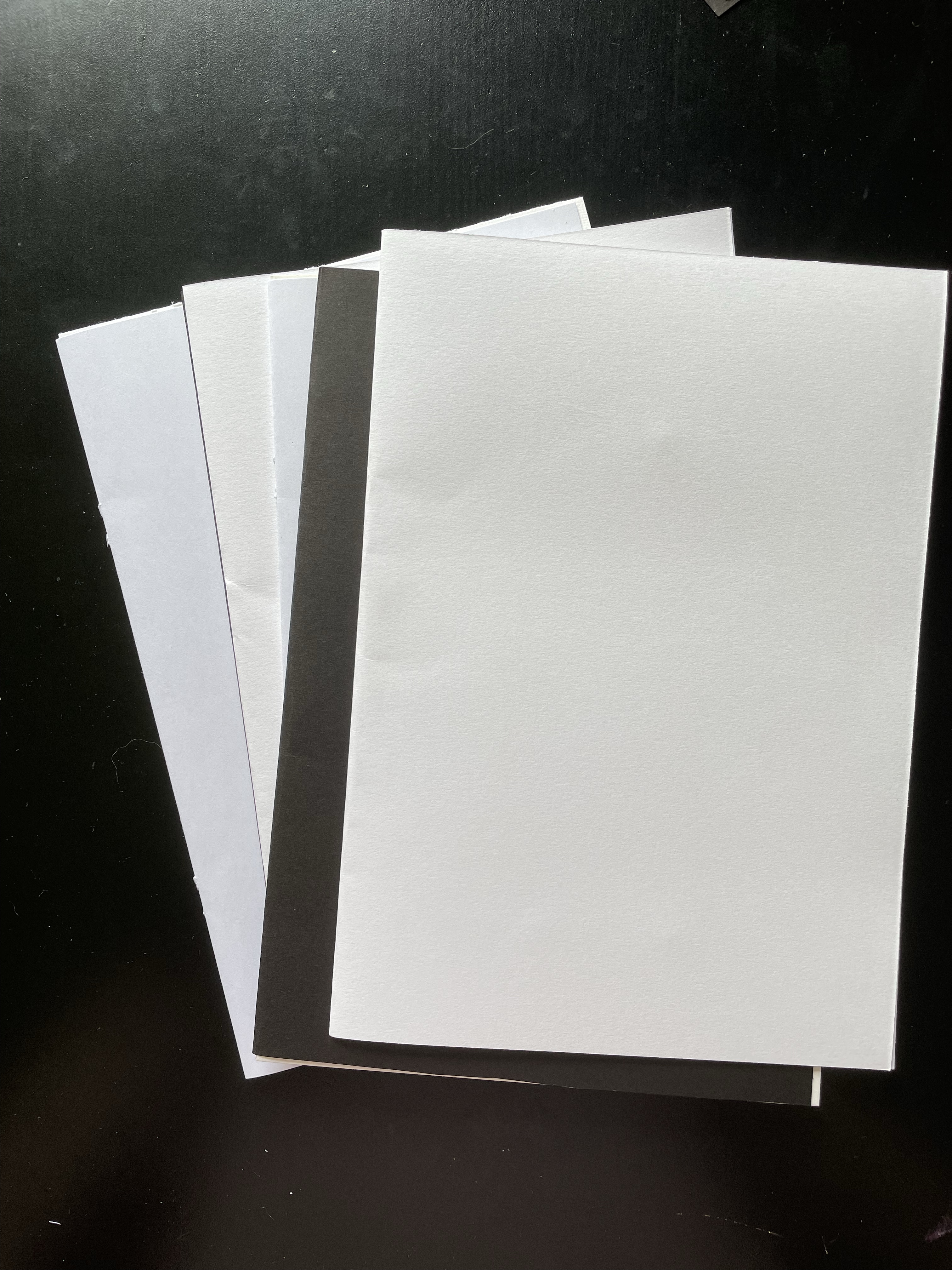
As discussed in Exercise 1.0 – I crave variety and change in my sketchbooks. I like lots of different textures, colours, and possibilities within one book. I like seeing how a range of mediums work on varying pages and being pushed into using specific ones due to the paper’s qualities. Here I had six different types of paper ready for me to explore. I decided to also buy a sketchbook containing black paper to add to the book for some colour variation. This plan seemed perfect to me, and I was very excited to get going!
I wanted my sketchbook to be A5, so the paper already being this size saved me a step. One of the pads was of A4 paper folded into A5, and the black sketchbook was A4 too, so I decided to use these to wrap my pages. I then removed 2-3 pages from each of the sketchbooks and began randomly organising them. I wrapped two pieces of A5 paper in a sheet of A4. I had quite a few sheets spare, and I also realised that all of my paper was heavyweight. I decided to add some cartridge paper to the mix to ensure I had space for ‘just’ drawings. This paper was A4 too, so it served as a wrap for the remaining pieces of paper.
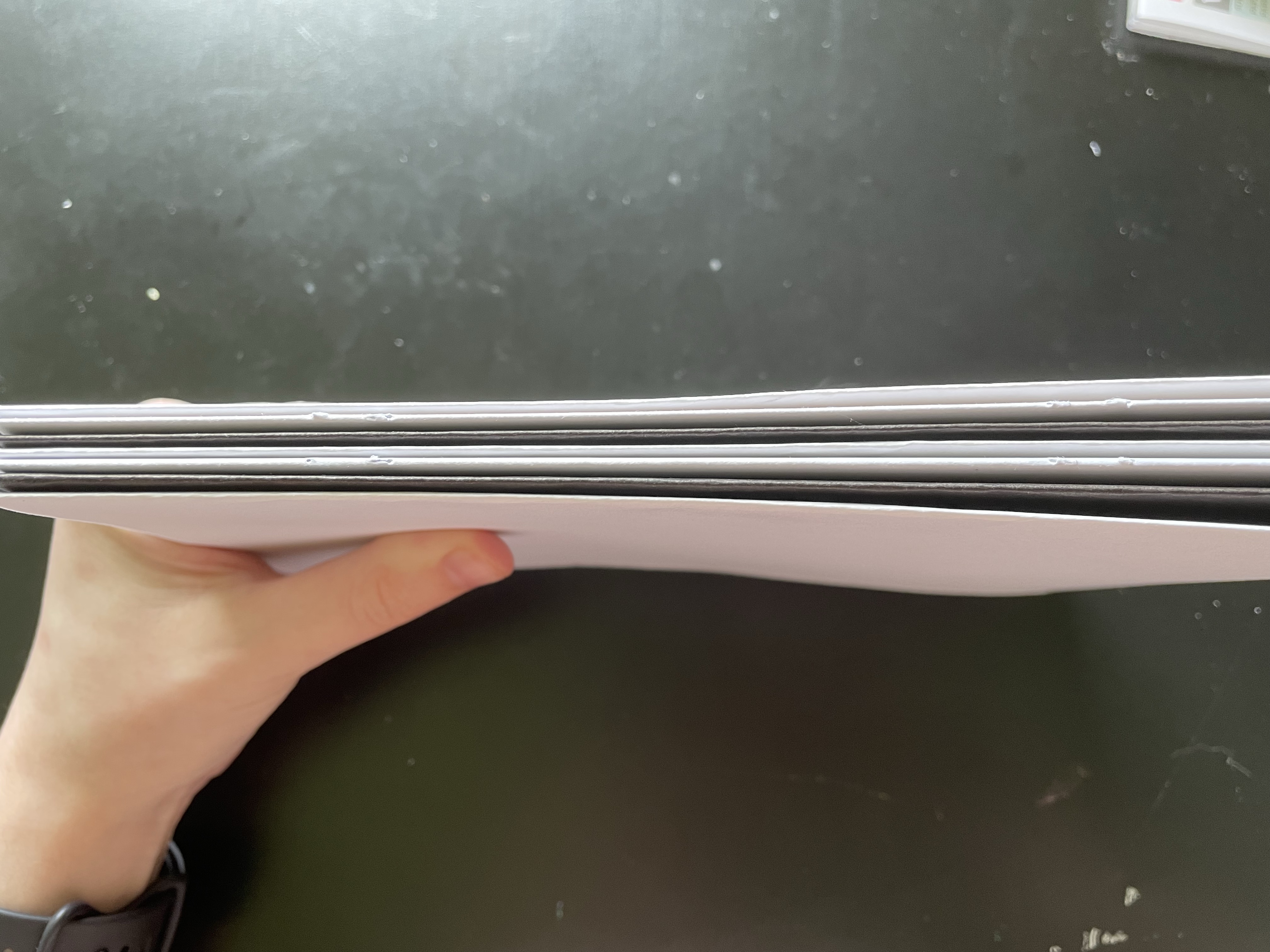
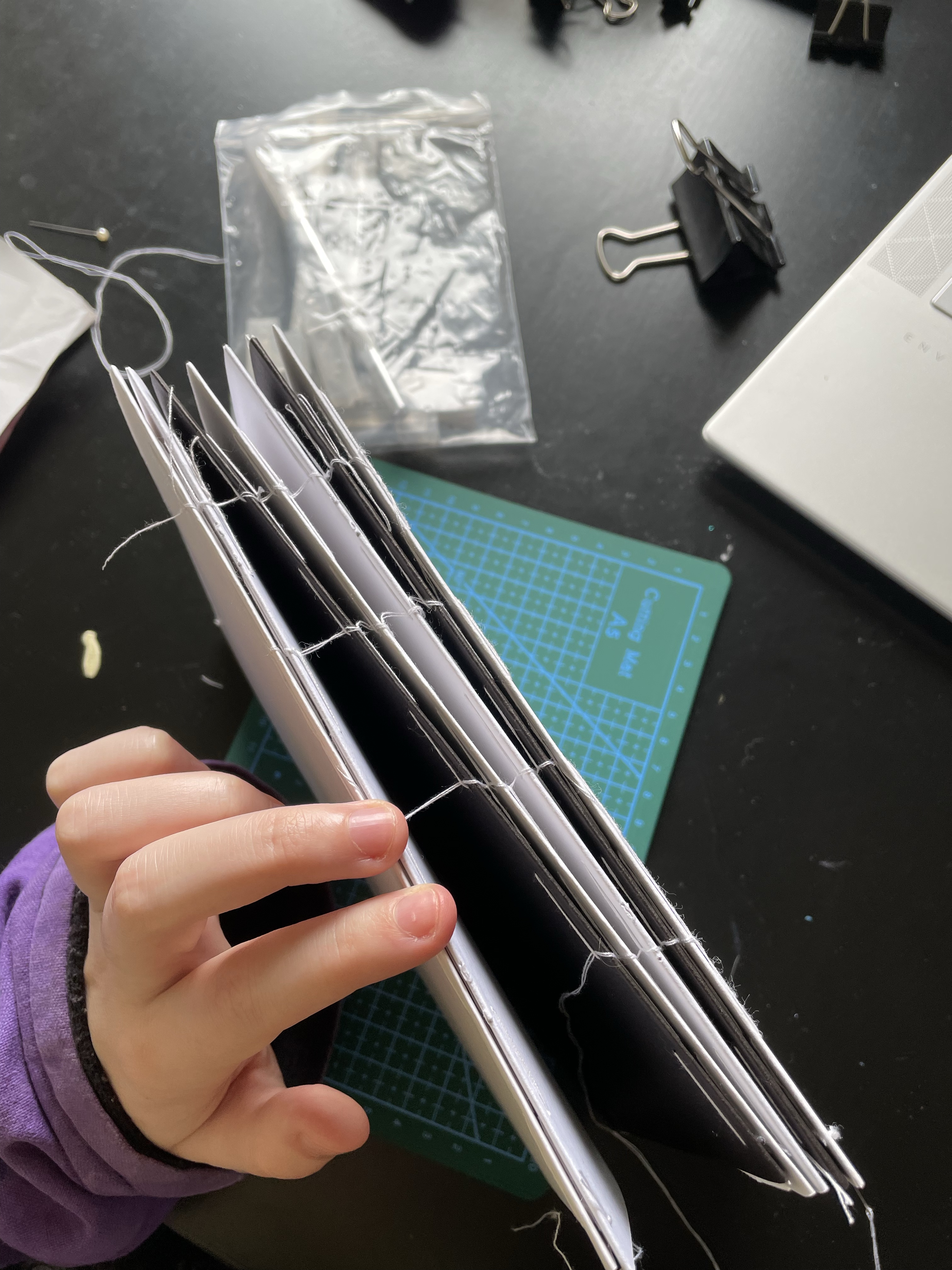
This left me with seven total signatures for my sketchbook. I was fairly confident I knew what I was doing, but before starting with stitching them together, I decided to watch this video on kettlestitch binding – the style of binding I intended to do. Within the first few minutes, I realised in horror that there was no way to secure together my A5 sheets to their A4 wraps. I decided to just start making it up as I went along, feeling confident that I knew enough about bookbinding to ensure it wouldn’t be a disaster.
My seven signatures
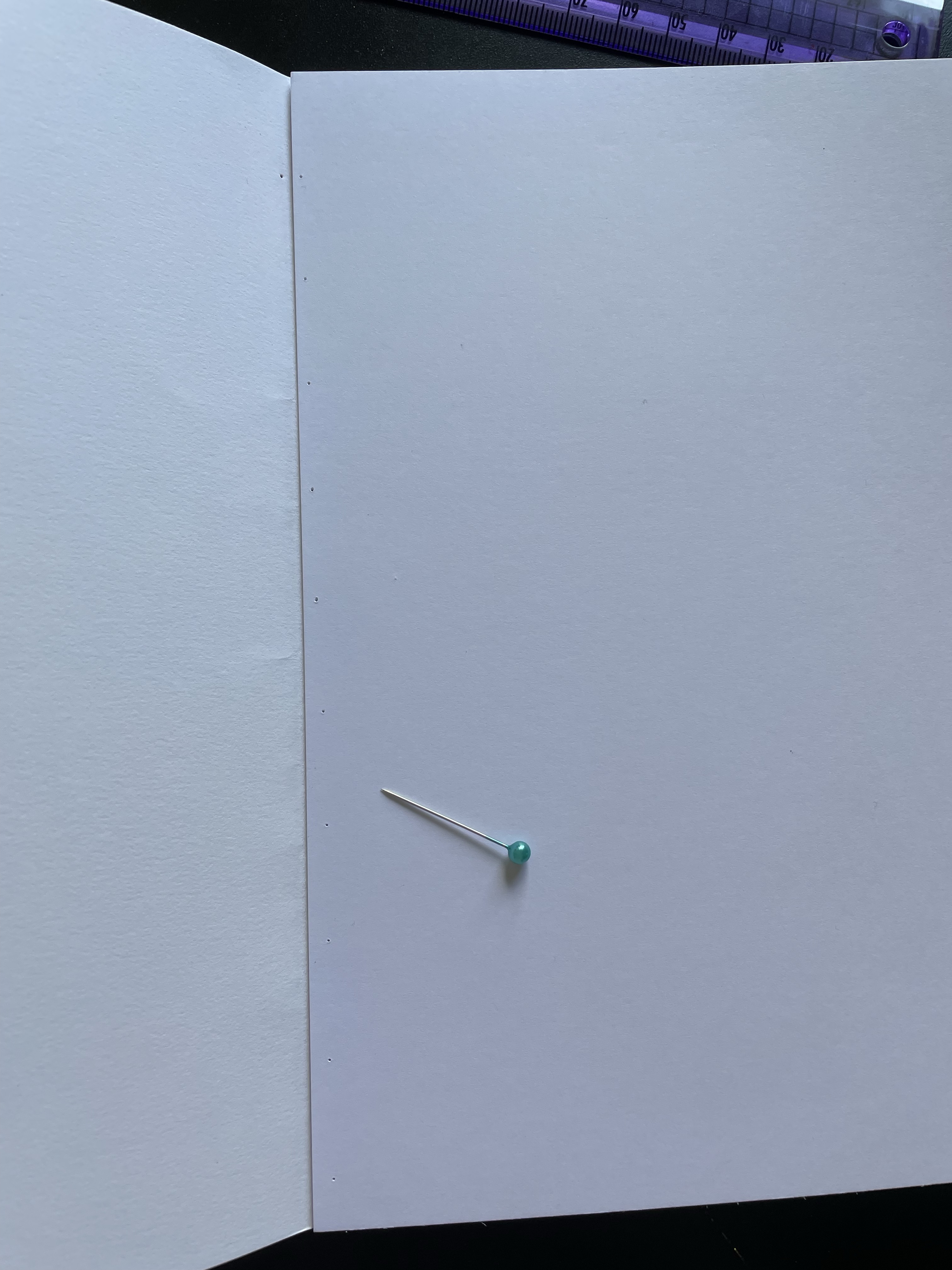
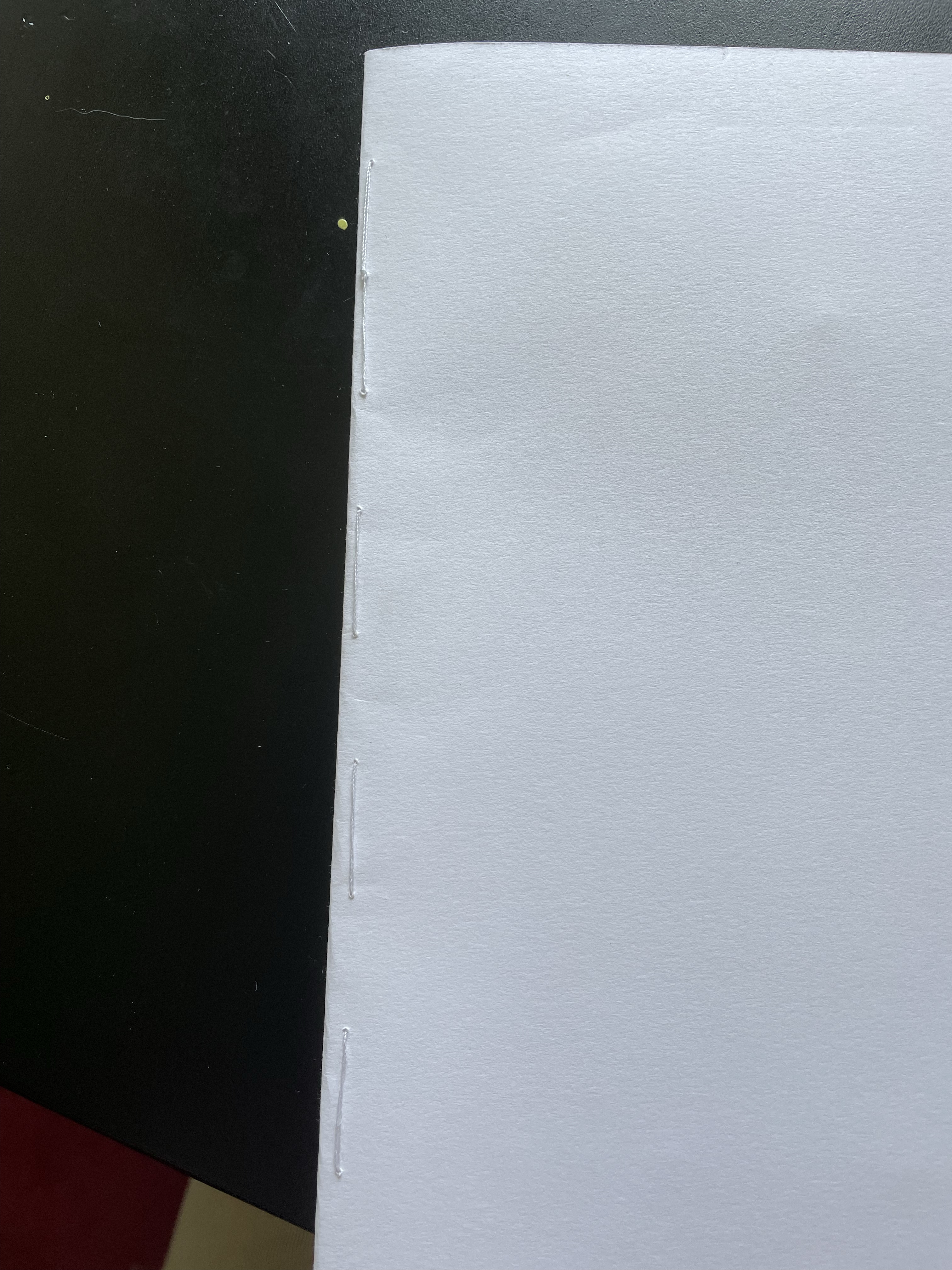
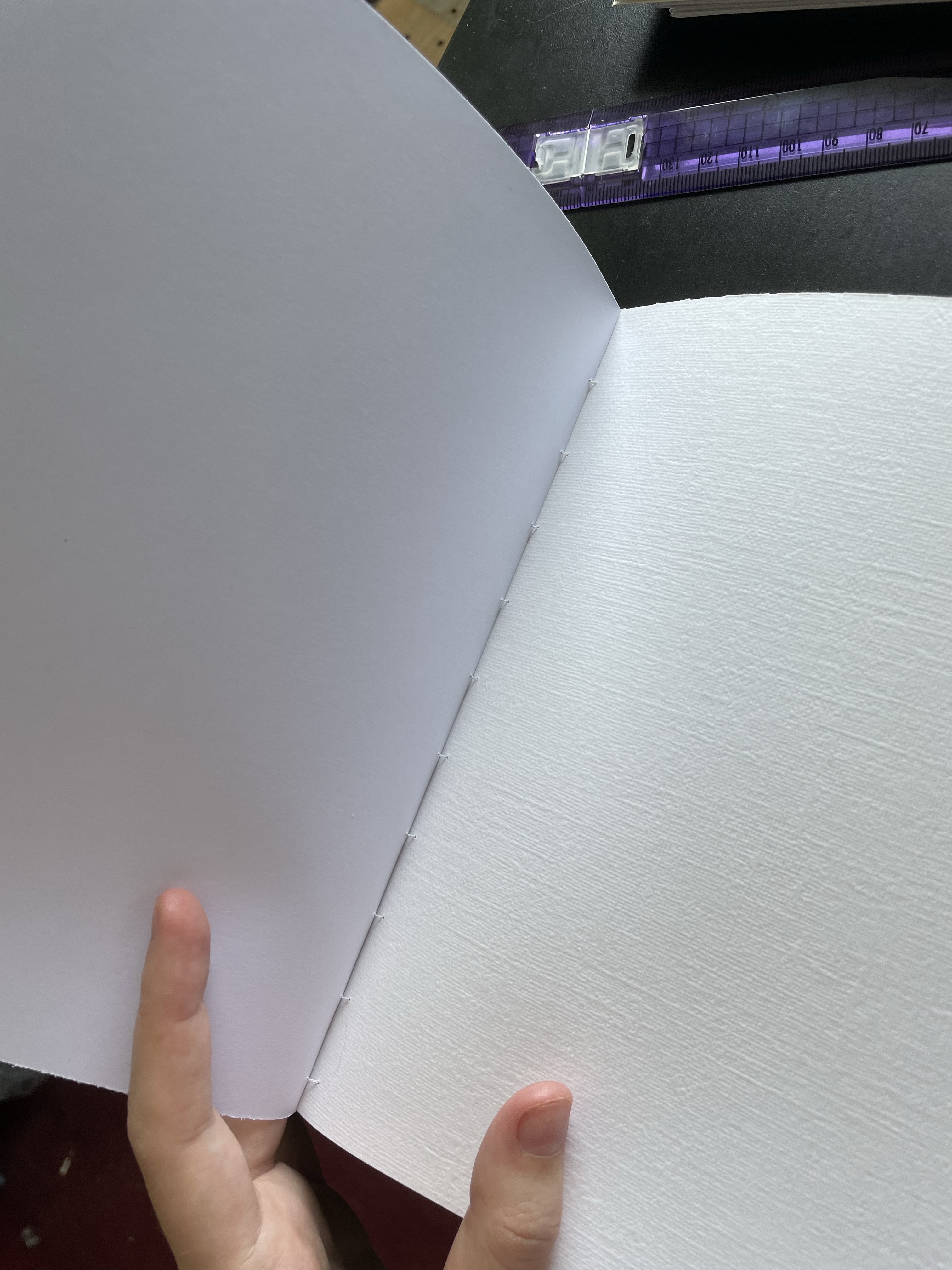
I began by poking equally spaced holes in each of my pages. I then stitched together each individual signature to ensure the internal A5 pages were secure. After this, I used a bulldog clip to secure the pages, and I stitched through the pre-existing stitches of all seven signatures, binding them together. I referenced the aforementioned kettlestitch tutorial a handful of times for inspiration, and I ended up with a sort of half kettlestitch. After doing this once, I decided to add a page on either side of the sketchbook that I could glue to the cover. I used some old wrapping paper I had lying around for this as I thought it would add some colour and interest to my book.
Stitching each signature together individually, then altogether
I cut 2 A4 sheets from the wrapping paper and folded them inwards so that the pattern would show once it was stuck to the casing. I then poked holes in the folds of each of them and repeated my earlier process of stitching through the pre-existing binding, this time including the decorative paper. Once finished, I started preparing for the cover to be added. My book felt very flimsy at this point, and I was concerned it would fall apart. I had been entirely confident the whole way through that it would ‘just work itself out’ – and only now was I starting to fear that my make-it-up-as-I-go approach was a mistake.
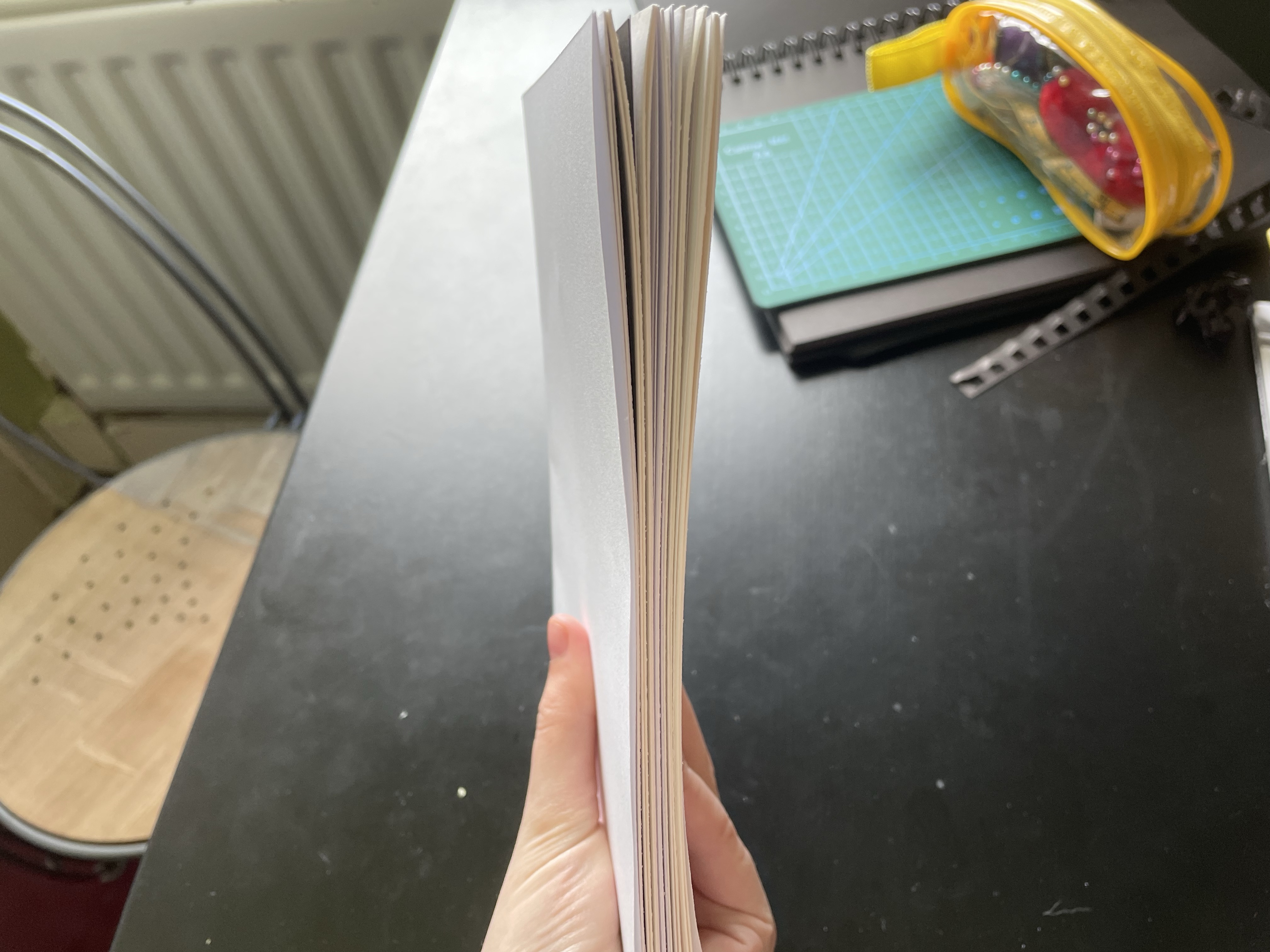
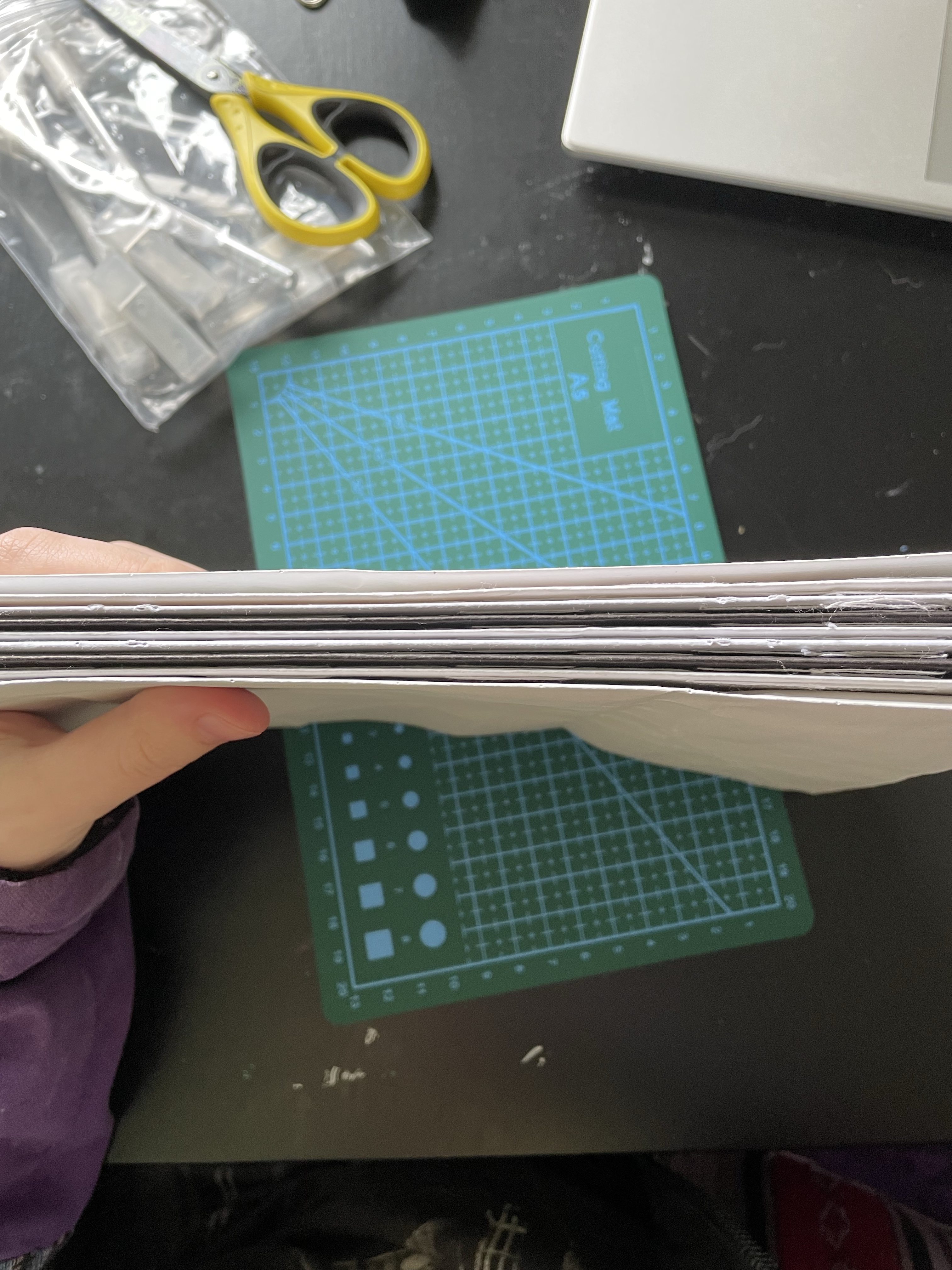
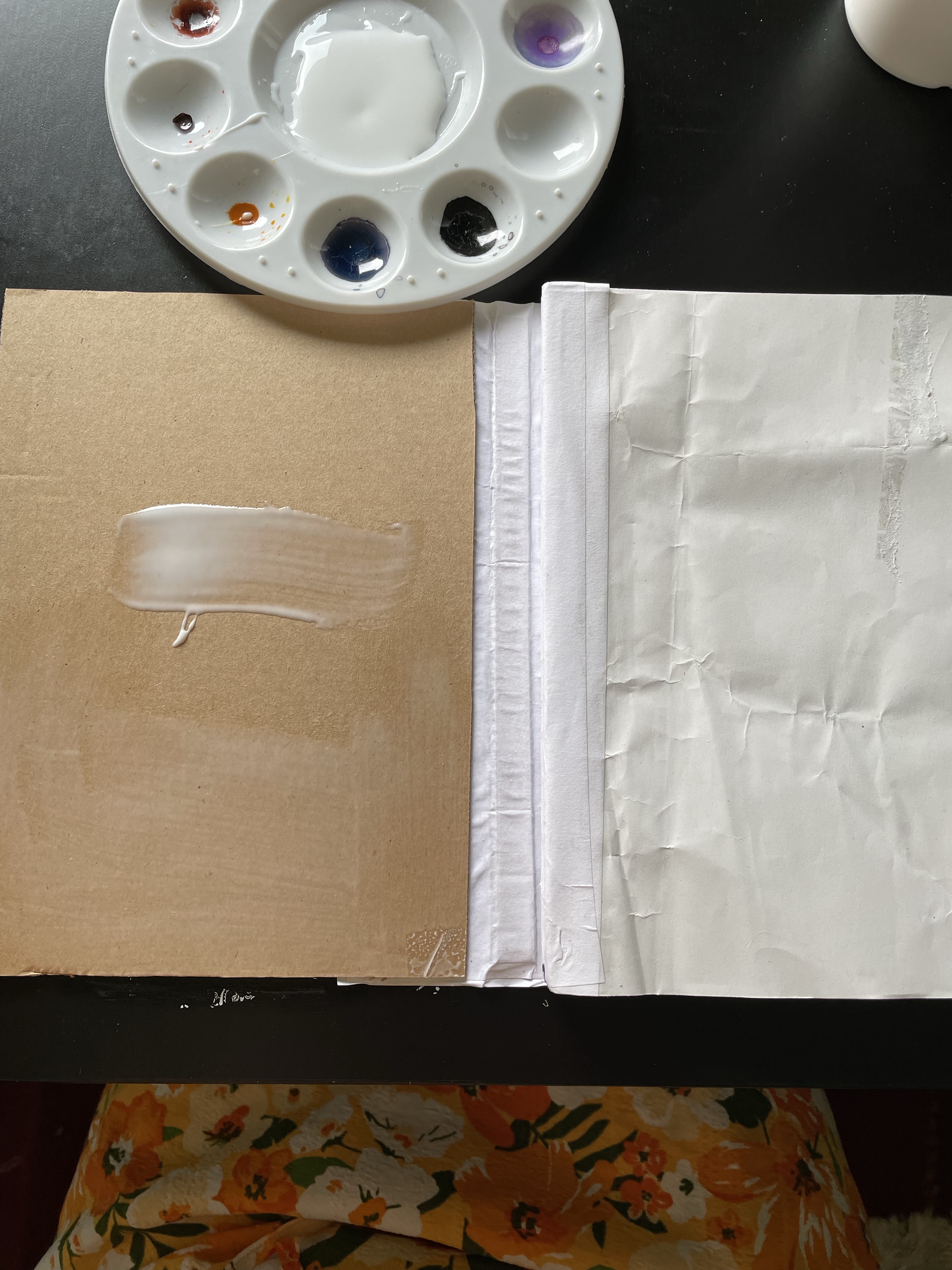
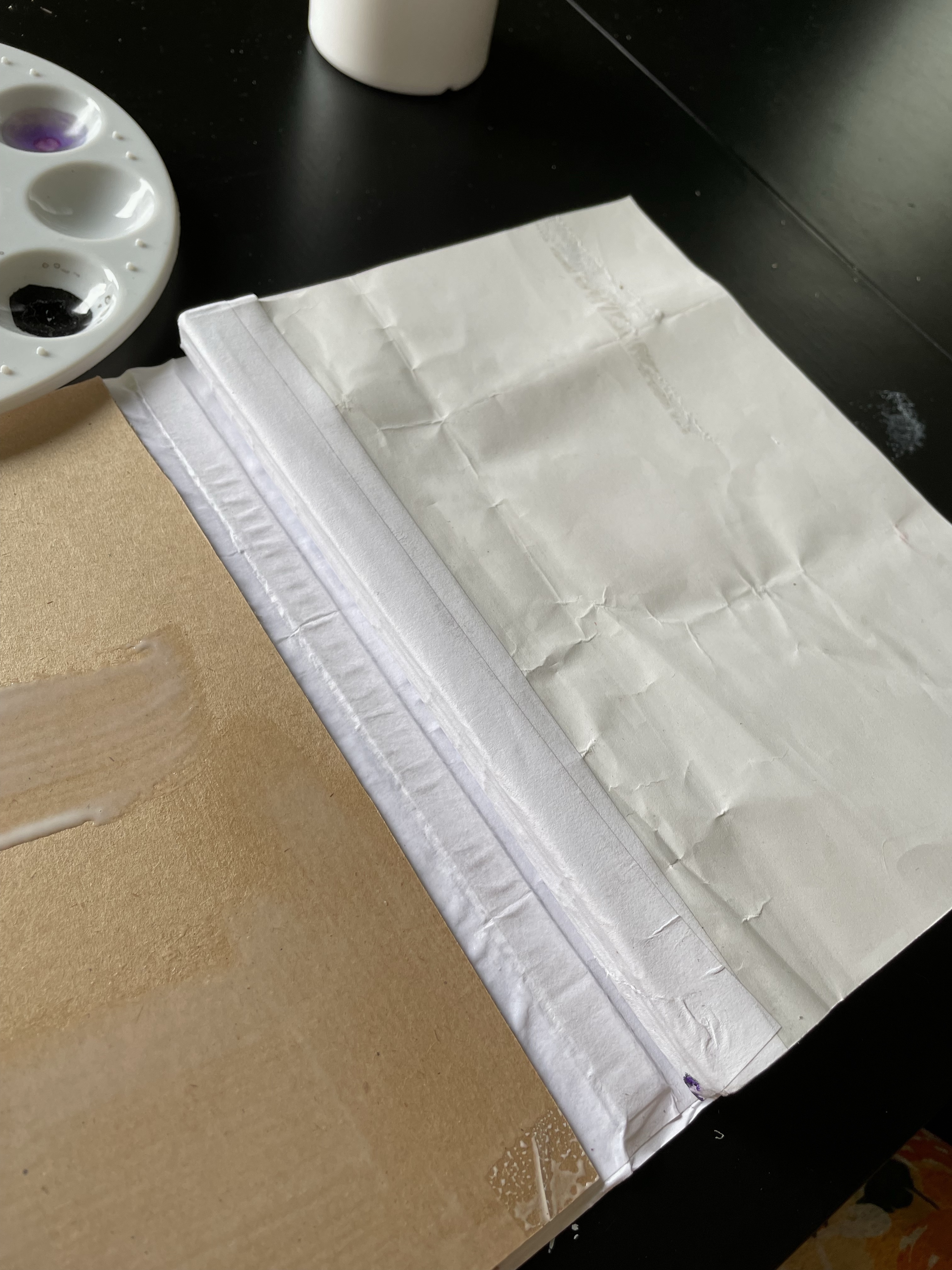
I cut two plain A4 printer paper sheets to glue down onto the binding and secure it in place. I very generously covered both the paper and the binding in glue to do this and learned that printer paper is tough to work with when soaked. After the first layer had partially dried, I added the second one, and then I prayed. Adding the mess of glue soaked printer paper onto the flimsy, sliding around, poorly bound signatures seemed like a recipe for failure. Nervously, I secured the pages with a bulldog clip, then left it overnight.
The following day I was extremely shocked when I found that the book was suddenly super secure and – joyfully – felt like an actual book! For the first time, I could see my vision coming to life. I was so excited. The glue had made the book sturdy, and the paper had solidified completely. The pages turned as they should; everything was falling into place.
Adding the cover
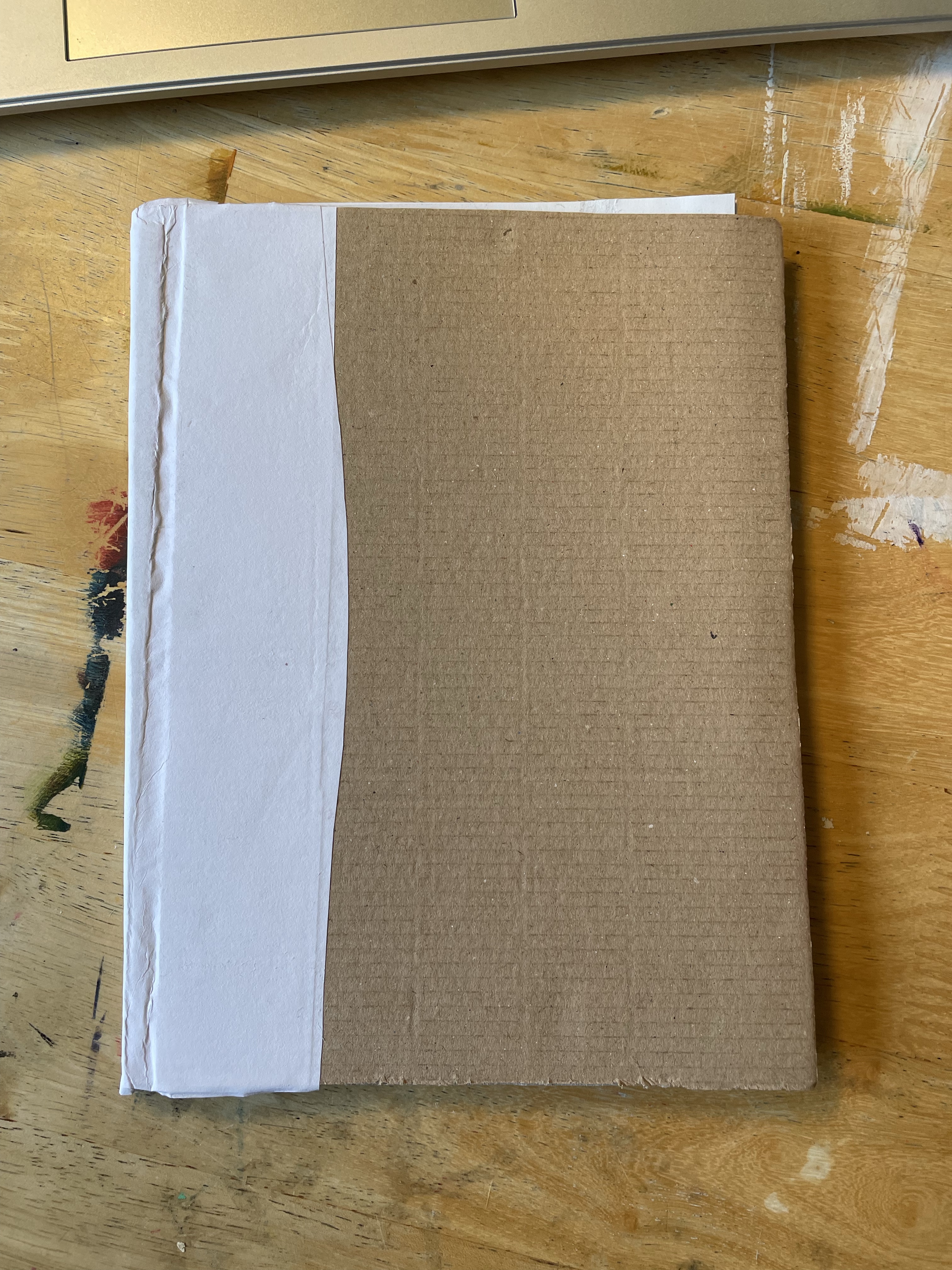
Next, I decided to cut the cardboard I would use for the cover. I used some spare packaging for this, and I made sure to choose a sturdy piece. I cut two pieces slightly larger than my book and a thin piece for the spine. Once again, I took two pieces of printer paper soaked in glue and used them to secure the two pieces with the spine. I placed the spine in between the two sheets of paper as it was so small I thought it would come apart otherwise. Once dry, I coated the inside of each piece of cardboard in glue and stuck down my inner decorative layer to the cover. My book, very excitingly, was complete.
Somehow whilst sticking my pages to my cover, I completely missed the mark, and the whole thing was lopsided. I was gutted. After days of work, the entire thing was a mess. The spine was bent around to the front of the book, and the cover was visibly wonky. After pressing the book and allowing it to dry, I went at it with my craft knives to see what I could do. I trimmed off any major wonkiness and found that it wasn’t so bad after all!
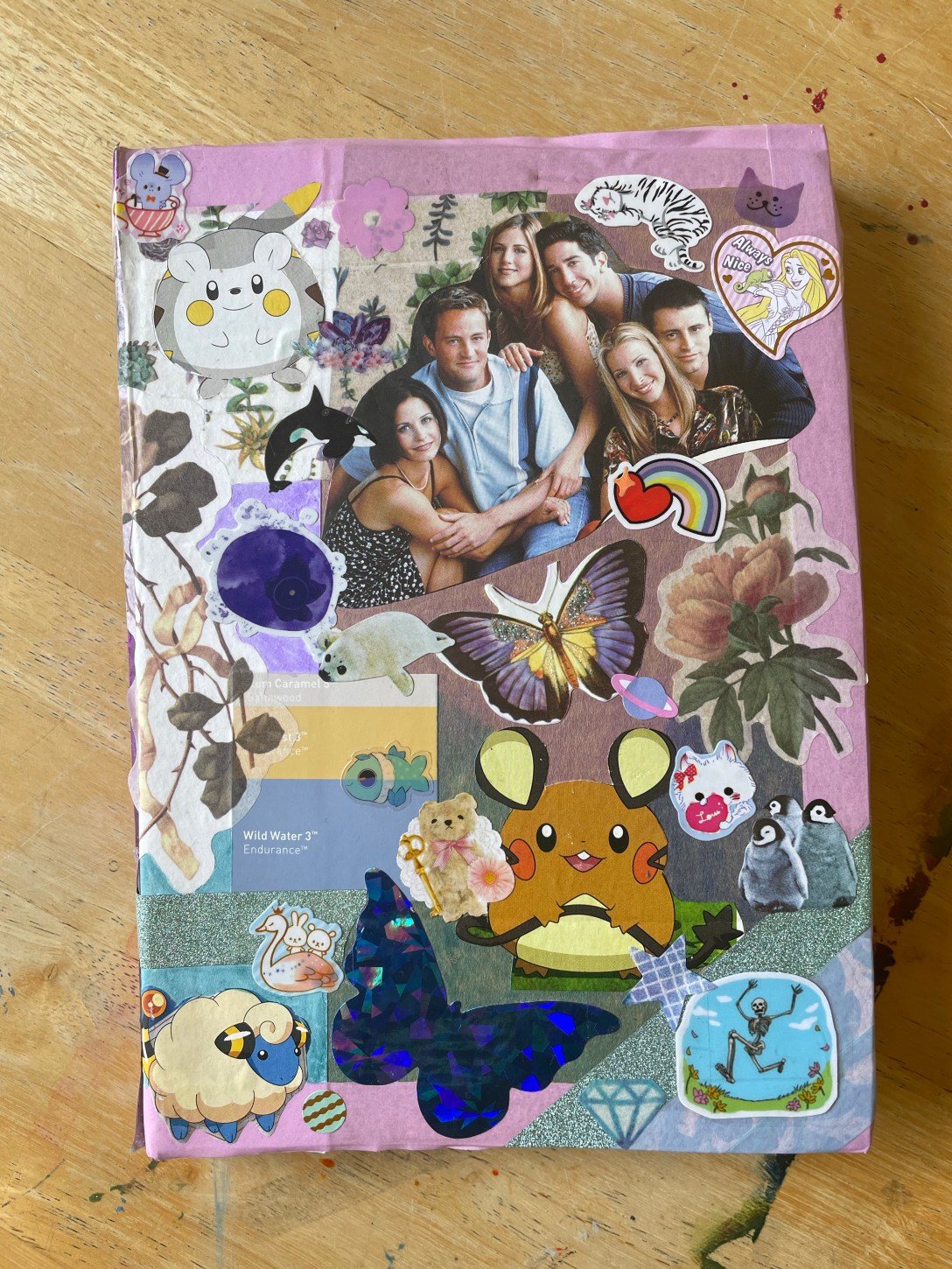
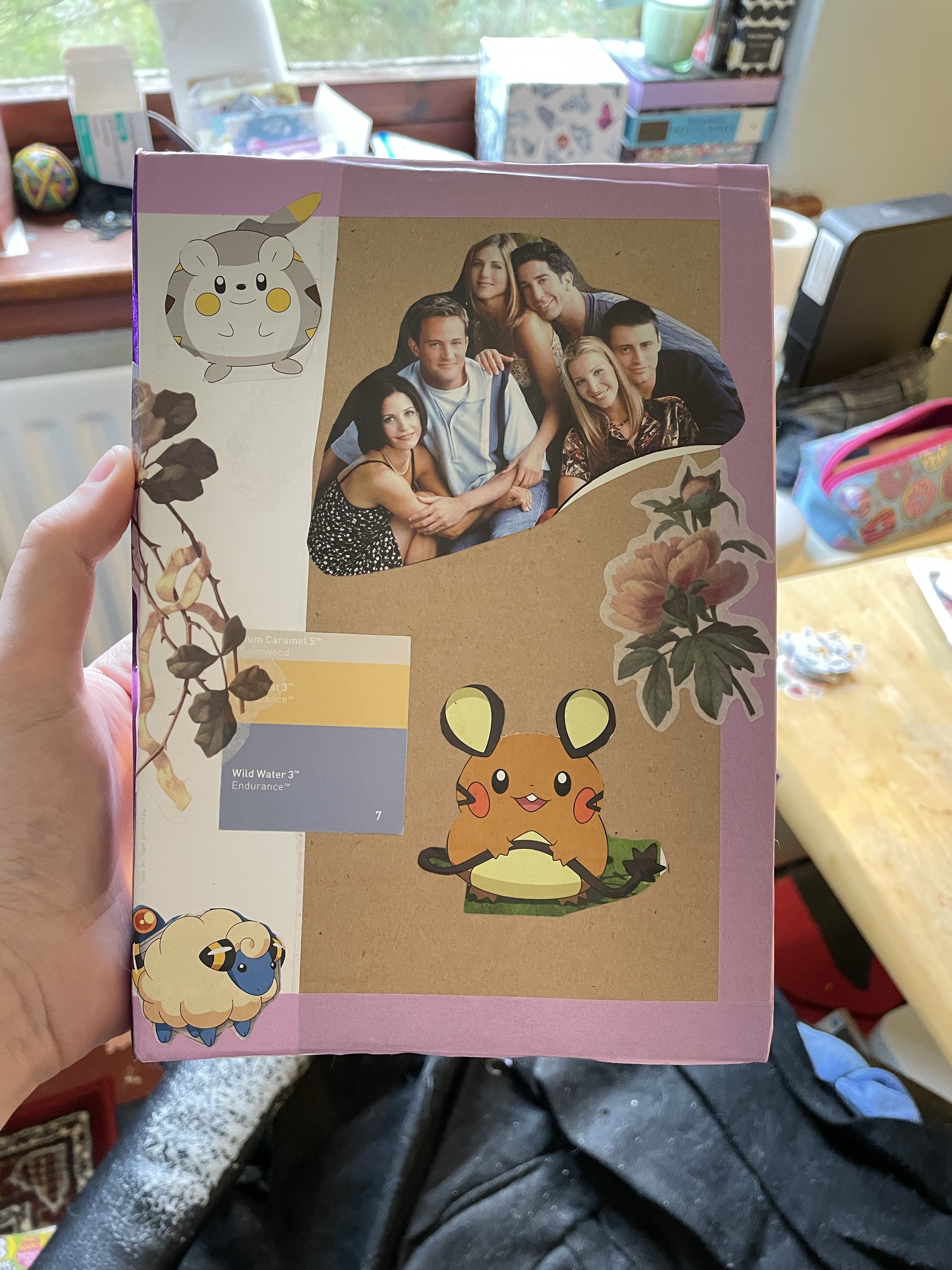
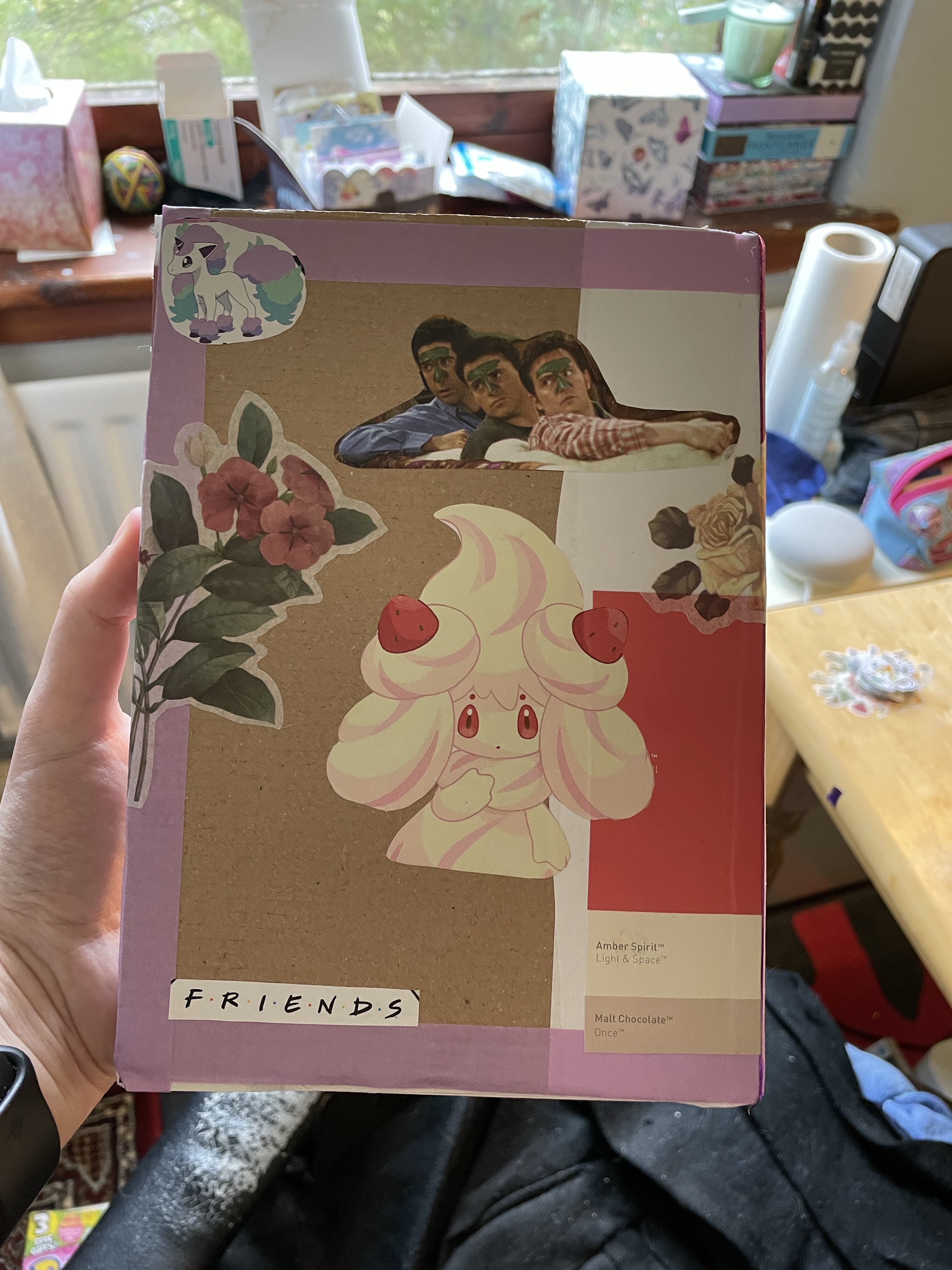
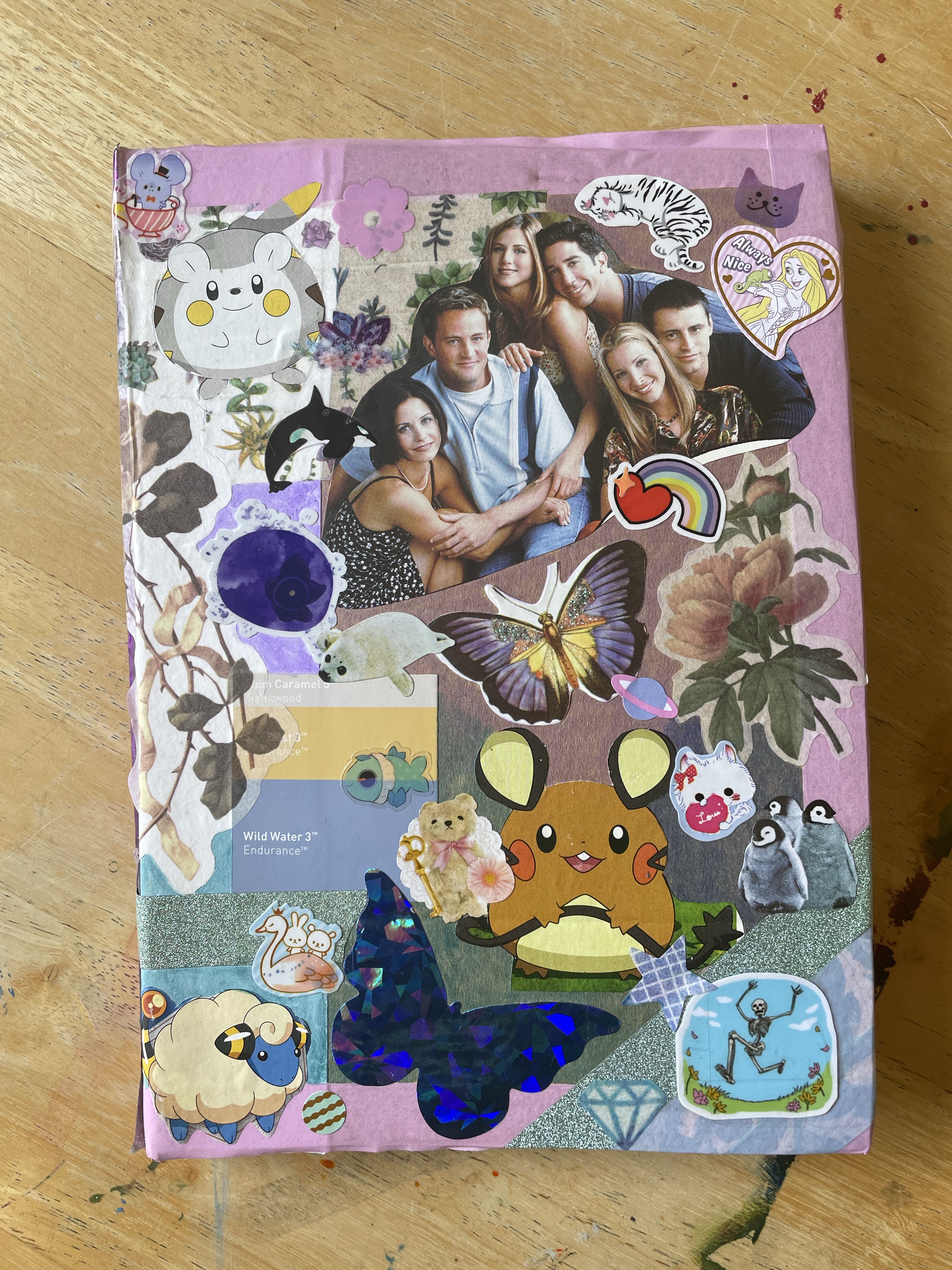
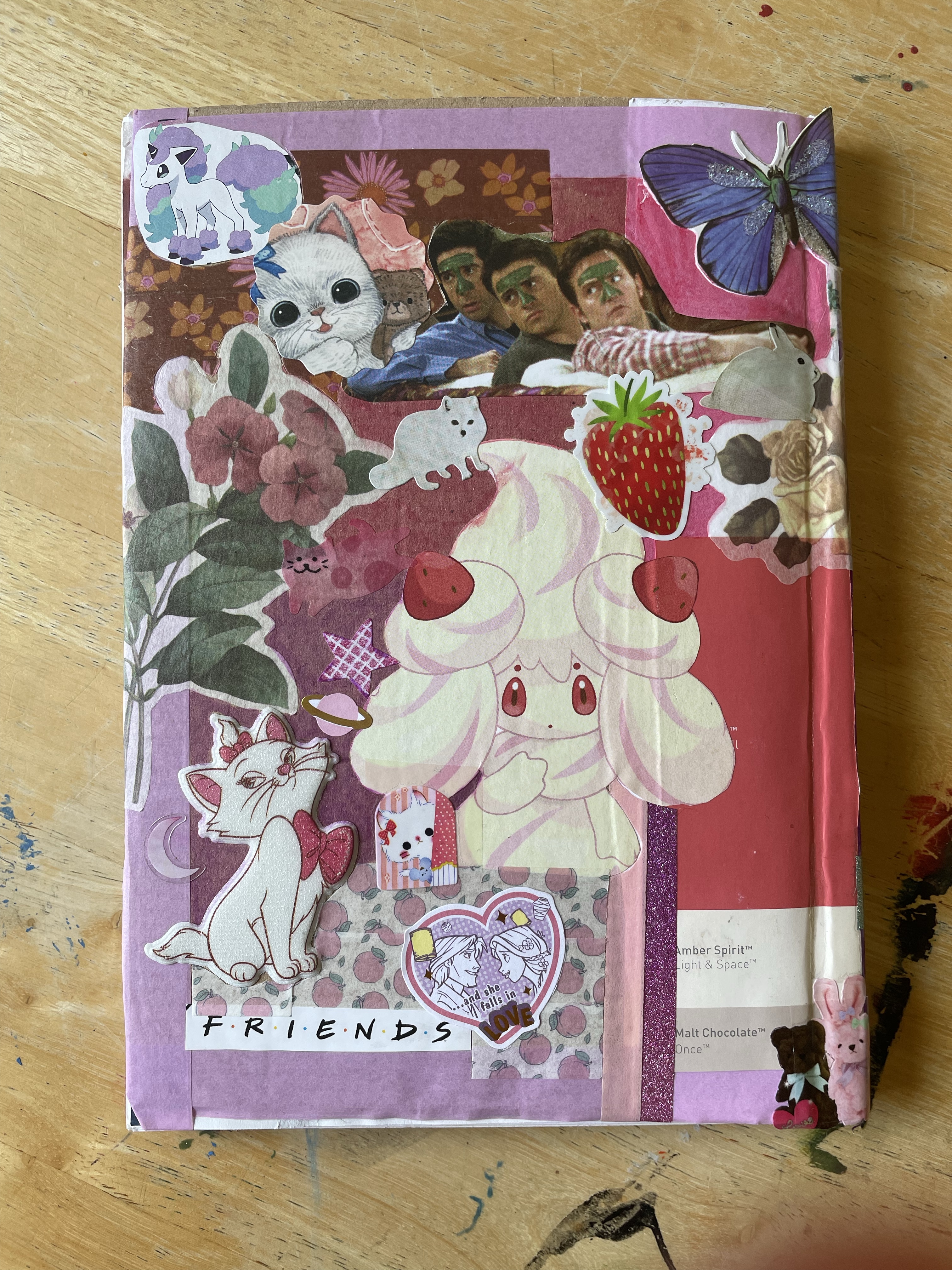
Next came the decorating. I usually don’t like to decorate the front of my sketchbooks – I just leave them as they are. However, I had been researching 80s/90s style binders and felt hugely inspired. I decided to try out something similar for myself. I used a combination of washi tape, stickers, and cut-outs from magazines/collage pieces to decorate the cover. It is so far from my usual style, but I absolutely love the result. The sketchbook feels so personal and perfectly suited to me in every way it could be.
Decorating the cover – and the finished product!
I have since been using the sketchbook, and I have to say – it is wonderful. The only real difference I would make is ensuring I don’t add the cover incorrectly! Everything else went as planned, and the pages are lovely to work on, bend without issue, and more importantly, I want to work in this sketchbook!! I am excited to fill it because the whole thing is mine, I created it, and it is a project within itself. I loved the process of making it, and I definitely want to continue making my own sketchbooks. As time goes on, I hope that I develop an even deeper understanding of bookbinding and make even better sketchbooks.
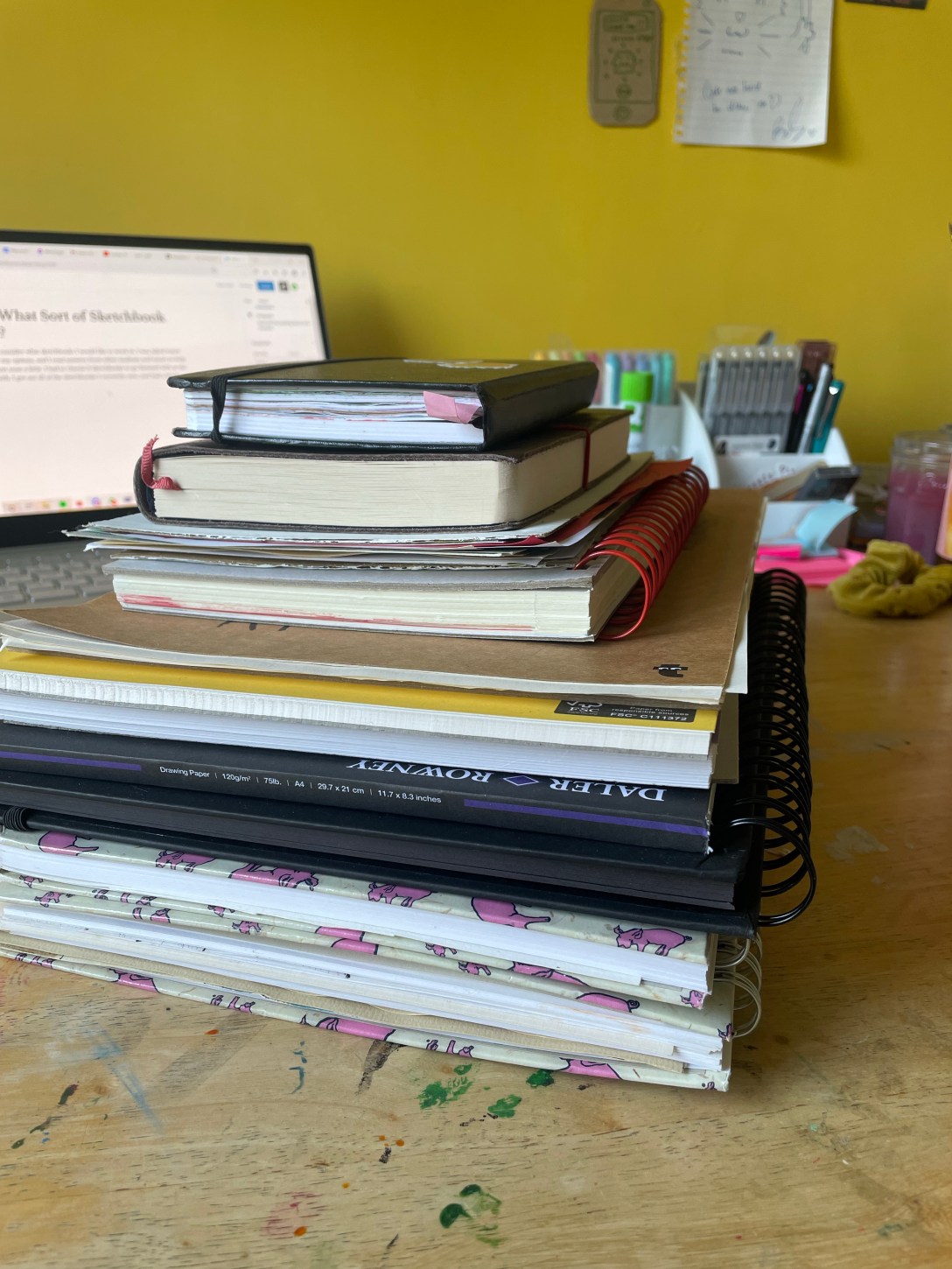
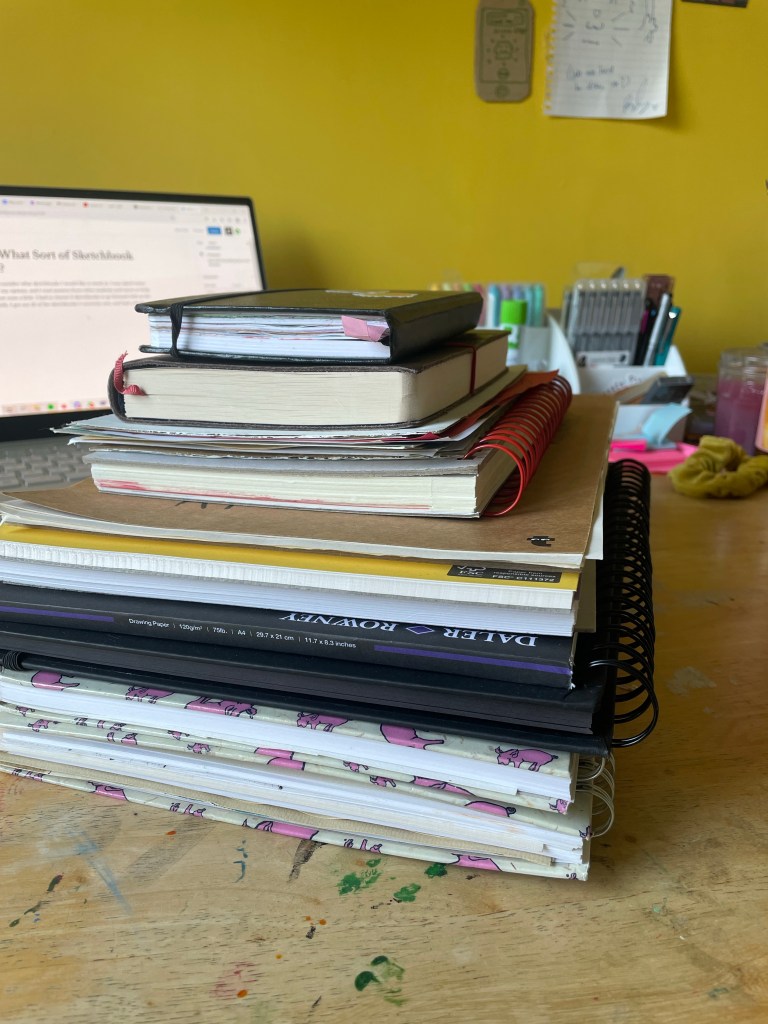
This exercise prompted me to consider what sketchbooks I would like to work in. I was asked many questions to help me consider my options, and I read answers from other students and tutors to help me think outside of my comfort zone a little. I had to choose 3 sketchbooks to go forward with at the end of the exercise. To start with, I got out all of the sketchbooks I currently own, and had a think about how I use them now.
All of the sketchbooks I currently own
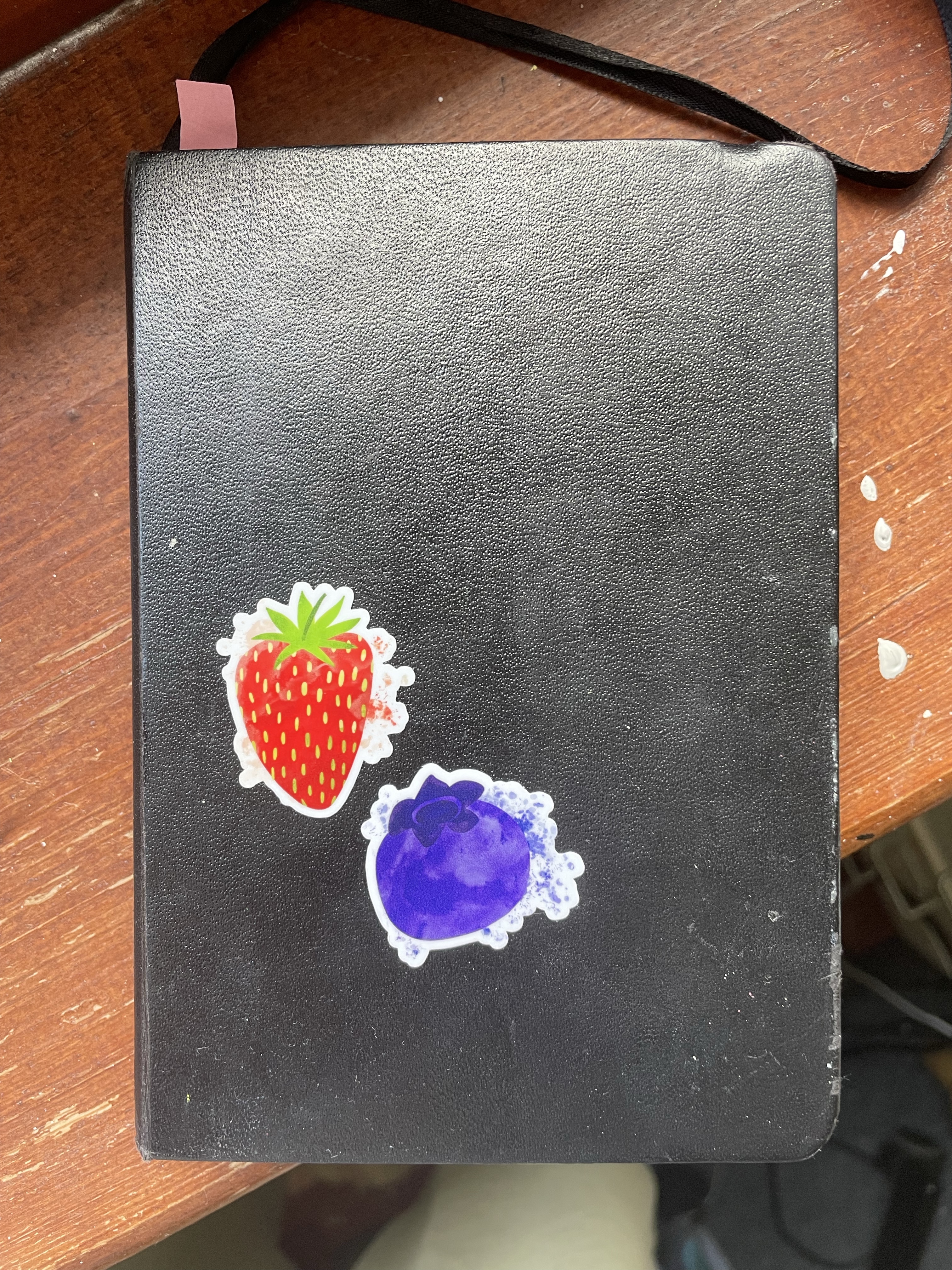
I have an enormous amount of unused sketchbooks and sketchbook paper that I’vecollected over many years because I’ve wanted to try them out. Currently in usage, however, are 3 sketchbooks. There was a fourth, but it filled up throughout Key Steps in Illustration. I have an A6 pocket sketchbook which I consider my ‘main’ sketchbook currently. It’s very portable and useful for that reason. It’s a bit small, however, and I can’t experiment much in it. I use it mostly for doodling, quick life drawings, and burning off creative energy.
My A6 travel sketchbook and an example of what’s inside
For experimenting, I typically turn to a budget waterpaper sketchbook I have. It’s A5 in size, and the paper in it is good quality despite the low price. It’s great for messing about and getting things wrong, as I’m not worried about wasting high-quality paper. I do use it occasionally for full pieces, but mostly it’s a place to mess about.
My watercolour experiment book and an example of what’s inside
Finally, I have an A4 sketchbook which I’ve used to explore briefs and projects throughout KSI. I love this paper. It’s just cheap low quality drawing paper from Flying Tiger, which isn’t an art supply specialist, and it is beautiful for planning. Rough draft sketches, notes from research, diagrams and ideas – they all flow fantastically. A combination of the thinner paper, the A4 size, how easy it is to remove sheets, and the way the sketchpad opens from the top, makes this dreamy for me. I am running low on paper in it, and my closest Flying Tiger store just closed down, so I recently bought a couple of new books to try out for this pupose.
The sketchbook from flying tiger and the 2 books bought to replace it
Prior to this exercise I already had a few thoughts about which sketchbooks I wanted to use. I knew I wanted to ‘finish’ my current sketchbooks, that was a first priority. Next, I have a beautiful Artway Doodle sketchbook that I’ve been waiting eagerly to break into. Finally, I wanted to use all of the paper I’ve collected over the years and turn it into my own handmade sketchbook. I also really loved the suggestion in the exercise to buy second-hand books and work into those. I was overwhelmed by my options and decided to put these thoughts to the side and work through the questions in the hopes I would narrow it down.
What do I think I might use the sketchbooks for? I would like to use my sketchbook for both wet and dry mediums, to collage in, and to explore in. I want a sketchbook that has the capacity to hold almost anything I want to put in it. I’d prefer to just use one sketchbook at a time, rather than having many on the go at once, even though that’s what I currently do. It is useful to have a specific wet-media sketchbook for the really messy work, and to have a bigger sketchbook for more in depth projects, but I would always like to have one single ‘main’ sketchbook on the go.
Do I get intimidated by the blank pages of an expensive sketchbook? Not anymore, though I definitely once did. Now I’m quick to add colour and just dive straight in. I find once I start making marks – whatever they look like – any intimidation quickly leaves.
Do I need something on my page already (eg a grid, faint lines, etc)? No. Actually, on second thoughts, I think I’d prefer variation. Different coloured pages, different surfaces, different backgrounds. I think mixing up the paper I’m working on makes it really fun! If I had to pick a constant, though, I would rather blank pages.
Do I prefer to work on a heavy weight paper or something more flimsy? This is very dependant on what I’m doing! I think as a standard, I prefer a heavier weight so that mixed media is possible. I would hate to work on a lighter weight then realise part way through I’d actually really like to add some acrylic, or some watercolour, and have barriers in place. Too heavy is a bit of a nightmare, though. Maybe a happy medium?
Do I prefer to work large or small? Right now I have no idea! Both, and neither, and in between. I need to explore this further.
Am I a creature of habit that needs things to look the same? I am, very much, but I like experimenting and pushing my limits and trying new things. After, I may jump back into my usual ways, but I feel there’s no harm in trying, and you aren’t going to learn by staying put. There are some habits that I never want to change, for example I may find that I love working at A5, but I’m unlikely to always buy the same sketchbook over and over again. I dislike feeling stagnant.
Do I want variety that relates to whatever I am working on? Yes. I think I’ve answered this in my other answers, but I’d definitely prefer variation in my sketchbooks.
Do I want a sketchbook that is like a hardback book so I can work across pages and treat them as double page spreads? In this way I could make larger images. Yes, I’d love hardback sketchbooks, but no I don’t want them for double page spreads. I have tried this, but I get caught up in the prettiness of the pages and get held back by that. I want things to occur naturally in my sketchbooks, because that’s the best bit of my creative process. So, if two page spreads happen, that’s perfect! It can be a 6 page spread if it needs to be. There will be no intention to do that, however. The flexibility is definitely nice, but in general I just prefer hardback as it’s easier to work in and more durable.
Do I want a spiral bound book so I can easily fold the pages and cover over? This really depends on the project. I’d say currently I’m leaning towards using them more as I like to focus on the page I’m working on and only that, but the rings do get in the way somewhat.
What am I using my sketchbook for? Hopefully I will use my sketchbook for everything! Journalling, researching, completing uni work, fulfilling my goals for this unit (as described in my introduction log), and anything else I feel like.
Where will I be using my sketchbook? I want to say ‘everywhere’ but realistically the answer is at home, at my desk, where I’m comfy. I really prefer to work at a desk. Honestly, this is because of how my disabilities impact my ability to sit comfortably in various positions. I’ll probably use it elsewhere, but always at a table.
Do I want to work secretively or publicly? My notes for this question say ‘Either. Public. No strong feelings.’ and in retrospect I had to laugh. That is truly how I feel, though. I don’t really care whether my work is public or not, and if anything I’d rather put it all on display. I’m very aware, however, that assuming people want to look at my work is quite presumptious. I don’t want to make it a goal for my work to be public, but I don’t care if it is. I’d like to share it, if people want to see!
Do I already have a favourite sort of sketchbook? I discussed this a little bit above. I’m not sure if I have any real preference beyond the paper needing to be suitable for mixed media.
Do I produce digital sketchbook work/drawings already? If so how will I document this for my tutor? Will a digital device be one of my 3 sketchbooks that I choose? A lot of my finished illustrations are digitally produced, and I want to continue using digital mediums as a way to create art. I don’t, however, intend on keeping a digital sketchbook. I really like the clear-cut seperation between the polished digital work I create, and the more messy unfinished analog work. I always combine the two, don’t get me wrong, but I feel I would be bored and uninspired with a digital sketchbook. I have tried it before, and I defintiely prefer analog.
Answering these questions was really helpful in figuring out what I want from my sketchbooks and in choosing three to go forwards with. I had some more thoughts that I wanted to explore before settling on my choices.
In art college I worked at A3, which I enjoyed, but this was because it was the only option. I like using A4 for research sheets and sketching, but I’d like to explore more sizes just to see which I like best. A5, A4, and A2 are all sizes I especially would like to use more, and I’d also like to explore alternative shapes/sizes of sketchbooks.
What actually defines a sketchbook? Could I have a folder of loose work and call that a sketchbook? A binder full of polypockets with work and ephemera in? I would like to research this further and look at non-normative sketchbook concepts to see if any appeal to me.
I have virtually no object permanence. All of the food in my house, for example, has to be easily accessible visually or I’ll forget it exists and not eat it. The same goes for all of my art materials, and anything else I own. How will this impact my sketchbook usage? If I finish a sketchbook and ‘put it away’, will I ever remember what’s in it? Is that a good thing? How much do I want to add to my sketchbook rather than, say, sticking it on my wall to take inspiration from constantly? Do I want to frequently look through my sketchbooks, finished or not, to remind myself of the work in there? Or am I happy with a sketchbook ending resembling almost the end of a chapter in my life?
I really want to make my own book. How can I do this? How do I want it to look? Do I want that to be one of my sketchbooks for this exercise?
I took a few days away from the exercise to think over these ideas a bit more and figure out which direction I wanted to go in. I also began making my own sketchbook, as it was the most exciting prospect to me at the time. I loved the process and ended up with a sketchbook that was perfect for my needs, which I suppose is the main reason to make your own in the first place. You can find my learning log post describing the process, the choices I made, and why, here.
The strongest feelings I had after finishing the book were that:
I want to finish my current sketchbooks
I want to use my new homemade sketchbook
I need the flexibility and freedom to experiment and use lots of mixed media
I don’t like the idea of being locked into three sketchbooks for a certain amount of time
I decided that I would use my homemade sketchbook as my core sketchbook throughout Part 1. I would fill it with research, ideas, exercise responses, and potentially my assignment response depending on how full it is once I get there. I would continue to fill my A6 pocket sketchbook in the meantime, still using itfor doodles/creative outbursts/taking out with me. Then, I would use my watercolour sketchbook and A4 pad where necessary. I could even take from those sketchbooks to stick into my others. Once these sketchbooks are full, I will reassess based on my current needs and the things I have learned throughout using those sketchbooks, and either buy/make the same thing again, or move on to something new.
This process of assessing my needs and interests and evaluating what sort of sketchbook I’d like to work in has been incredibly useful. There’s a lot of room to explore new things in the rest of this unit and hopefully by the end I’ll be able to narrow down exactly what sorts of sketchbooks I enjoy working in.
For this exercise, I was asked to choose a minimum of 6 artists and research their sketchbooks, developing both visual and written research and using it as a starting point to create my own sketchbook work. I was asked to think about the artist’s work and how it resonates with me, responding visually to that rather than replicating what I saw. I was also encouraged to consider how I could learn from how the artist uses their sketchbook, whether they leave mistakes in or not, how they use materials, and whether anything is hidden.
The exercise provided answers from OCA students and staff on which artists sketchbooks inspire them. Emma Powell, the author, had listed her favourites too. Initially, I quickly googled a few of these artists but wasn’t finding myself inspired, and I didn’t want to risk wasting hours choosing the ‘right’ artists to research. I instead searched ‘artists sketchbooks’ to see what would show up and came across the publishing house Unseen Sketchbooks. The company’s focus is on publishing the never before seen works of artists in limited run books. The content in them varies from sketchbook work to unfinished or personal projects, and these were a fantastic starting point for my research.
I looked through the publications from Unseen Sketchbooks and picked a handful of artists whose work I felt drawn to. On reflection, I thought it would be best to also choose some artists from the list Emma had included, as my choices so far were quite ‘samey’ and were chosen based on qualities I was already inspired by. I knew I could learn a lot from the more famous artists out there, and I wanted to challenge myself to see how I could learn from anyone. I ended up with ten artists to research, but aware that I was unlikely to research all of them in one go. They are:
I decided to work through these at random rather than in order and to go into depth exploring how the artist works. I have added links to each of the artists so that their research sections can quickly be accessed. If there is not a link, that means I have not yet researched that artist.
Jesús Cisneros
Six/Seis by Jesús Cisneros takes the viewer on a journey through Cisneros’s personal sketchbooks. The book takes it’s name from the six sections within – themes, series, memory, exploration, accidents, and fiction. Each section contains unedited work from the depths of Cisneros archive alongside interviews and text from the artist himself.
I was particularly inspired by the names of the six sections of his book. I love this take on how we use sketchbooks and how almost everything we do in them could be put into one of those six categories. This prompted me to think about how I use my own sketchbook currently and whether there were any categories I could split my work into that were missing from his list. I probably wouldn’t use the word ‘series’ for any of my work, but I’m unsure what I could replace that with.
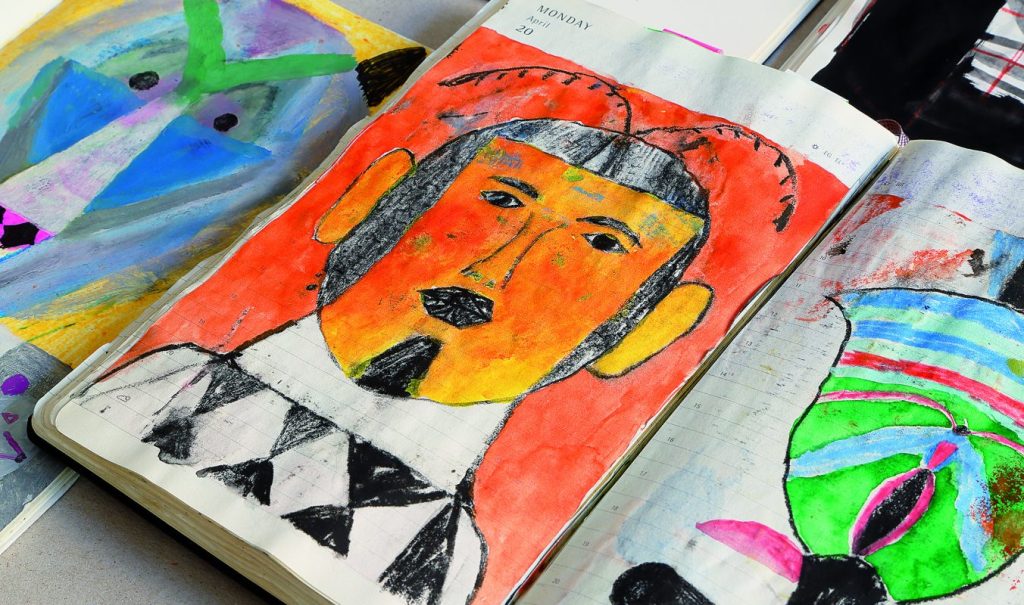
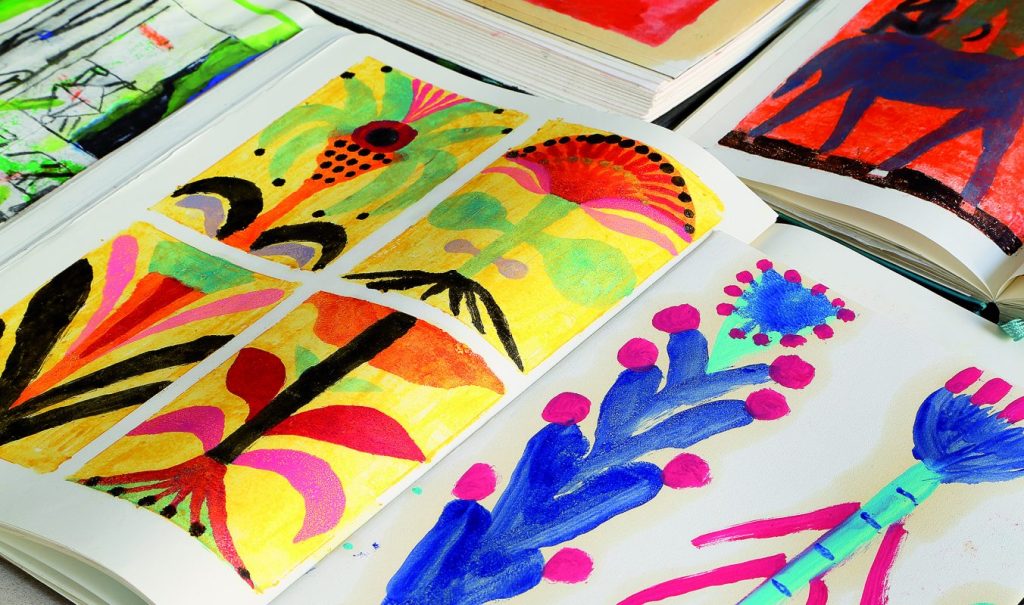
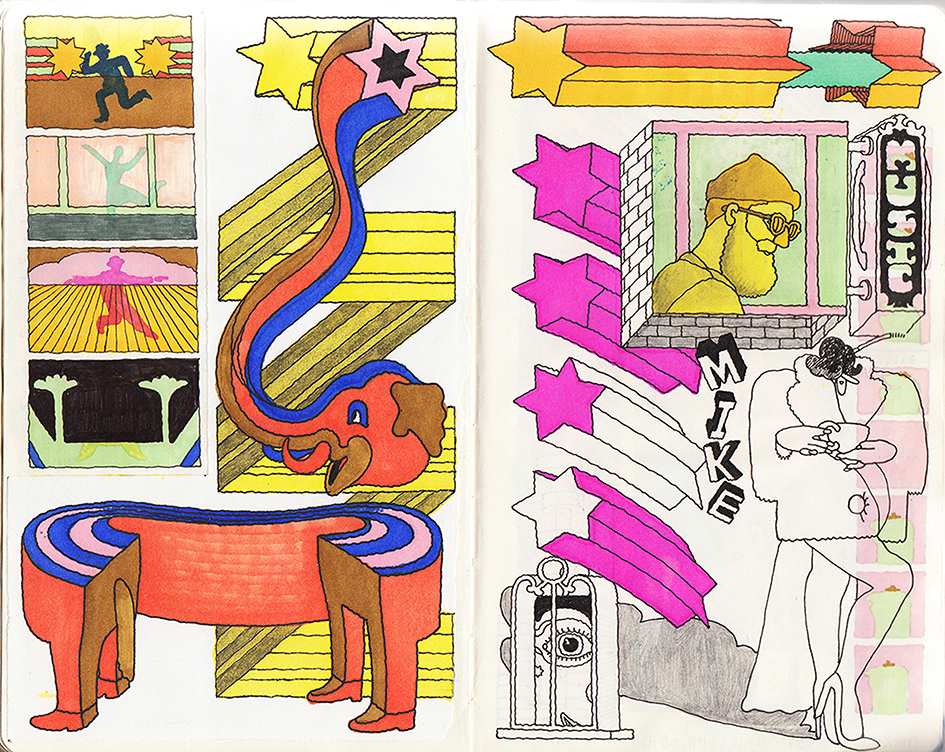
Cisneros’s sketchbook pages are messy, creative, playful, exploratory, and, best of all – fun. His consistent usage of bold neon colours paired with his seemingly intentional ‘mistakes’ is truly inspiring. Letting go, being free, and moving away from the perfectionism so commonly sought after in the artistic world, is a dream for many artists. Cisneros is achieving this perfectly. I described his work as ‘messy done with style’, and it’s a phrase I stand by and one I feel I could certainly learn a lot from.
Maybe it’s because the idea of ‘what kind of sketchbook should I use’ is already on my mind, but Cisneros’s usage of diaries as sketchbooks stood out to me especially. It adds to the playful carelessness of the work – almost as if he picked up the nearest book to him and just started working away. I mentioned in Exercise 1.0 that I’d like to work in second-hand books more, and seeing how Cisneros uses the diaries in this way furthered that desire.
There’s a great deal of experimentation within Cisneros’s pages. A lot of his work could be perceived as the first steps in a project – trial and error to discover how to perfectly achieve the look he is going for. This relates closely to how I’d like to use my own sketchbook: as an explorative space to take me from point A (an idea) to B (the finished project). Jotting down these notes and considering how I related to Cisneros’s sketchbook pages got my creative juices truly flowing, so I decided to move on to my visual responses.
Pages 2-3 of my sketchbook
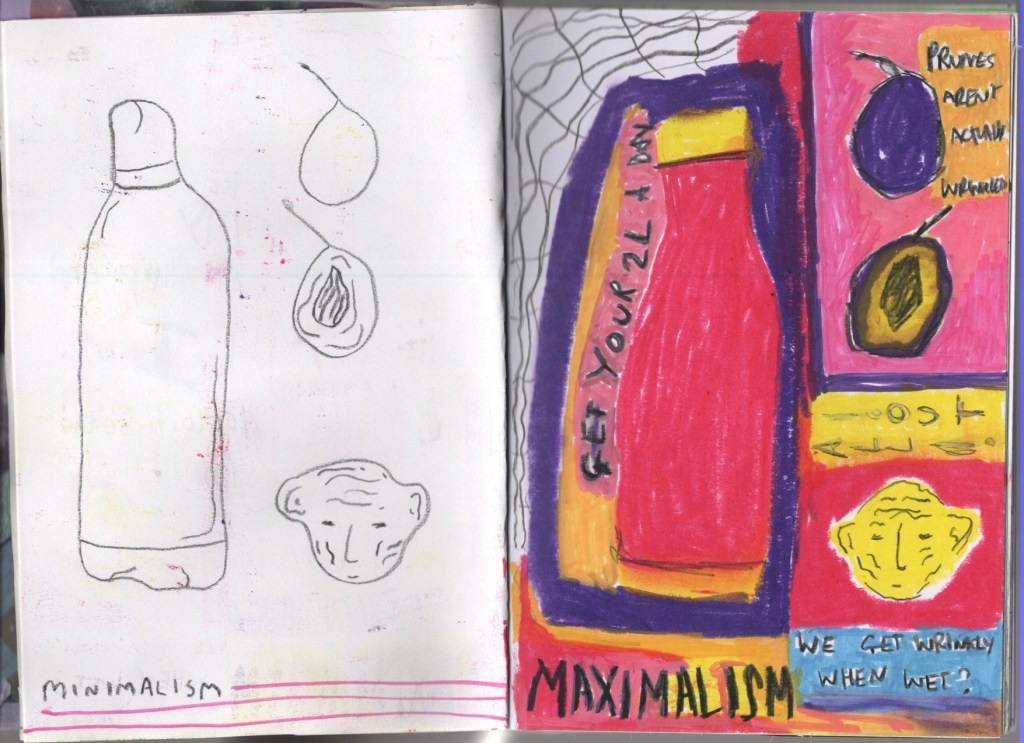
I loved the bold colours found in Cisneros’s sketchbooks, and I wanted to explore the playfulness he demonstrates in his work. I chose to use a combination of artists crayons, acrylic paint pens, and chinagraph pencils to start with, as these were bright and easy to get down on paper. I started with page 3 and drew what was right in front of me – my water bottle. I was thinking about the six sections of Cisneros’s book and how they related to my piece as I drew. ‘The everyday’ is a theme, one which prompted me to draw my water bottle to begin with. All of my work on the page was an exploration, and within the page, there were many accidents.
I sort of just let my mind wander whilst filling this page, seeing where it took me next. There was very little thought going into my actions, just a lot of ‘let’s see what happens when I do this!’. Together, my brain and hand took me on a journey around the page, from the water bottle to the prunes, then to the wrinkled old man. The busyness of the page and the chaos within led me to write ‘Maximalism’ at the bottom and inspired me to create the same thing on page 2 – this time from a minimalist perspective. Upon reflection, maybe ‘Journeys’ is a category that I could contain my work within.
Pages 4-7 of my sketchbook (from left to right)
Page 4 was an attempt at the same process I used on page 3, however I was less enthused this time. I feel the writing speaks for itself – I wasn’t enjoying the processs as much and couldn’t place it within the six categories easily. For this page I introduced some coloured pencils that I bought when I was visiting Slovakia on an Erasmus exchange in 2015. My mind was preoccupied with this, rather than with the work I was trying to complete. I realised ‘memory’ was one of the categories Cisneros had chosen for his book, so jumped to page 7 to draw my memory of that trip using the pencils.
Pages 5 and 6 are on acrylic paper, so I was eager to use paint for this. I was hoping to recreate, in my own way, the paintings Cisneros has done in his sketchbooks. I wouldn’t say I achieved that, but the goal of this exercise was not to copy his work, but to be inspired by it. I used gouache as I find it the most fluid and I once again let my mind wander to see where it took me. I really enjoyed this exercise and the process of letting go whilst working. I feel I have learned a great deal in completing these sketchbook pages, and researching Jesús Cisneros’s work has given me much food for thought.
David Hockney
David Hockney is known for his contributions to the pop art movement. A quick google shows a clear, expressive style, with bold and rich colours used throughout his pieces. His sketchbooks, however, show an entirely different world. Their content is not so far removed from his paintings that they seem to be produced by another artist, but they are comparatively bland and lacking. You can tell that these sketchbooks are places for him to simply explore options, ideas, and the world around him.
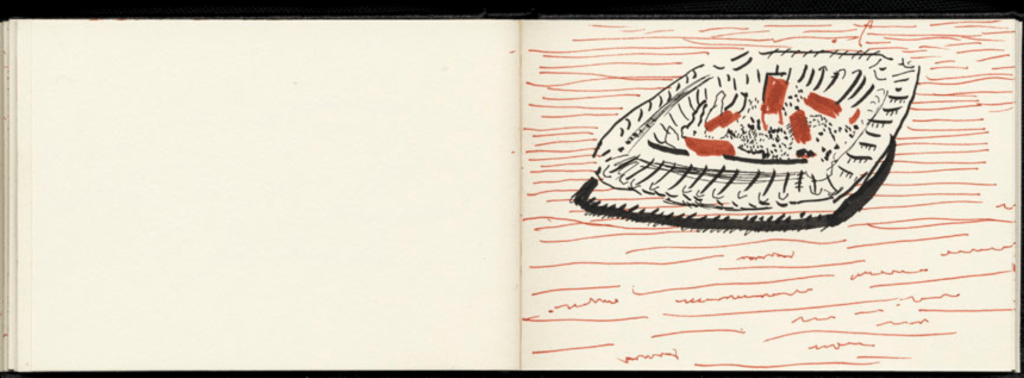
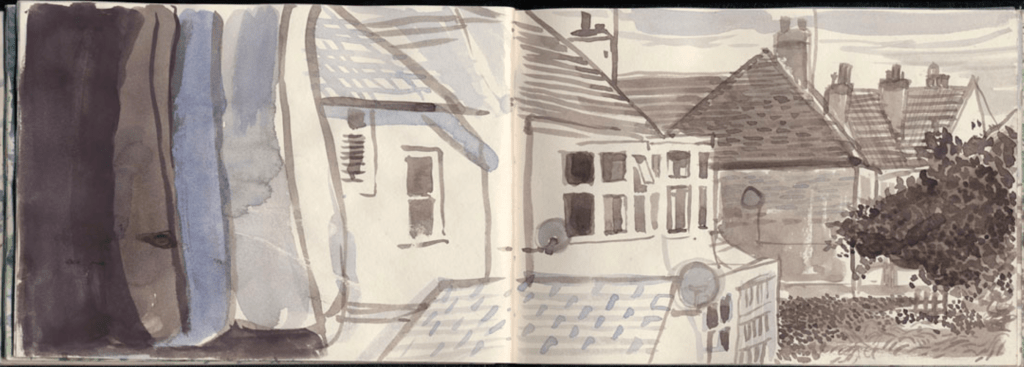
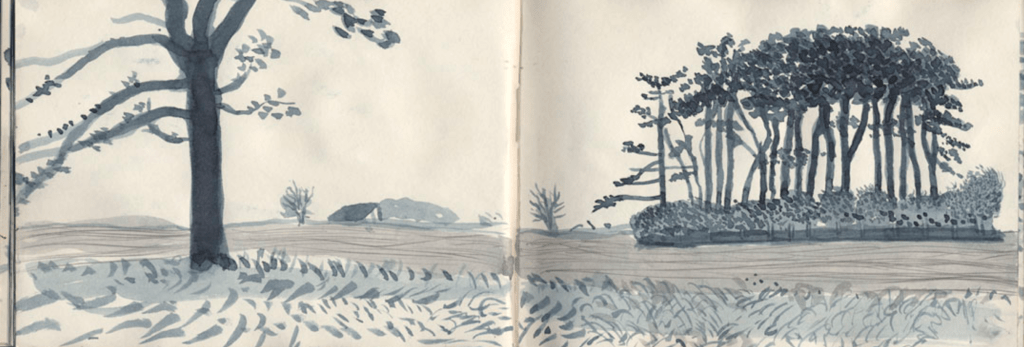
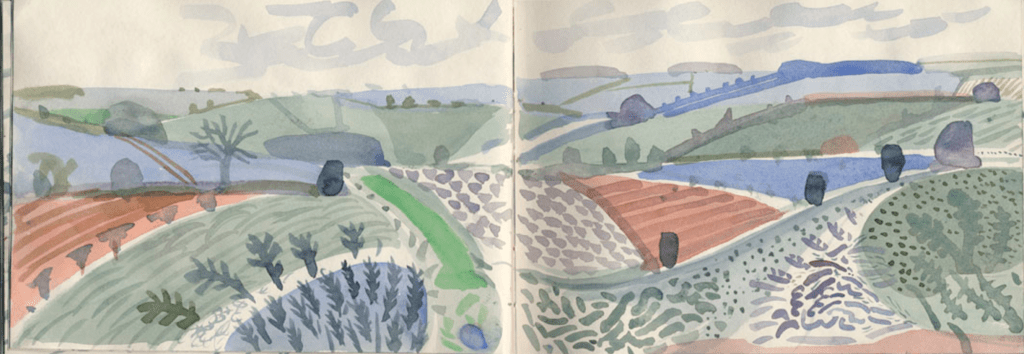
Using the archive of sketchbooks available on Hockney’s website, specifically focusing on the books titled ‘London 2002‘, ‘Norway 2002‘, and ‘Yorkshire 2004‘, I considered the potential relationship Hockney has with his sketchbooks and how I could translate his usage of them into my own style. It is clear that these sketchbooks go everywhere Hockney goes, living in his pocket or some other easily accessible location. This is made more apparent by the chosen names of each sketchbook being tied to the place and year they were completed in. Some of the content that Hockney chooses to draw is random and eclectic, which often happens when you are in mundane locations looking for something to draw. Every page features a landscape, object, or person, most likely drawn whilst waiting for something else to happen or just to record the moment.
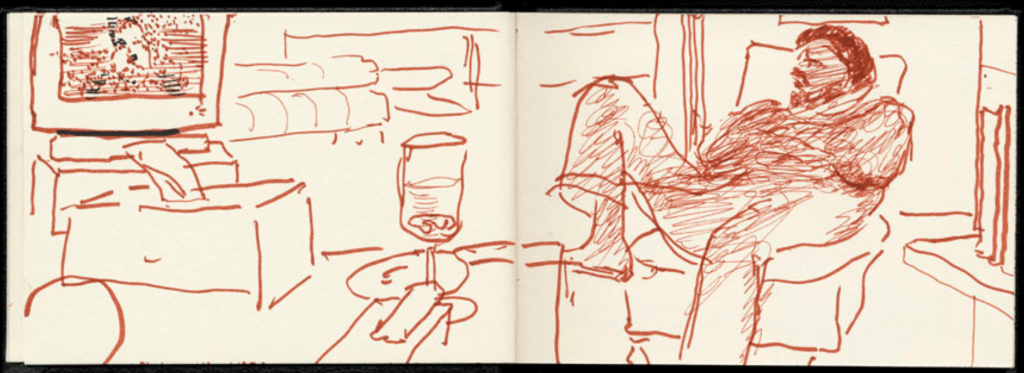
Images taken from ‘London 2002‘
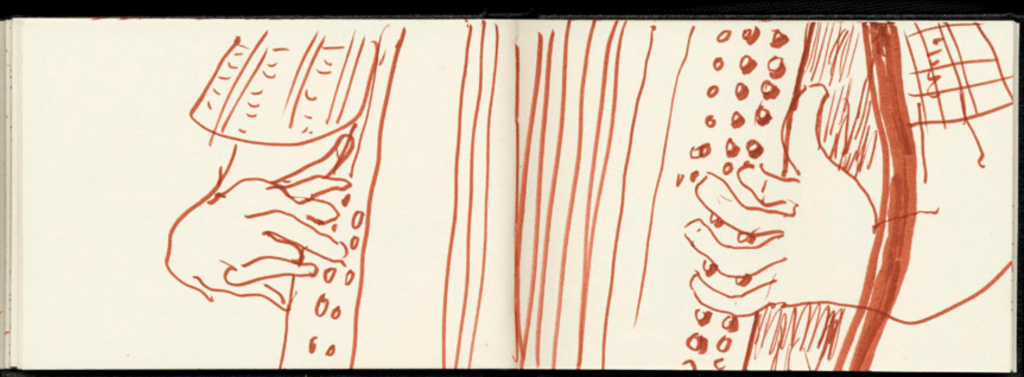
All of the drawings and paintings throughout his sketchbooks have been done quickly, loosely, and using pens or watercolour without any preparatory sketches. He seems to favour only using one medium per sketchbook and a limited selection of it. London 2002, for example, features only black and red pen drawings. The pages are also often seemingly unfinished or quite empty. This is contrary to his usage of colour and the maximal usage of space in his paintings. Hockney’s signature usage of pattern remains, however, as he uses this to fill space or shade certain areas. It is inspiring to me to see how he uses line as texture in this way – something that I am interested in further developing myself.
It is clear that Hockney simply wants to get down what’s in front of him on paper. There isn’t a great deal of planning or consideration going into his sketchbook pages – he just starts drawing. His sketchbooks are the perfect example of taking the everyday and building off of it. You can see clearly how his sketchbooks have informed his creative process and how the messy and freehand drawings of random objects later become famous works of art.
Images taken from ‘Yorkshire 2004‘
The work in Hockney’s sketchbooks reminds me of Bryan Lewis Saunders ‘Under the Influence’ series. The drawings Saunders produced whilst experimenting with various drugs are very free, exploratory, and focused on getting information down on paper. They are intimate and personal works of art, and communicate Saunders unique perspective of the world as seen in that moment. Hockney’s sketchbooks do a similar thing – showing an insight into his perspective of the world. The viewer can’t always tell what’s in the image, and we don’t know the feelings Hockney was having or why he chose to draw what he did. In some regard, these sketchbooks will always remain personal and have things ‘hidden’ – experiences we can’t share with the artist.
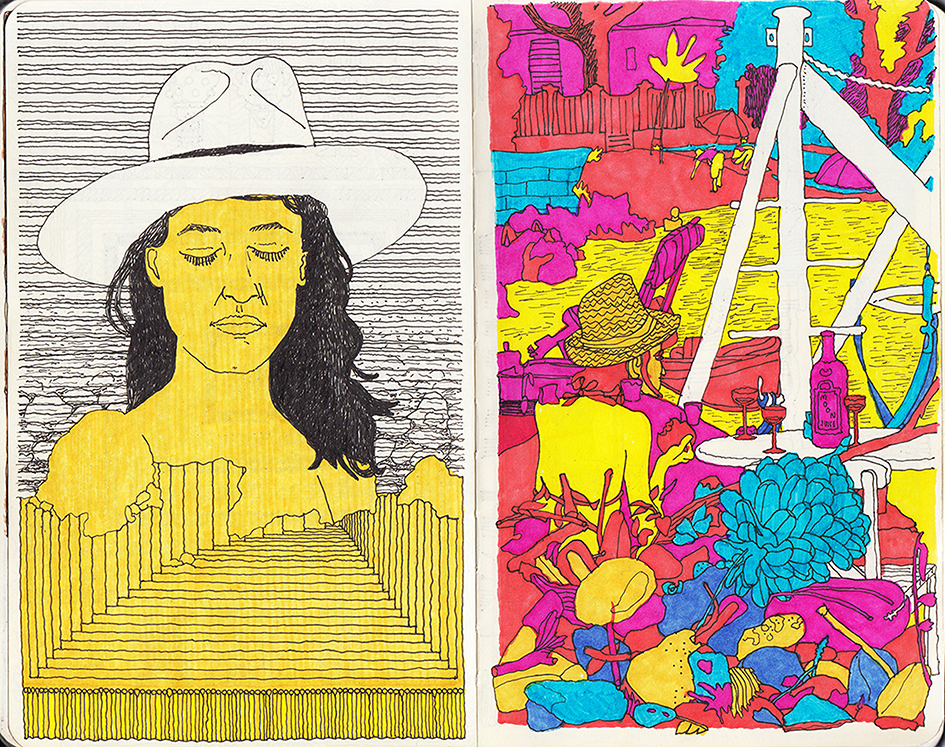
My first attempts sketching inspired by Hockney – pages 6, 15, 16, from left to right
When I first looked at Hockney’s work, I felt overwhelmed by the idea of learning from it. Currently, my life is spent in the same few rooms of my house, as a combination of worsening health and the COVID-19 pandemic has meant accessing the outside world isn’t very easy for me. I felt I didn’t have moments to just draw random objects in, nor did I know how to go about drawing the objects I look at every day in a natural way. I wrote down that I needed to ‘be quick and eager in my sketching, worry less, capture moments, and draw what’s right in front of me’. I tried to do this – some quick sketches of the things on my desk and my cat but found it really boring. Then I sort of put it away for a while.
About a week later, I got an opportunity to go out to some local venues and tried hard to get some Hockney inspired sketching in. I only managed two pages, of which neither makes me happy. They did inspire future ideas and were definitely useful, but I didn’t find myself enjoying the process. I kept pushing myself to pick up my sketchbook and draw whilst in the little moments between things, and finally, I found my groove. The first page I did was page 24, and I was so happy with it. I felt I was working quick and effortlessly but was having fun and feeling inspired. I then proceeded to set a series of alarms throughout my day, at which point I had to draw whatever was happening – I only actually did it for two of them (pages 32 & 36), but I’m happy with the outcome.
My second attempt at sketching inspired by Hockney – pages 24, 32, 36, from left to right
Analysing Hockney’s work and considering his relationship to his sketchbook has hugely influenced how I have worked in my sketchbook throughout Assignment 1 – even if it isn’t immediately apparent. I spent a lot of time working quickly, focusing on getting information down on paper, and trying to see the world around me from different perspectives. I really hope that my relationship with my sketchbook grows to a point where I, too, have sketchbooks with similar names, documenting the different times in my life.
Jim Stoten
Skotchbook by Jim Stoten is a publication from Unseen Sketchbooks featuring a selection of work from Stoten’s personal sketchbooks. Stoten’s illustrations are wacky, nonsensical, and bursting with bright neon colours. He discusses on the Unseen Sketchbooks page for his book how using his sketchbook to record everything he thinks, hears, and sees helps him develop these pieces. The work shown in Skotchbook isn’t dissimilar to the illustrations Stoten creates for clients, but he explains that his sketchbook allows him to translate feelings and thoughts that don’t feel appropriate for commercial art.
I chose Jim Stoten to research for two reasons: first, I felt drawn to and excited by his artwork, and secondly, his approach to using sketchbooks was something I felt was deeply admirable. This quote from the Unseen Sketchbook page on his publication resonated especially with me:
My sketchbook has a function much like a valve on a steam driven engine. Things go in there that do not, cannot and perhaps should not, go anywhere else. My work as a commercial and editorial illustrator does not always allow the creative freedom to transpose these thoughts and ideas into work pertaining to a brief of any kind, and so my sketchbook provides a balanced counter weight to the prescriptive and sometimes even instructional nature of commercial briefs.
Throughout Key Steps in Illustration, I felt that whilst I enjoyed the process of designing for client briefs, I missed the ability to explore my own thoughts, feelings, and creative desires. I didn’t have as many opportunities to play around and make art that was meaningless and fun – something I sorely missed. The appeal of a sketchbook to me is the ability to have this place separate from any client work or official briefs, to record a part of myself, and let go. This is the bit that I am missing right now from my creative process that I am hoping to develop throughout this unit.
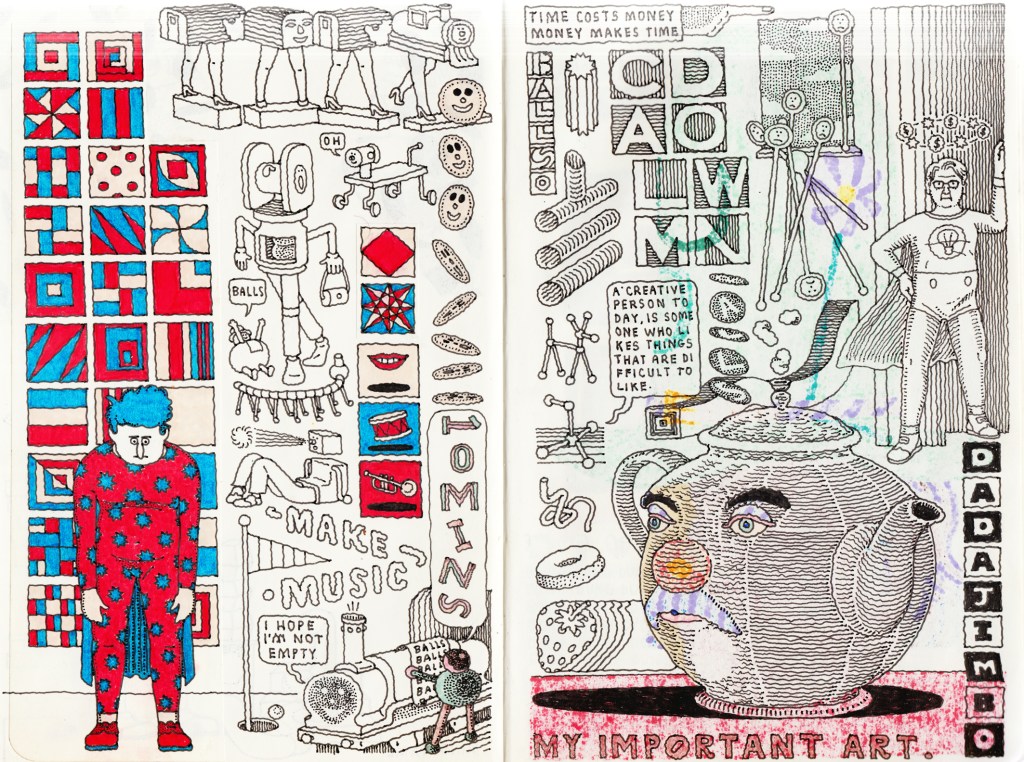
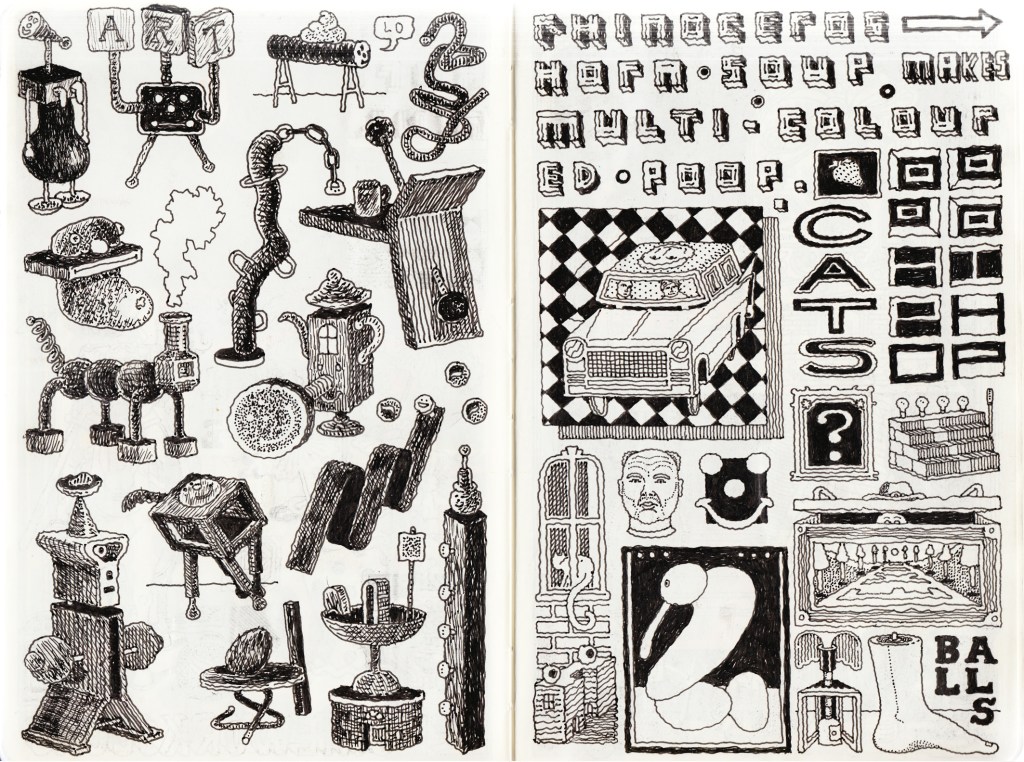
Jim Stoten presents the inner workings of his brain in a visually organised and clean way. Each page of his sketchbooks contains neatly collaged ideas, concepts, and thoughts, randomly placed with no real purpose. Stoten himself describes his sketchbooks as containing ‘comic strips that attempt to make sense of my own thoughts, feelings and reactions to the World…poems, hand drawn type, song lyrics, memorable quotes from films, TV, debate forums on all topics and interview chat shows from the 1970’s and 80’s….observational drawings from train journeys, exhibitions and visits to the pub, as well random drawings of imaginary people, architectural forms, modes of transportation and animals.‘ He truly includes anything and everything within the pages.
Some pages have the same bold, neon colours that Stoten uses in his formal illustrations, but they are usually used lightly or not at all. A black fineliner dominates the sketchbook pages, and Stoten makes use of white space and abundant patterns. Decorative typography is used to write passing thoughts alongside any drawings – though some pages are solely built out of type. I find it hard to find words to describe the work in his sketchbooks as I find myself mesmerised by it. I definitely want to work in a similar way.
Stoten and Hockney are approaching the same problem, and each has produced very different results. Both are trying to record and navigate their thoughts, the world around them, and the things they engage with. Where Hockney aims for speed, quantity over quality, and simply getting information on a page, Stoten has a more linear and methodological system to his pages. Neither is ‘correct’ – they are merely different approaches to observing your everyday experiences. However, there’s something about the approach that Stoten takes that feels ‘at home’ to me.
When I came to researching Stoten in full, I was already quite far into Assignment 1 and had spent a lot of time researching Hockney. I realised that a lot of the things I could learn from Stoten, I had already begun the process of learning from this research. However, the main thing that I feel I need to learn from Stoten is that it’s my sketchbook. I make the rules – it’s my place to exist freely and without limitation. Anything I want to put in it is allowed. Anything counts as art, and I can do as I wish. I need to be less afraid of things not being allowed in my sketchbook – when I’m the only one constricting myself!
Other things to learn from Stoten include exploring my own thoughts and feelings, responding to music or other media I engage with, creating made-up things that I enjoy thinking about, and generally expressing myself a little freer. Where Hockney has inspired a sense of freedom in how I create, Stoten has inspired it in what I create. I feel like I have already started working towards these things whilst completing Assignment 1 in general, which you can read more about in my Assignment 1 learning log. Pages 13, 16, 27, 28, and 41, as well as some of my later work inspired by Hockney, all demonstrate this exploration. My focus on including more text in my sketchbook work has achieved this too.
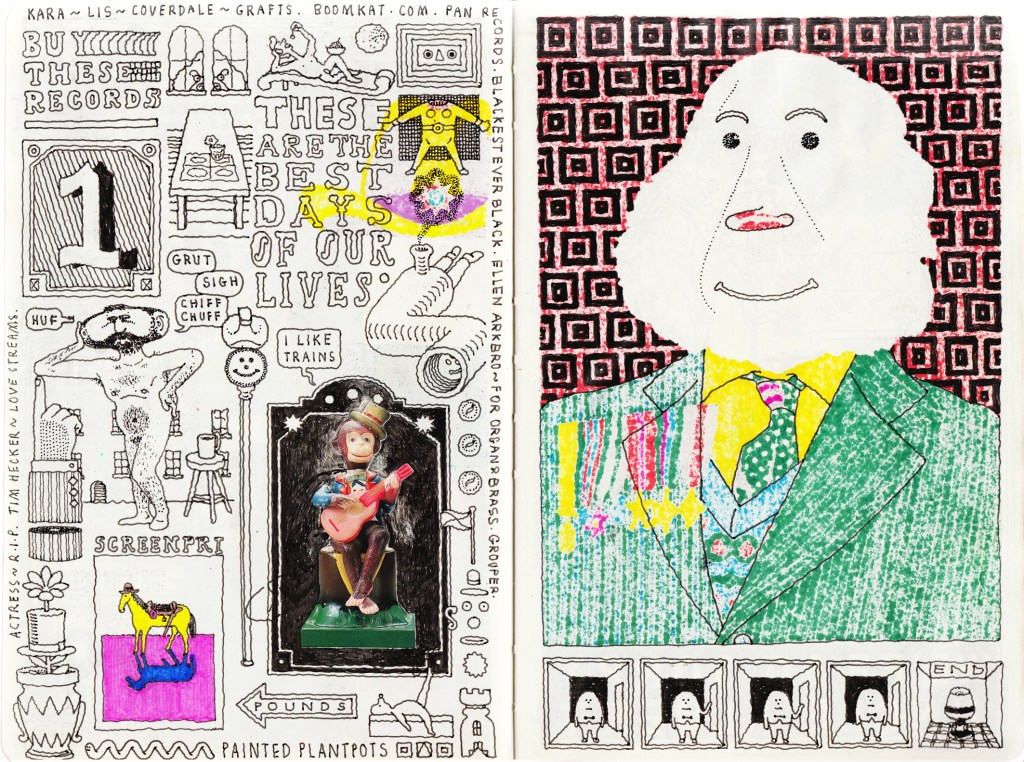
Pages 13, 16, 27, 28, and 41 from my sketchbook (left to right)
A key difference in my work vs Stoten’s is that I have found I really enjoy using a 1.0 fine liner, which is considerably thicker and allows for less neat, orderly work. On a particularly stressful day, I decided to use an 0.5 fine liner and try out a page closer in style to Stoten’s work. I really enjoyed the process, and it felt cathartic to get my thoughts out in this way. I also love the final result – I feel it could be a piece of art in its own right. It did take a lot longer than my usual approach, but that felt okay as it felt like a process of letting go of built-up stress. I also felt like I was really breaking down barriers in my quest to allow myself to put whatever I want in my own sketchbook. I think I will opt to include an 0.5 pen in my pencil case now, just in case I want to do something like this again.
Page 38 of my sketchbook, inspired by Jim Stoten
Whilst researching Jim Stoten, I used his website alongside the Unseen Sketchbooks page for his book. He has excerpts from his sketchbooks on his website, which can be found here. Examples of his other work can be seen here.
For this exercise I was asked to watch a video of tutor Emma Powell, in which she takes the viewer on a tour through her sketchbook. The video can be found here.
I took some notes whilst watching and considered my thoughts in relation to how she uses her sketchbook, and how this might change my perception of my own sketchbooking process. My immediate thought was that her sketchbook is very large, both in page dimension and in how many pages it contains. It’s much bigger than what I typically feel comfortable working in. I prefer to work in smaller sketchbooks, and having less pages to work on makes me feel less overwhelmed about the idea of ‘completing’ a sketchbook. Later on, though, Emma reveals that her sketchbook is built so that it can have pages added when needed, so I guess it doesn’t need to be full!
It was interesting to see that she takes a lot of photos of things and sticks them in her sketchbook. I relate to this, but I don’t currently stick them in with my sketches. Her work is also consolidated from everywhere in one place. All of the random bits of paper or pieces completed in workshops have been added. I don’t know if I would do this myself. I like to have everything spread out in a visually accessible way. If I’m referencing something, I think I’d rather it wasn’t in my sketchbook. It is nice, though, that she was able to say ‘look, these are all related things from one project, and they’re all together in one sketchbook’.
Alongside being literally large, I found that all of the stuck-in bits and pieces, empty space, pages upon pages of photographs, etc, took up way too much space. I much prefer to have things more concise and organised. I think that’s to do with how my brain works more than anything, I’m a very structured thinker and I always seek order. I would still take the hundreds of photographs, or do the twenty colour experiments, but I think I’d seek to do it in such a way that I conserve paper. At the time I noted that this might be to do with the fact I grew up in poverty, and art resources were very precious.
I really enjoyed watching this video. I love seeing other people’s sketchbooks and how they work in them. Even if I wouldn’t do the same in mine, it inspires me to explore new things and to question how I do currently work. I definitely like the idea of making my own sketchbooks, and I’d be interested in creating almost a binder of my work similar to how Emma has done.
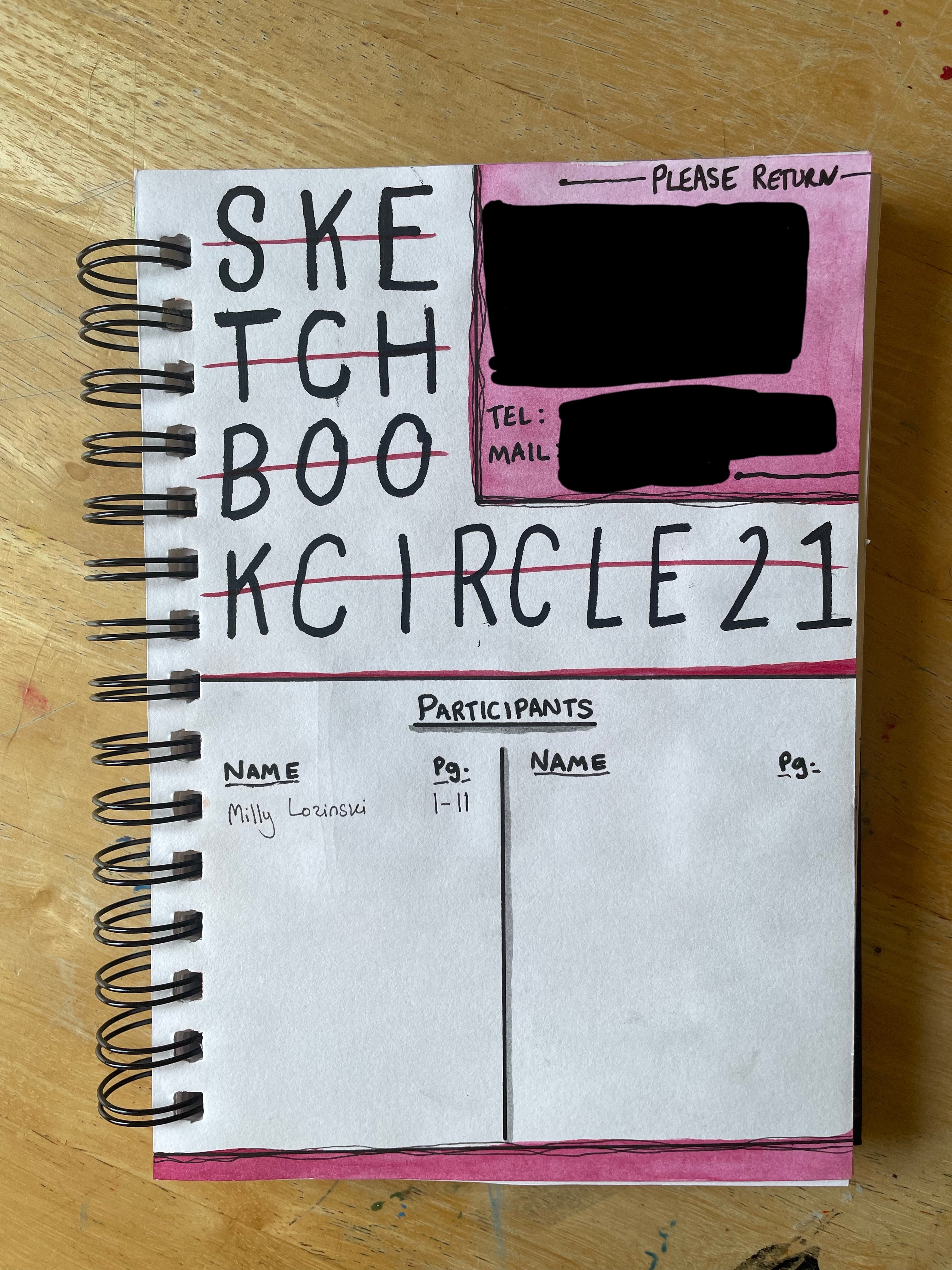
A requirement of Illustration 1: Sketchbooks is to join a sketchbook circle. As you can see, this isn’t my first sketchbook circle, as I joined a student-run one last year. I really enjoyed participating, so I’m more than happy to be doing one again. Last year my theme diverted from ‘the everyday’ as I chose to focus on the concept of time in my sketchbook pages. This year I stuck to the everyday theme as I had a slightly different challenge I wanted to fulfil.
I began getting a Scrawlrbox subscription last year.I paid for 6 months off the bat so I could really get a feel for the box and whether I liked it. I found that I wasn’t actually using the products sent to me as I was struggling to find ways to add them to other pieces of work. You typically only get one or two colours of product, leaving it difficult to use them independently. I decided to cancel my subscription as I wasn’t getting my money’s worth.
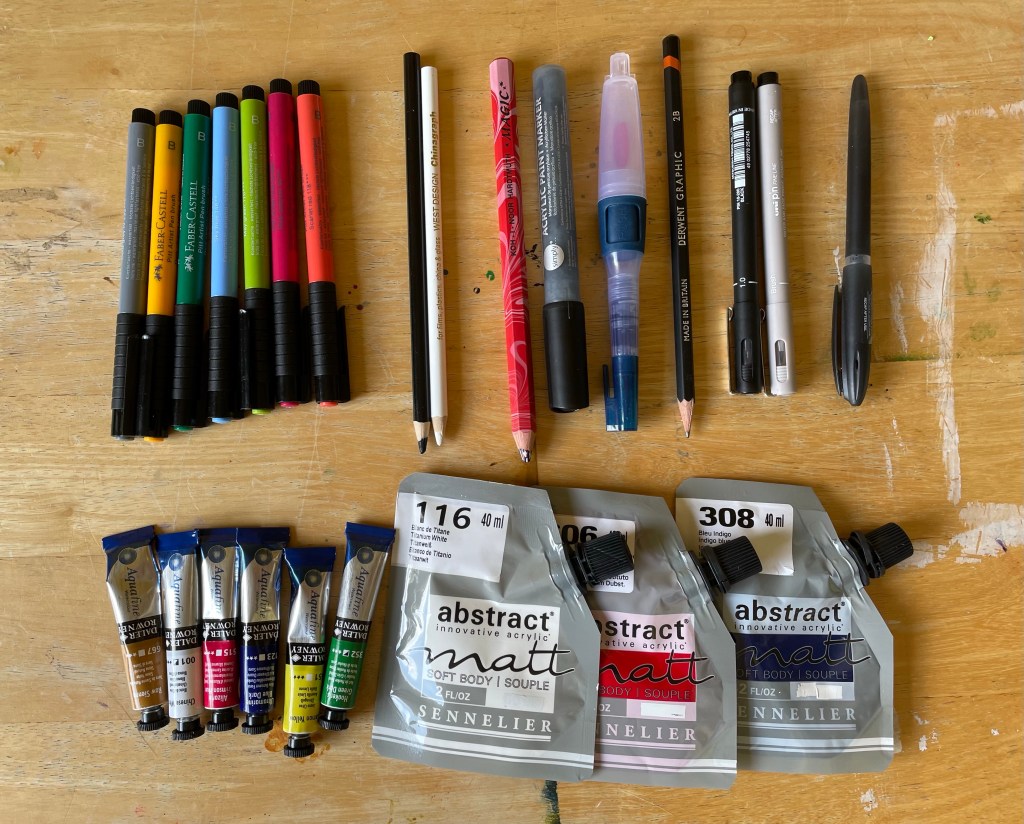
Those art materials have just been lying around in my studio ever since,waiting to be used. I keep planning to use them and procrastinating it. I decided that for my sketchbook I would use these materials and nothing else, limiting myself to experiment with them, think outside the box, and figure out how (or if) they work for me.
The materials I limited myself to
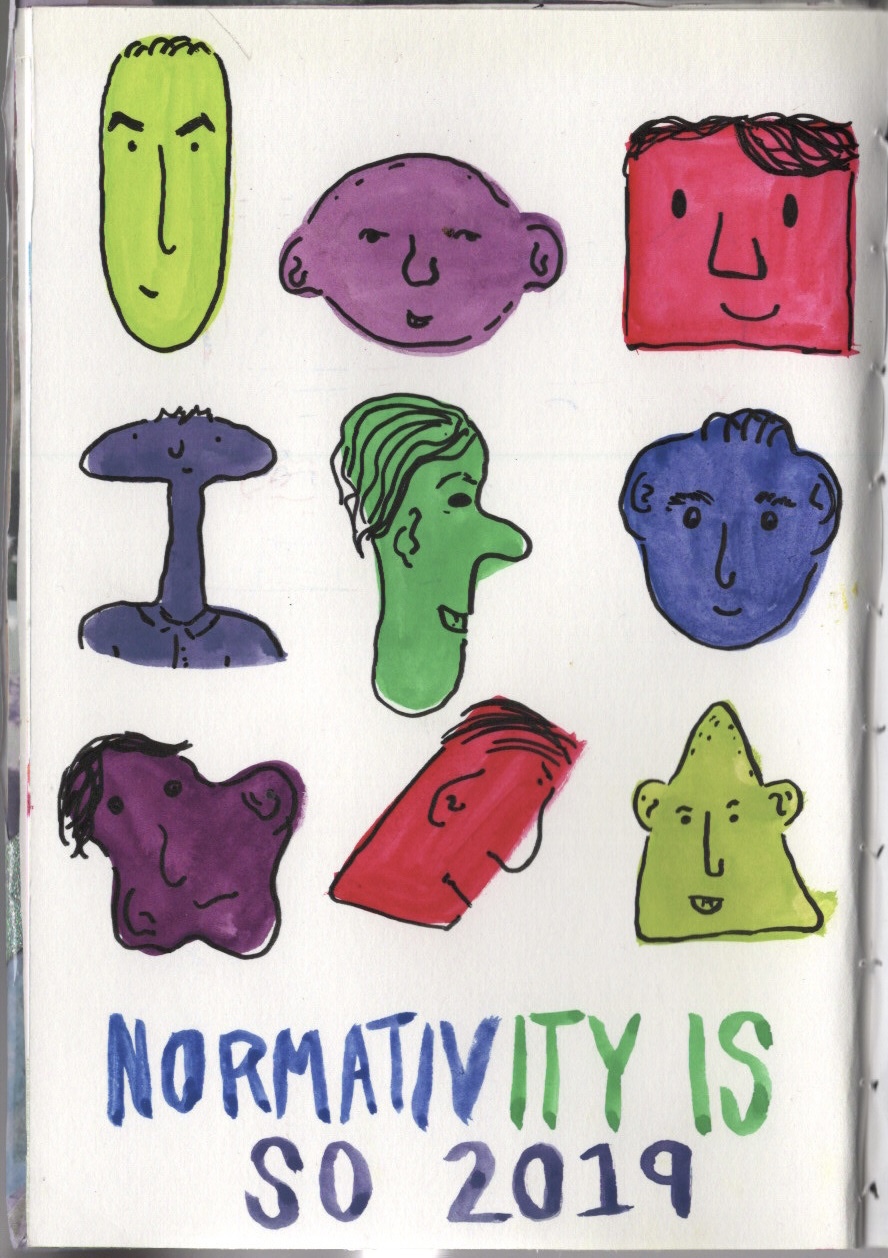
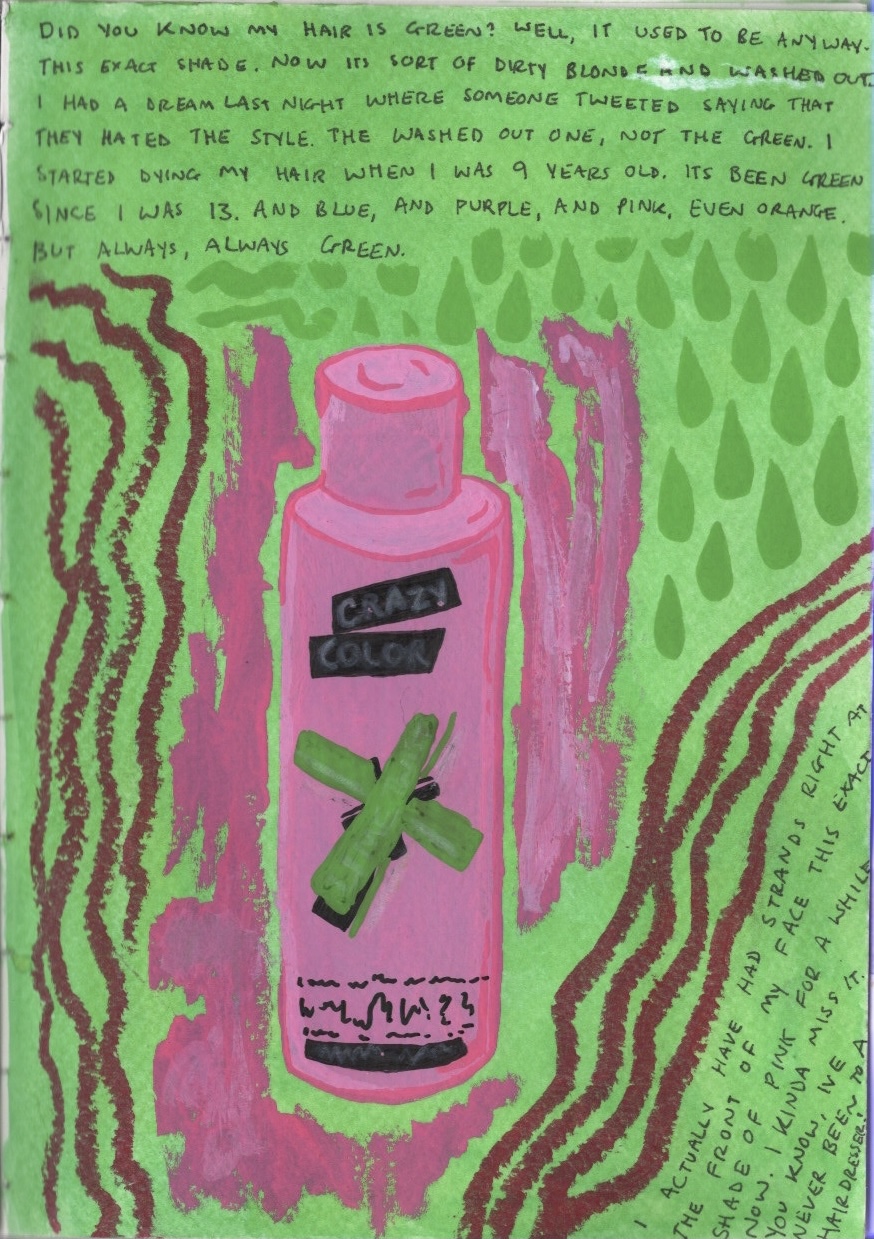
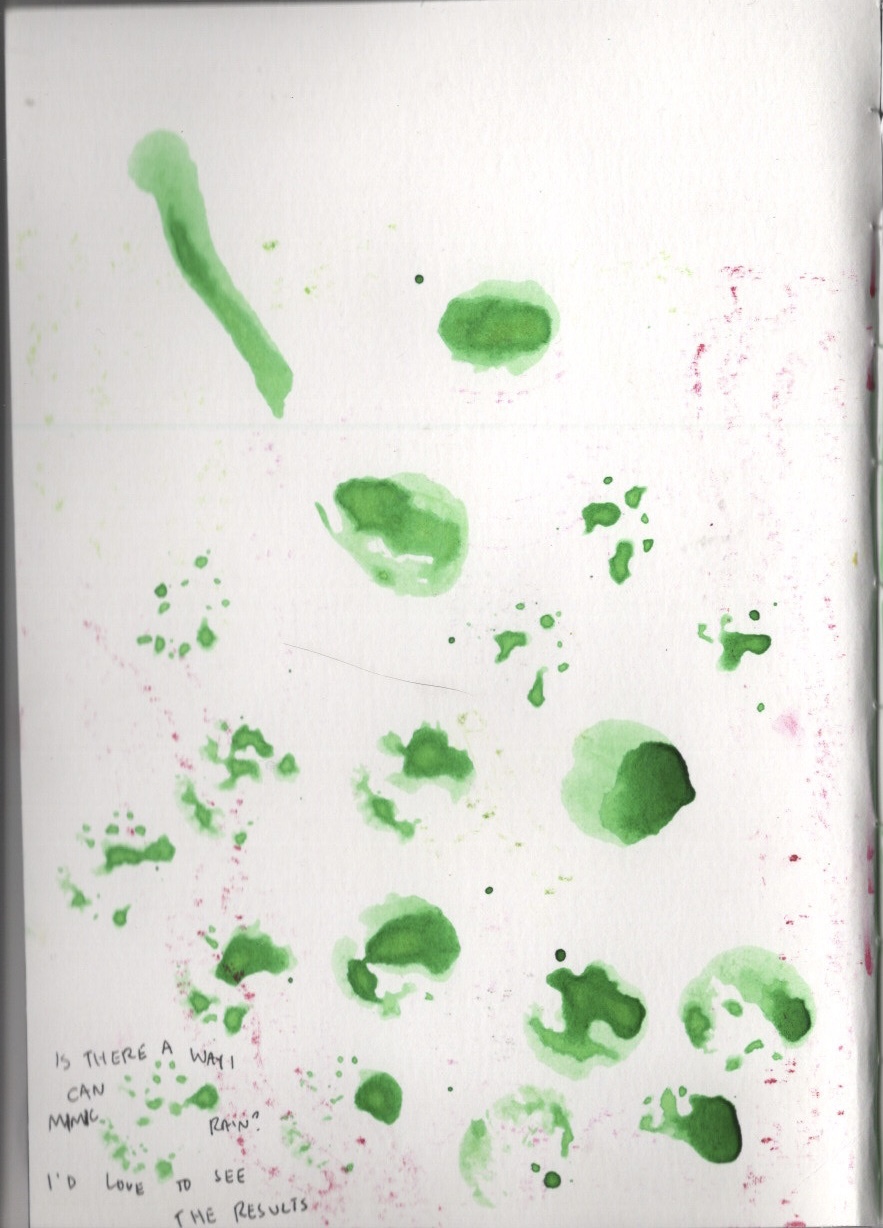
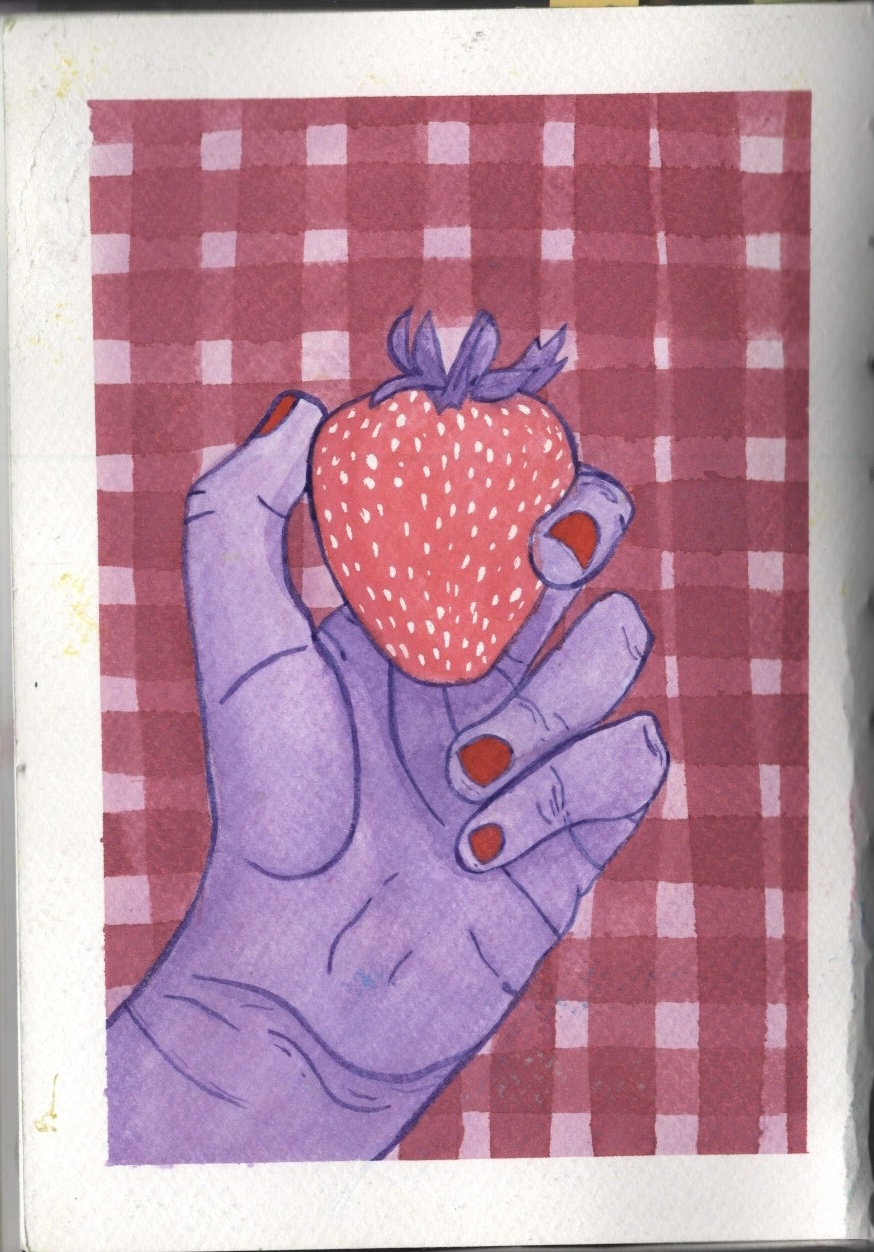
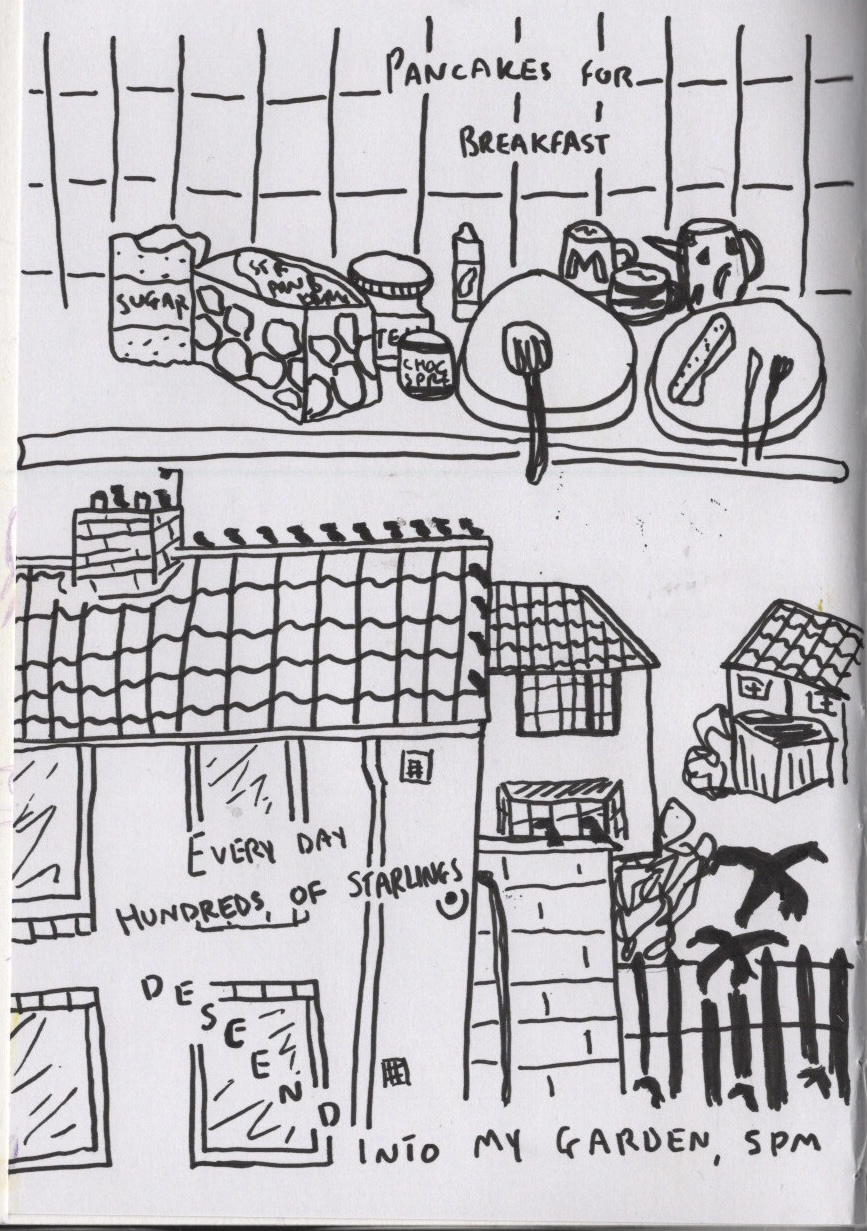
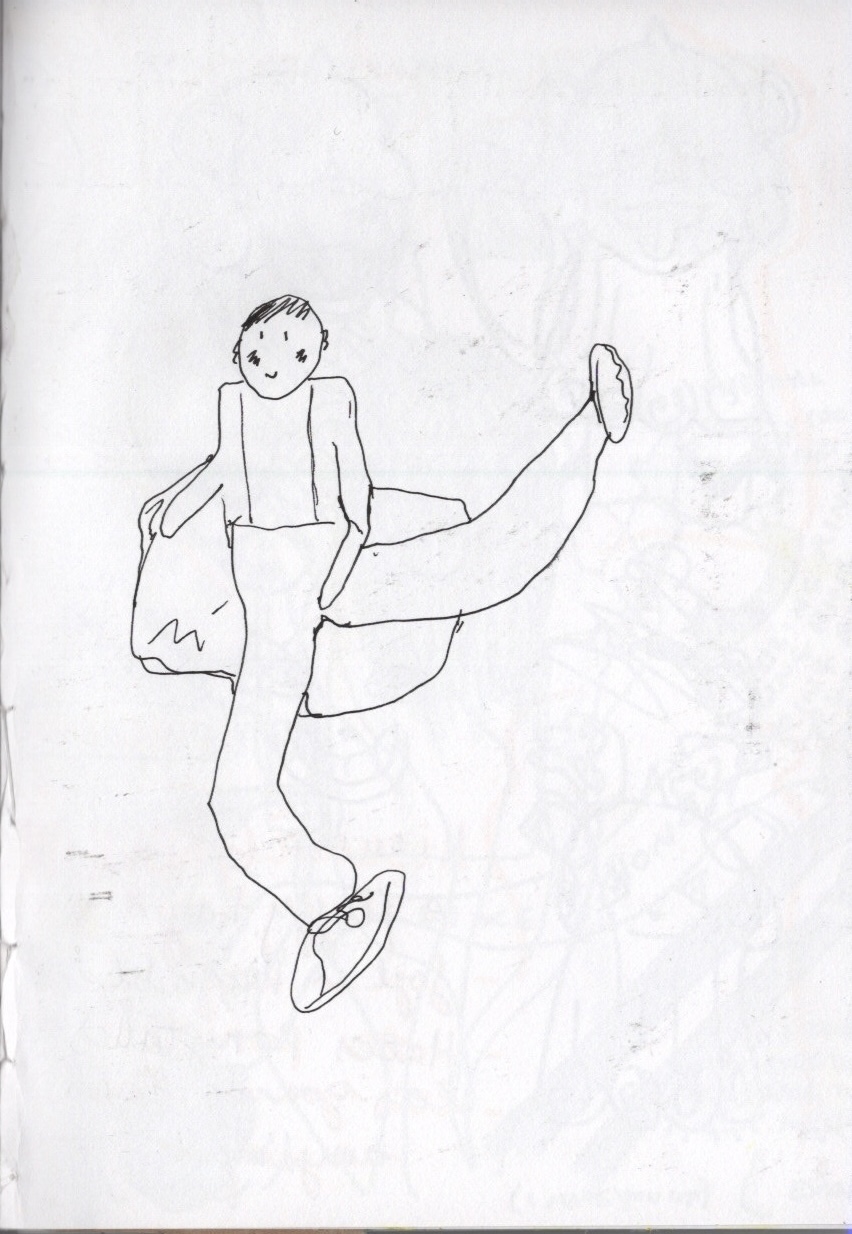
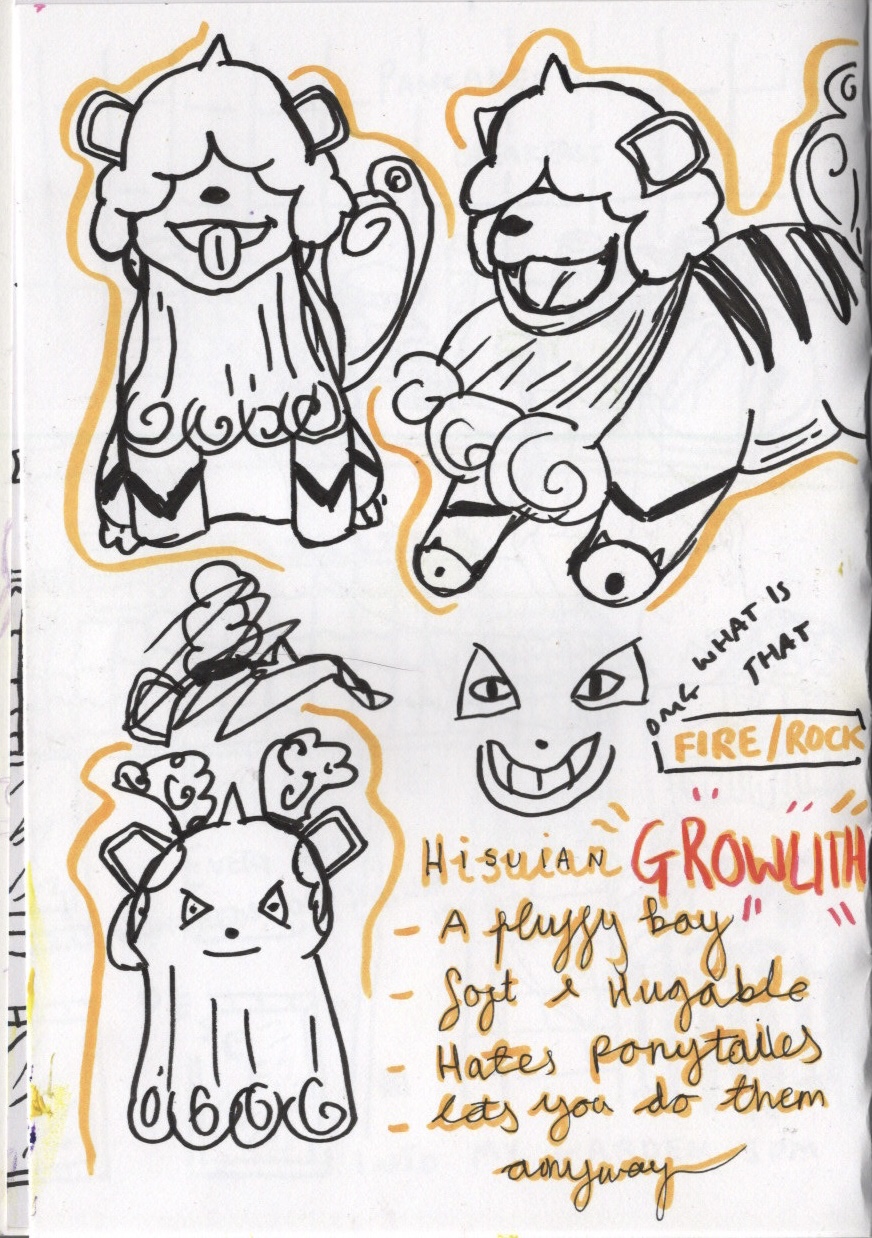
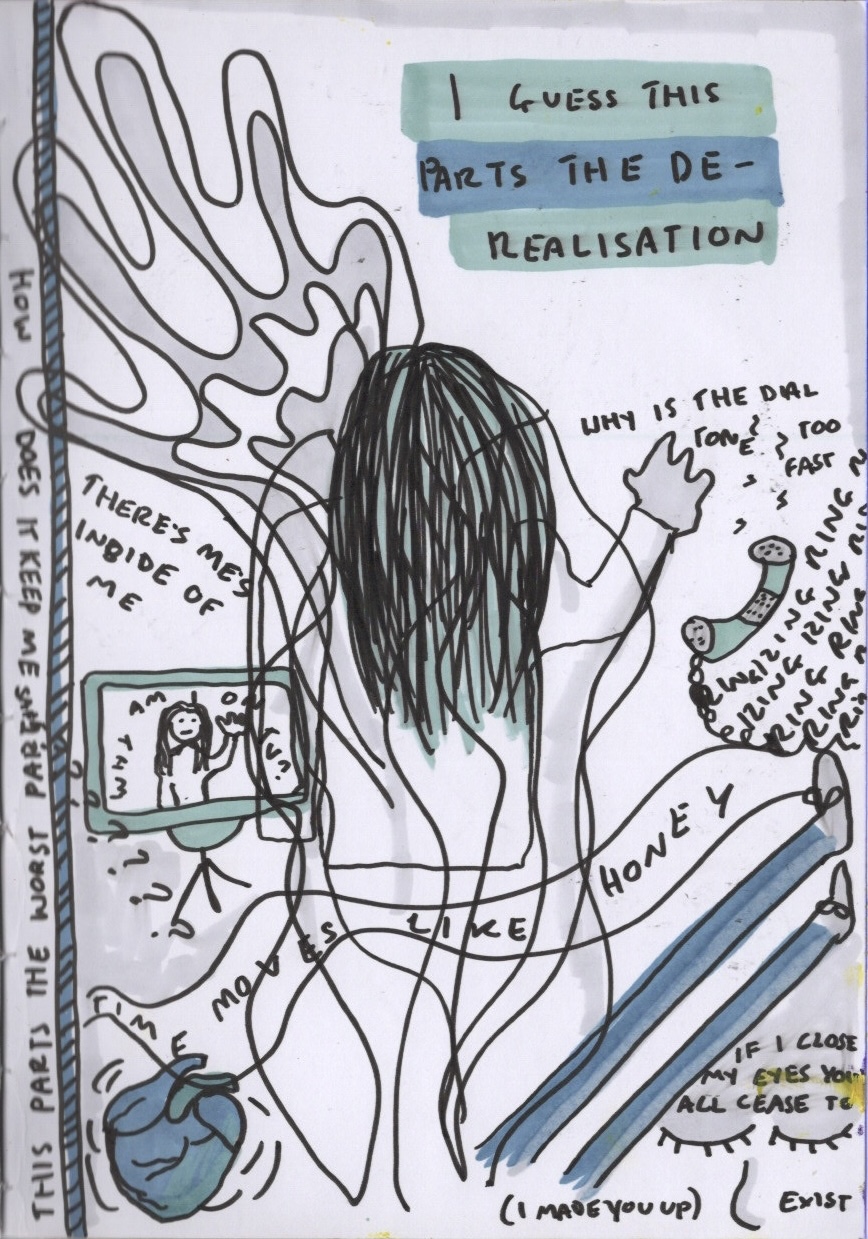
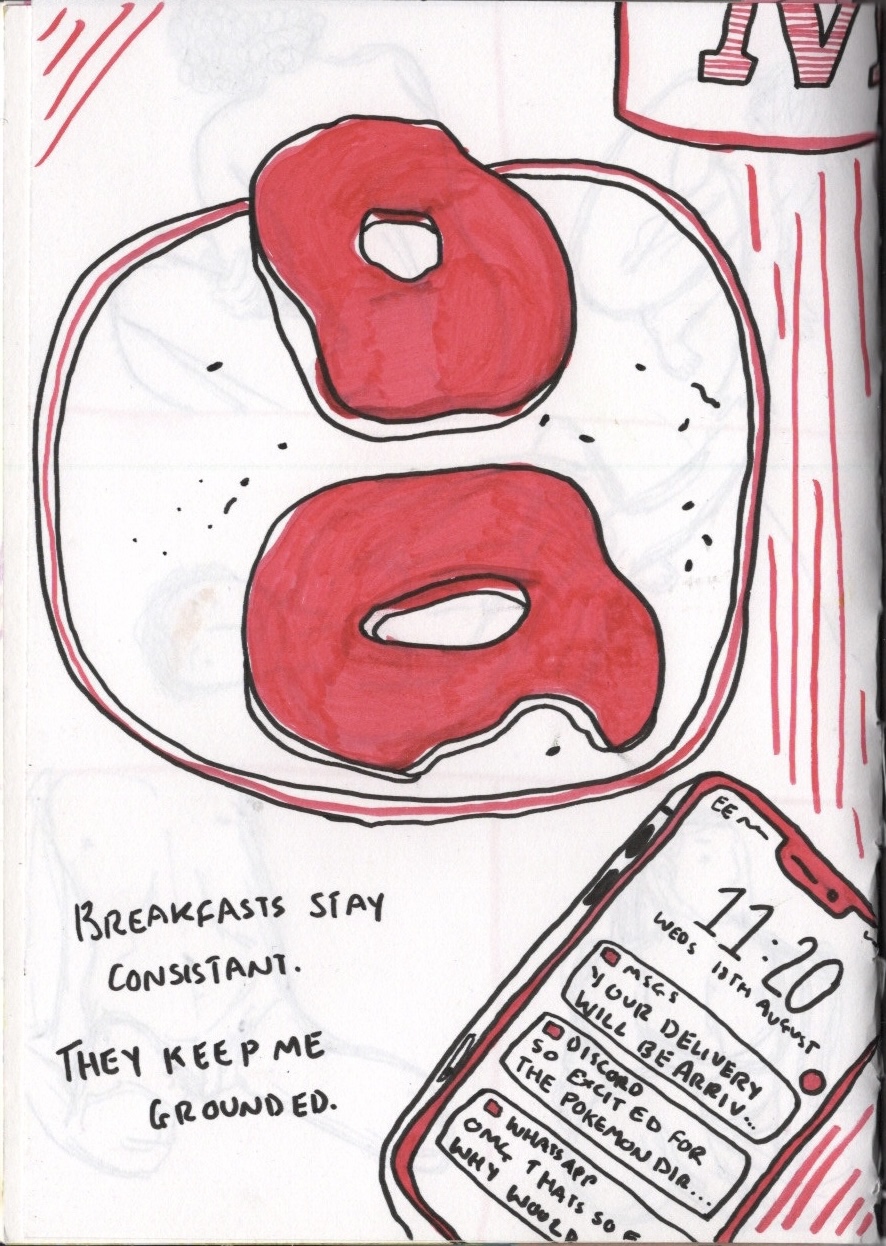
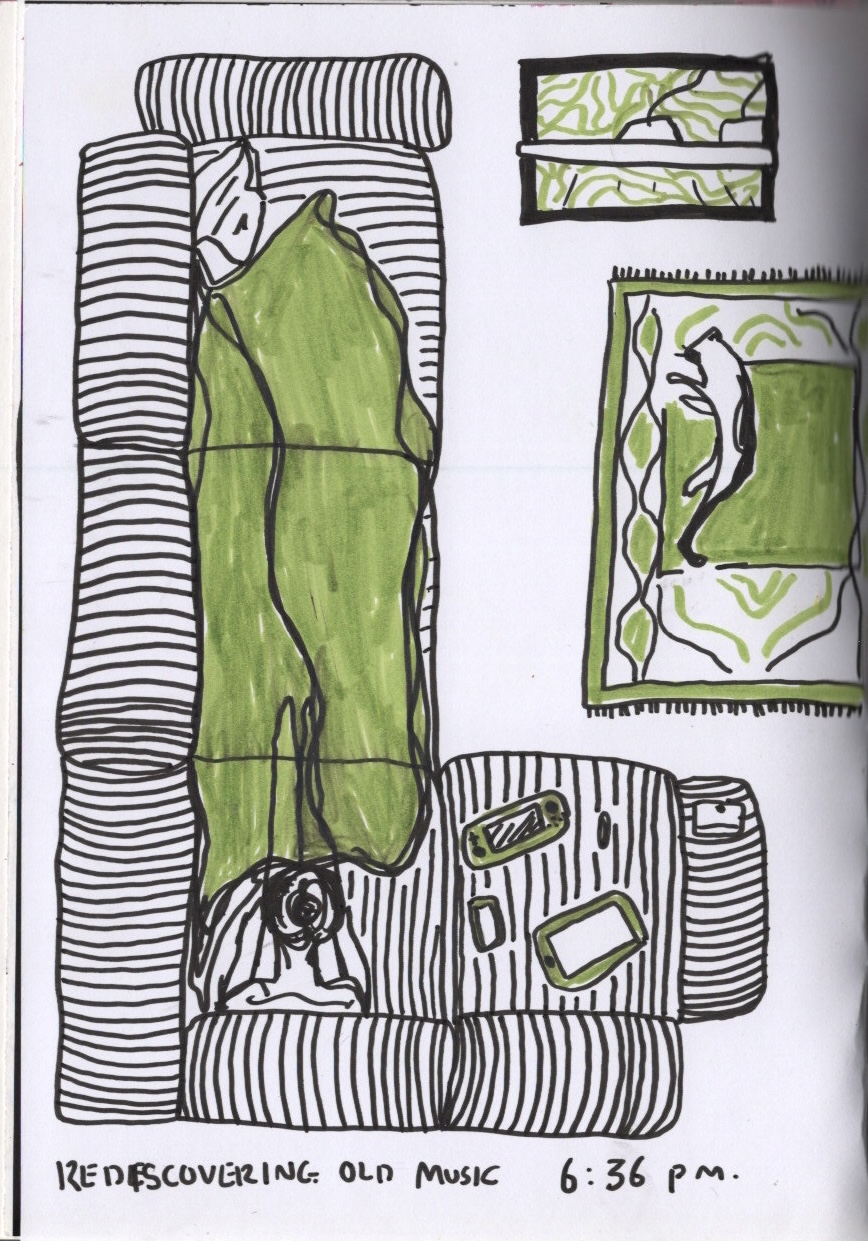
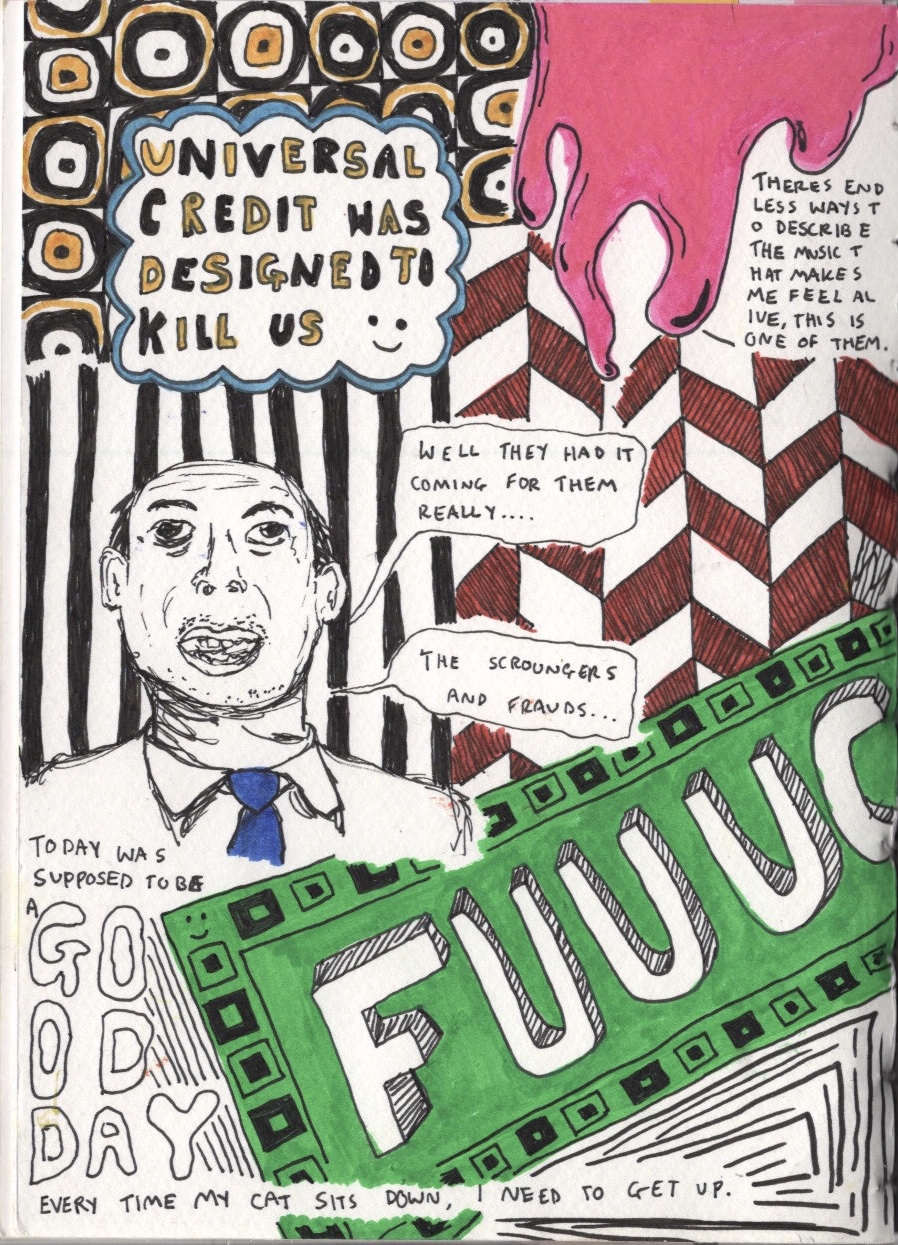
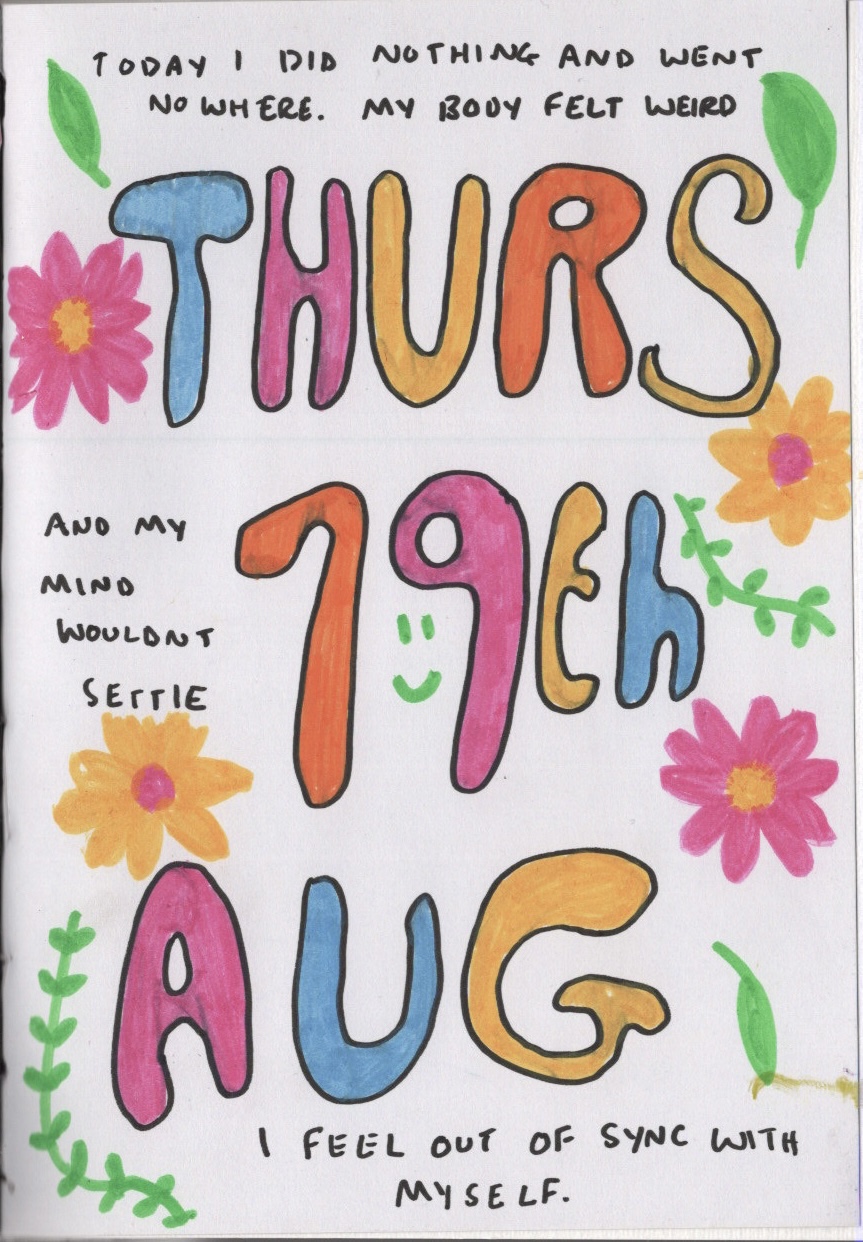
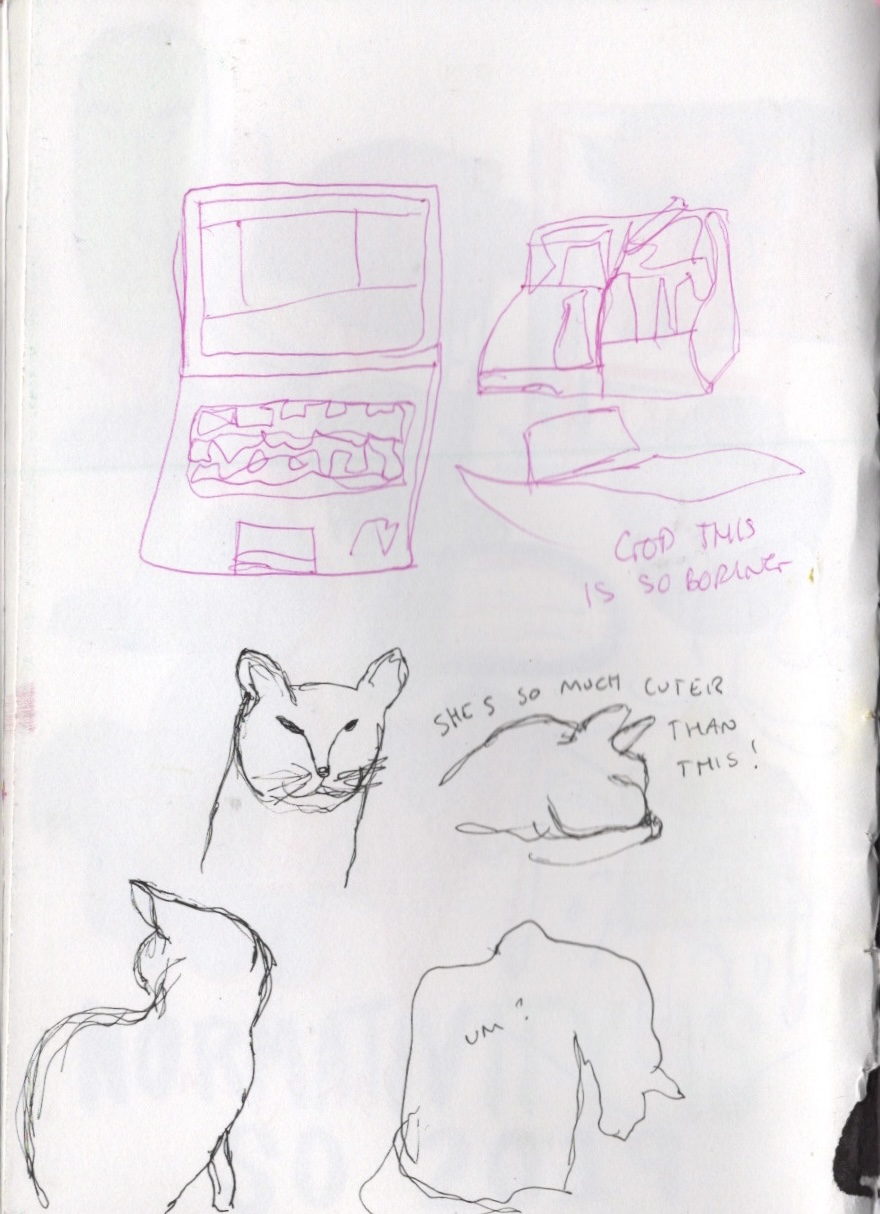
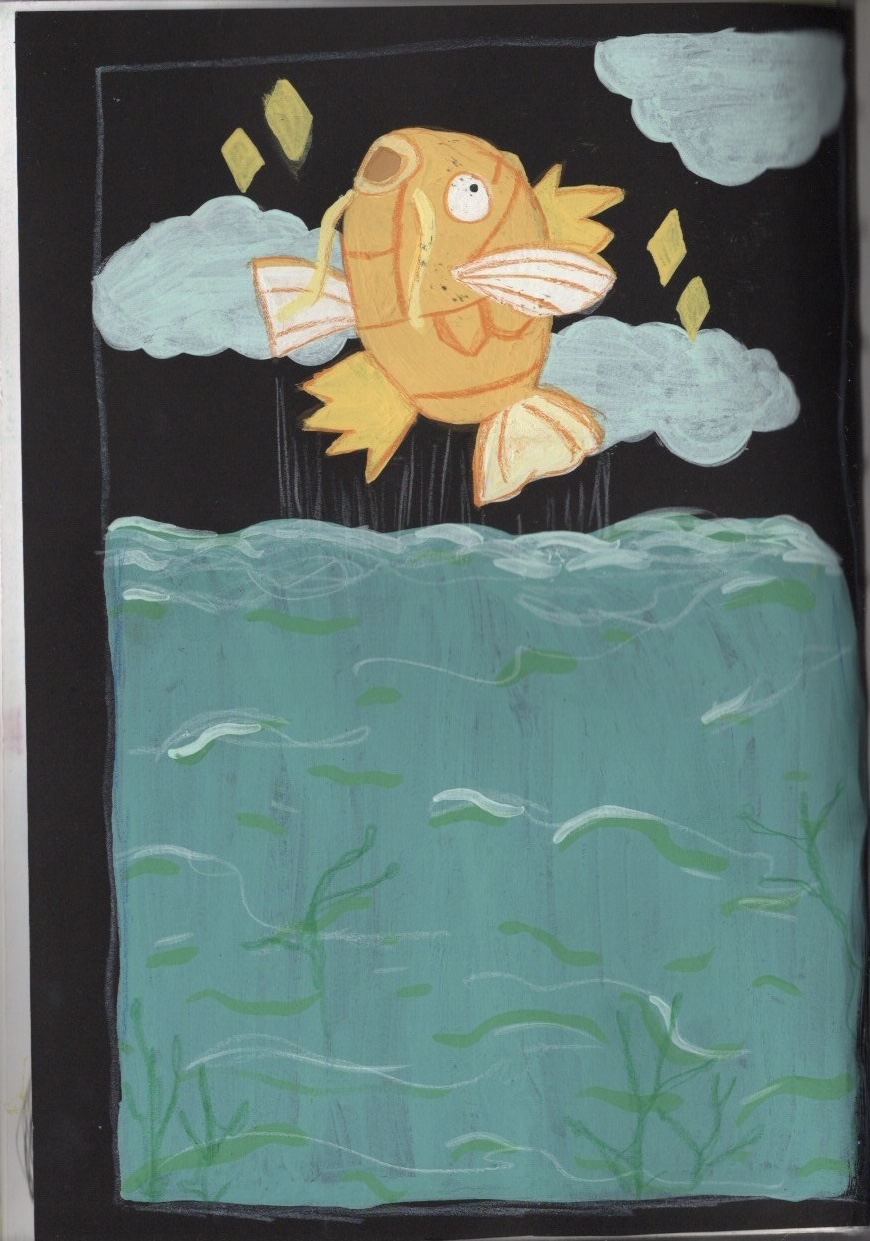
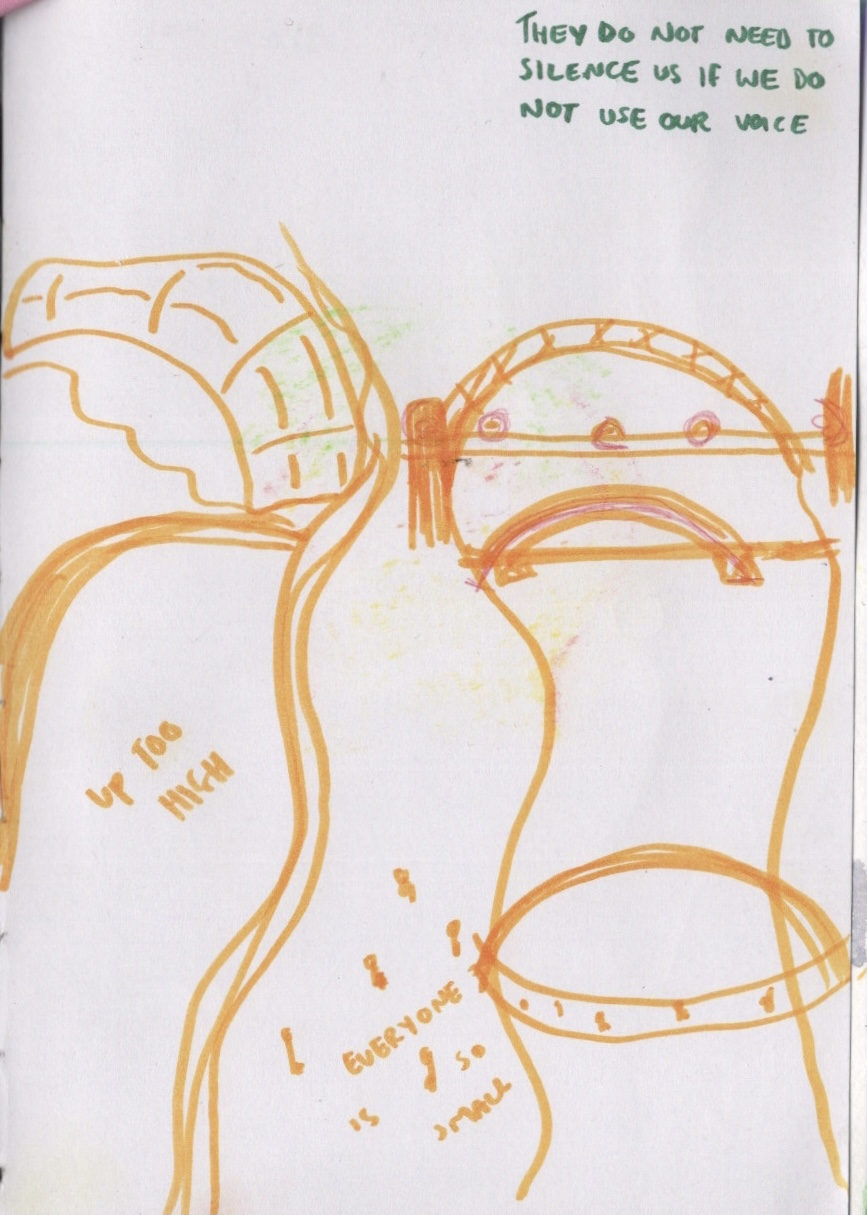
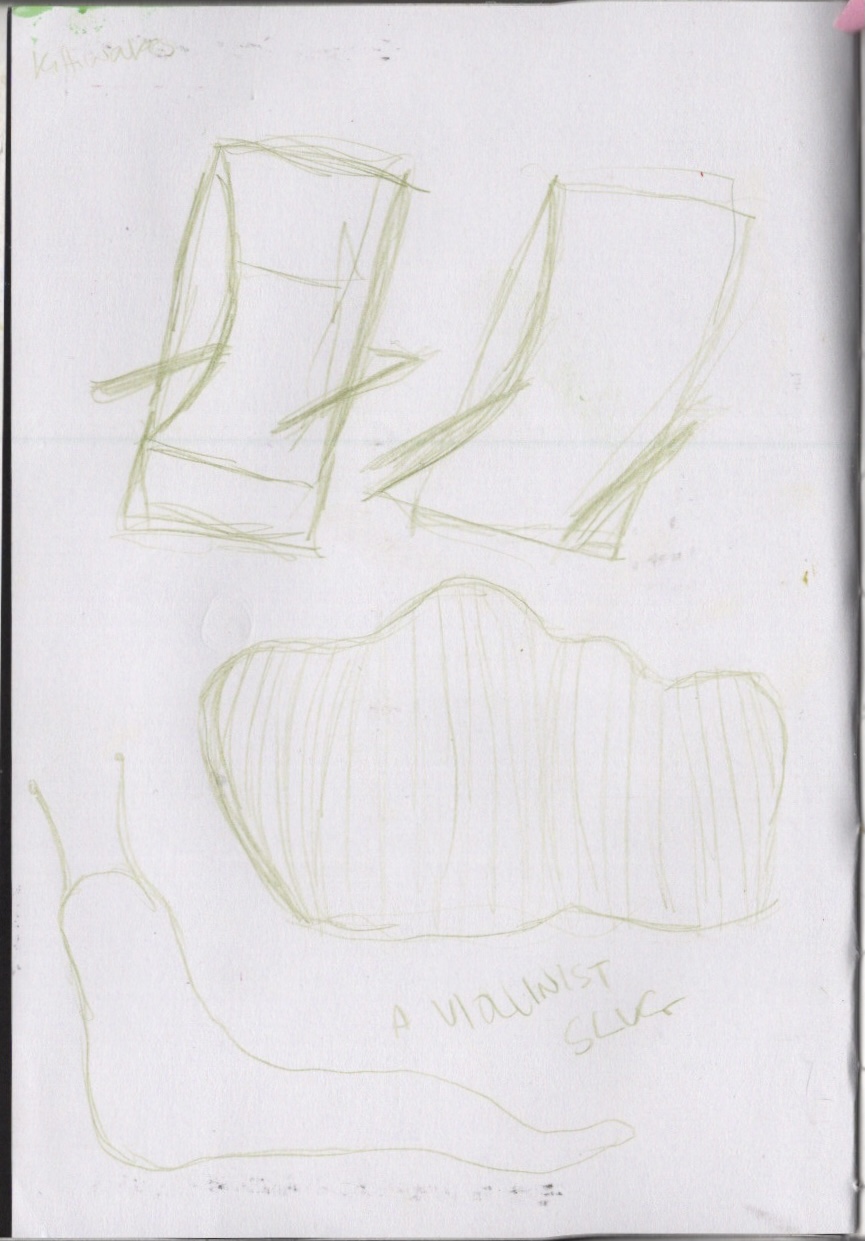
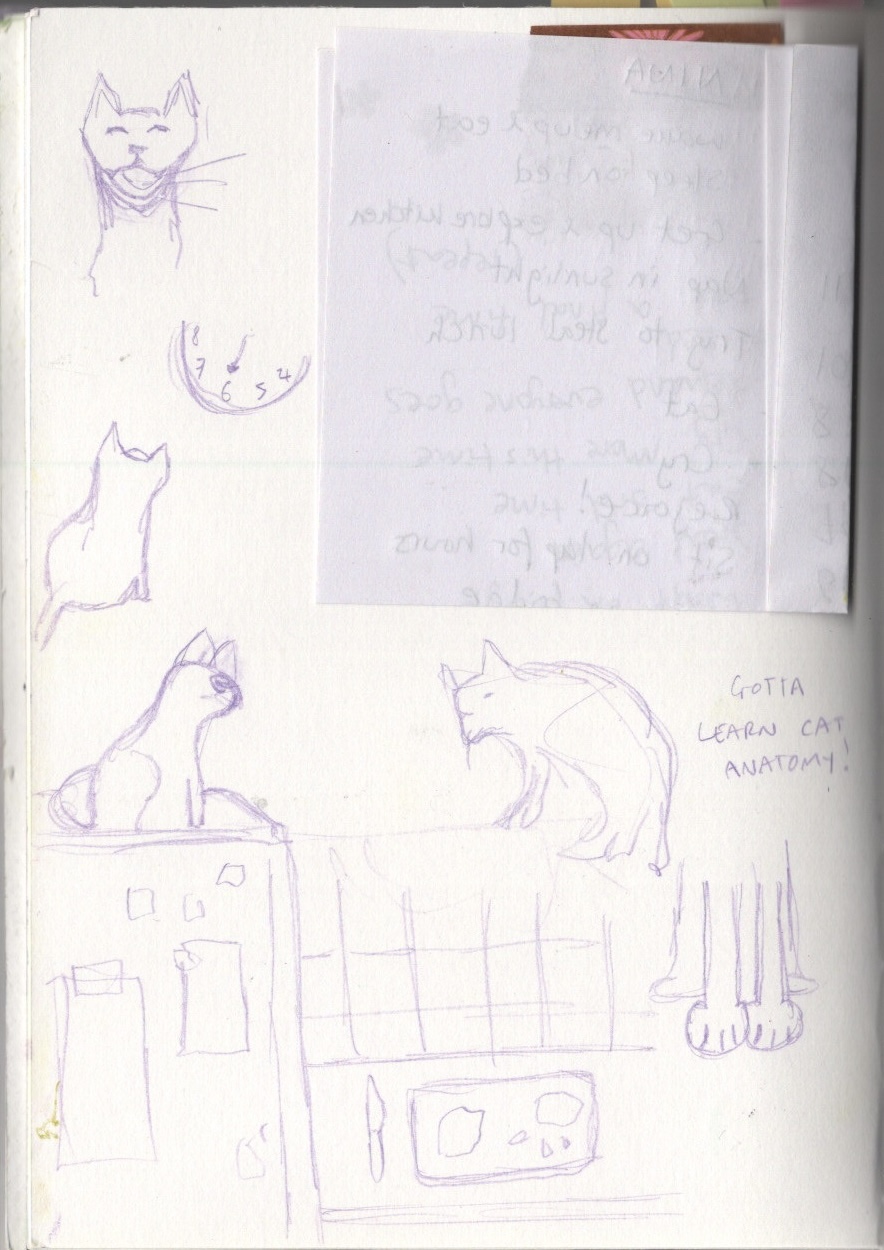
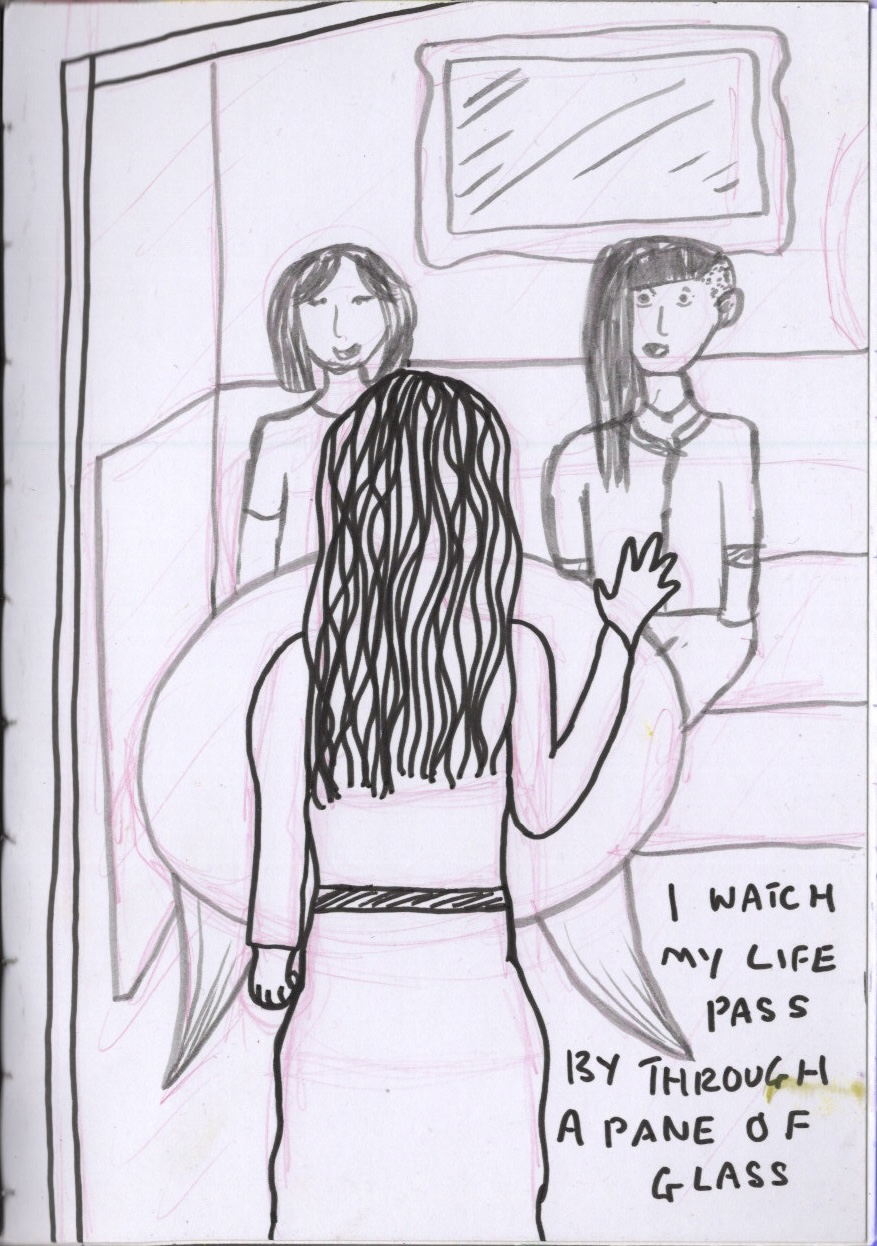
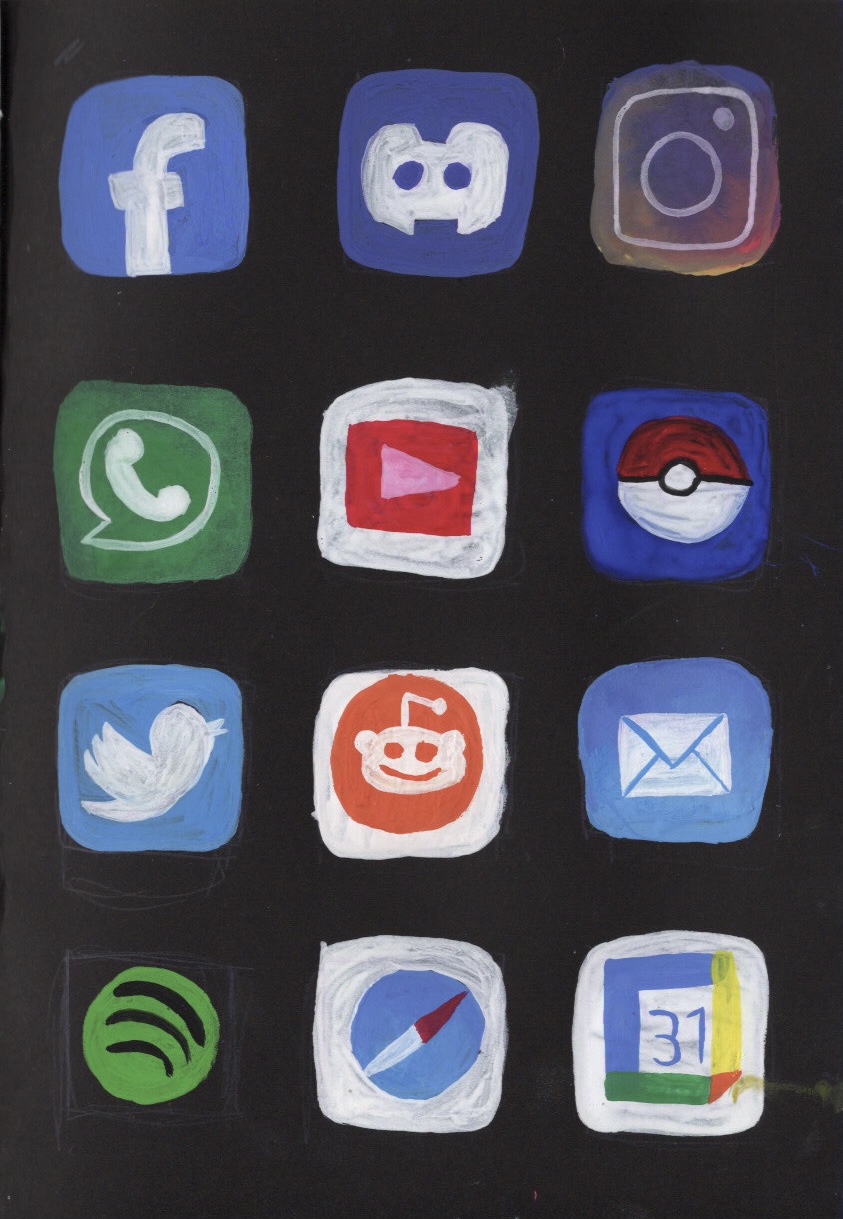
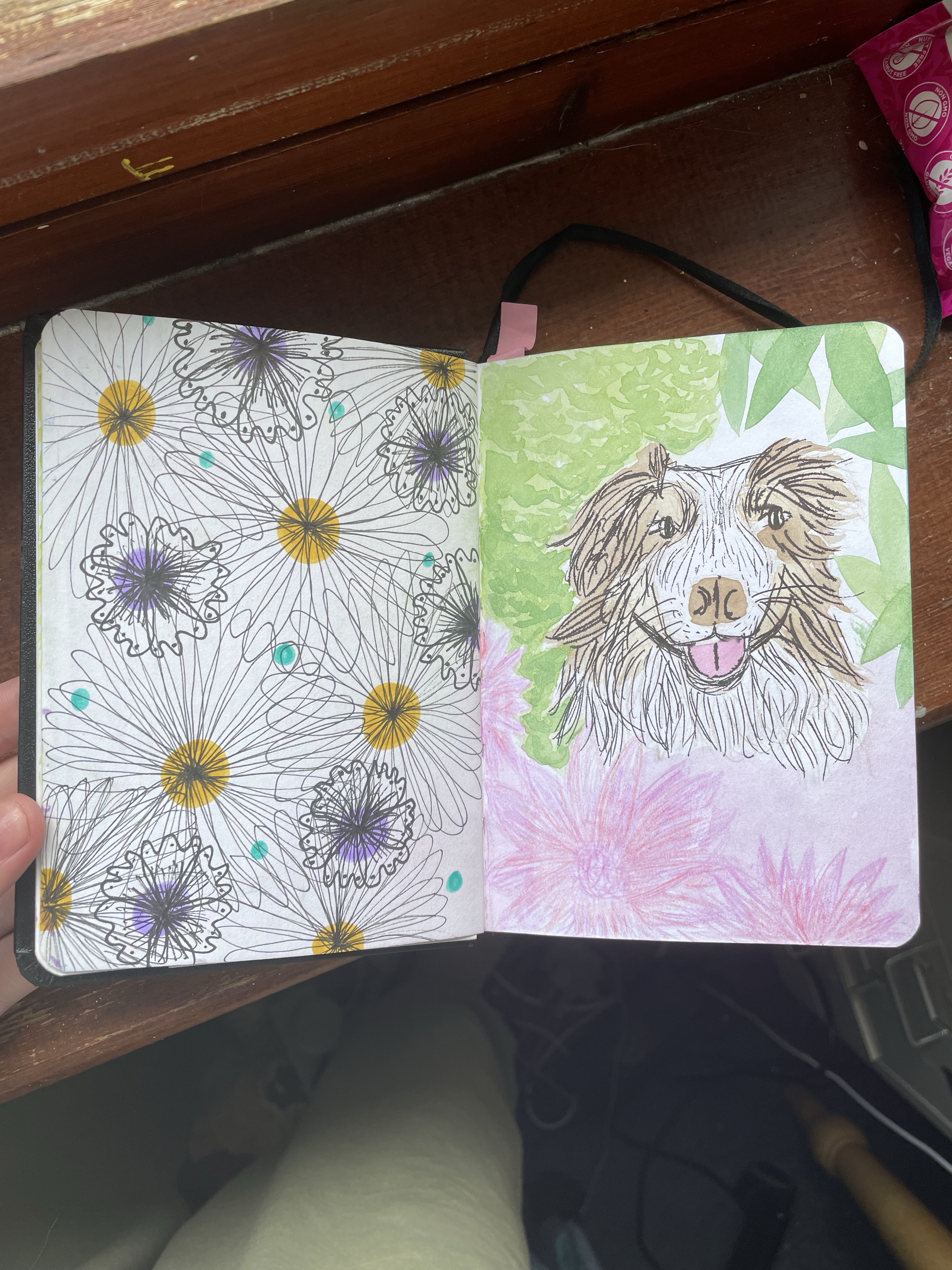
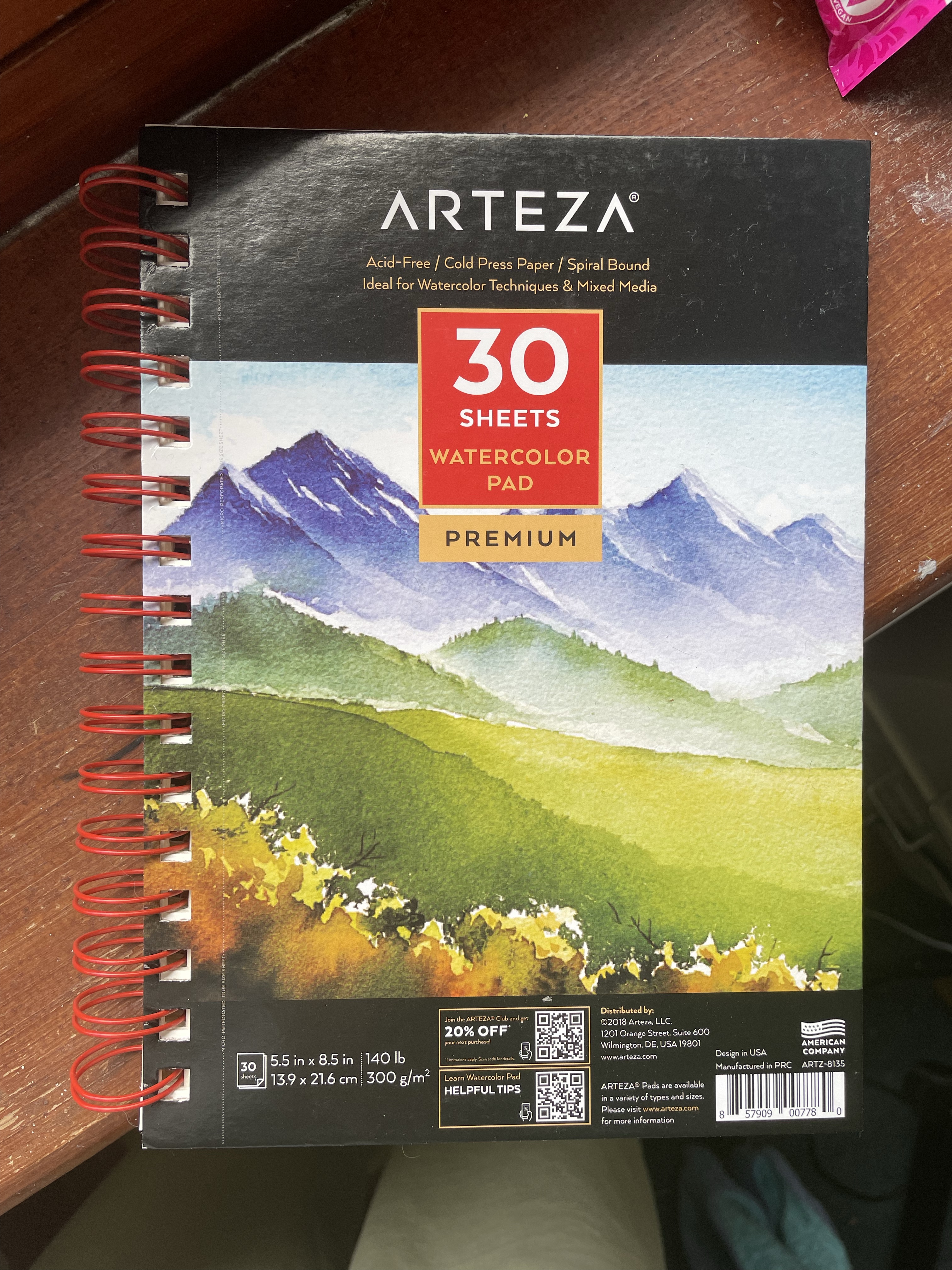
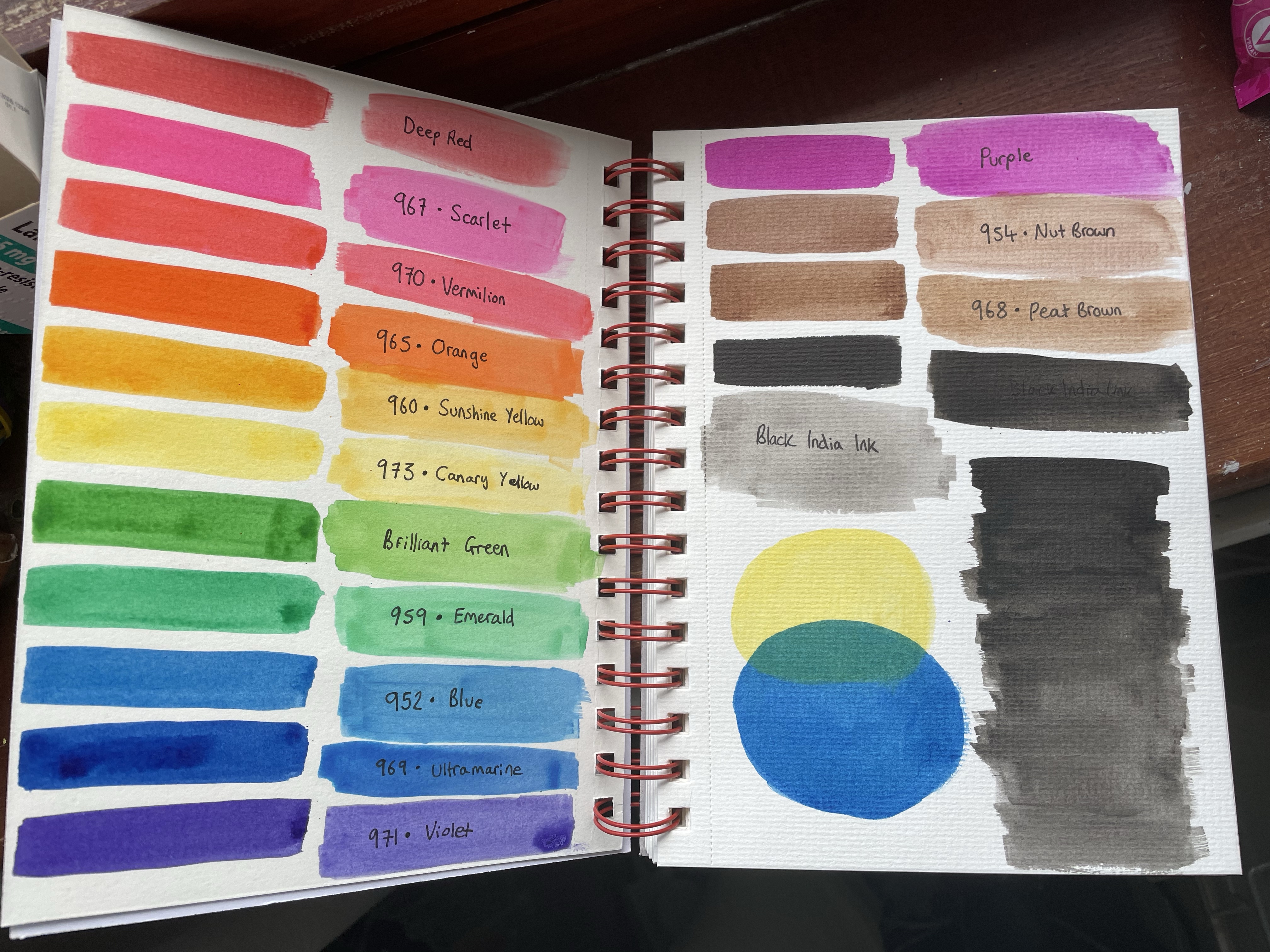
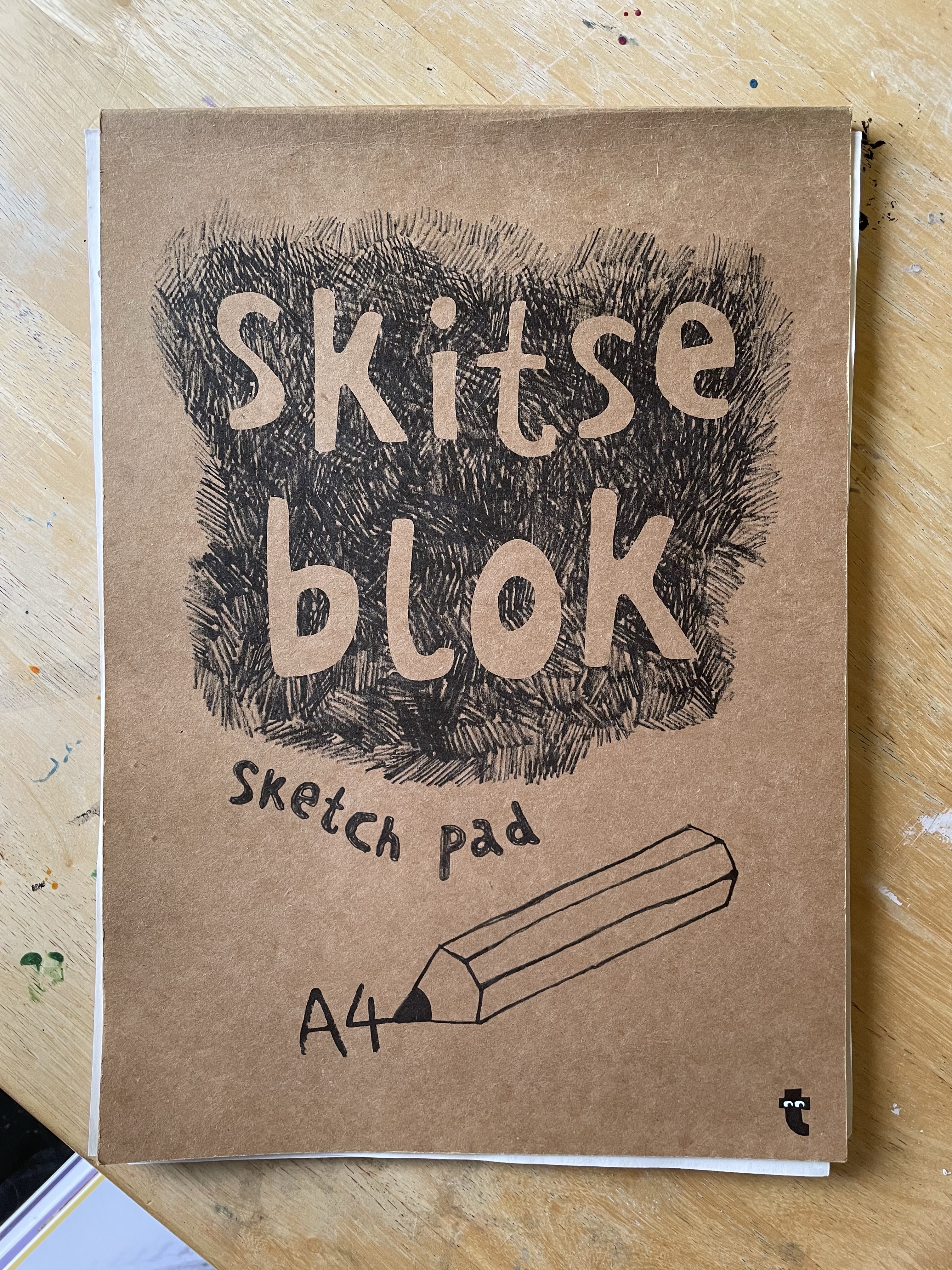
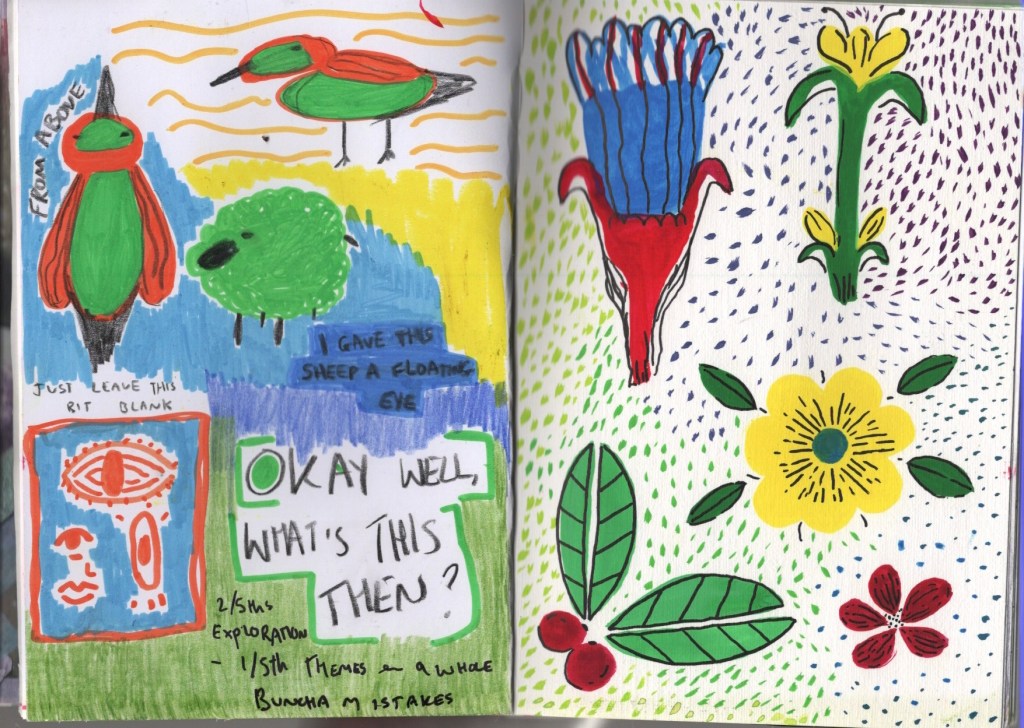
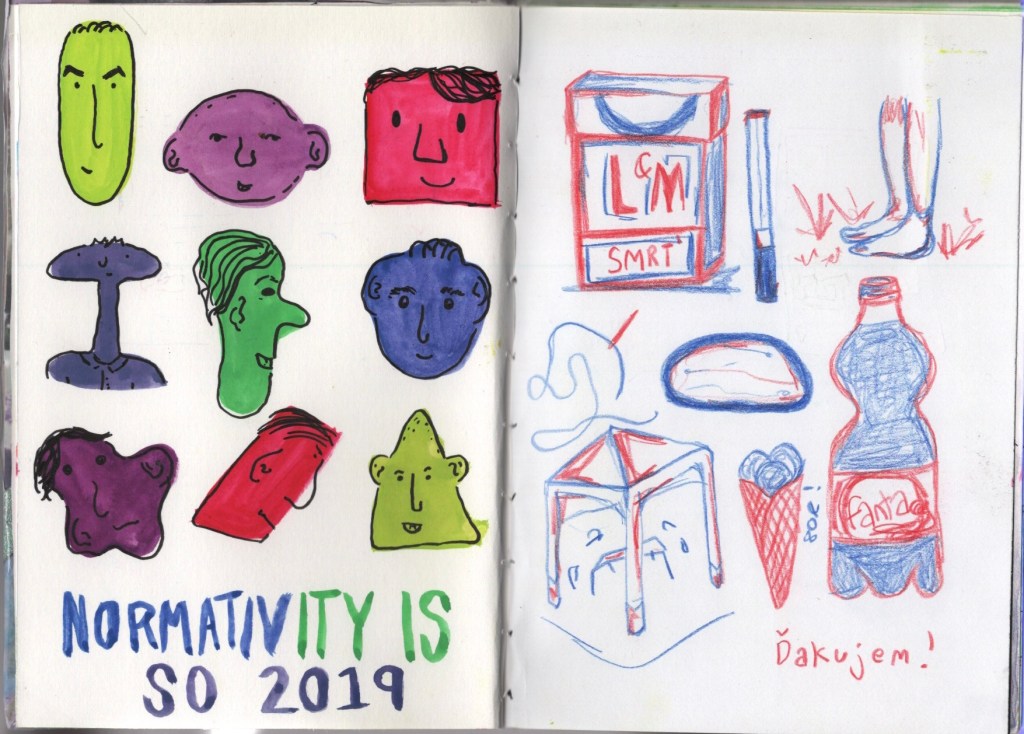
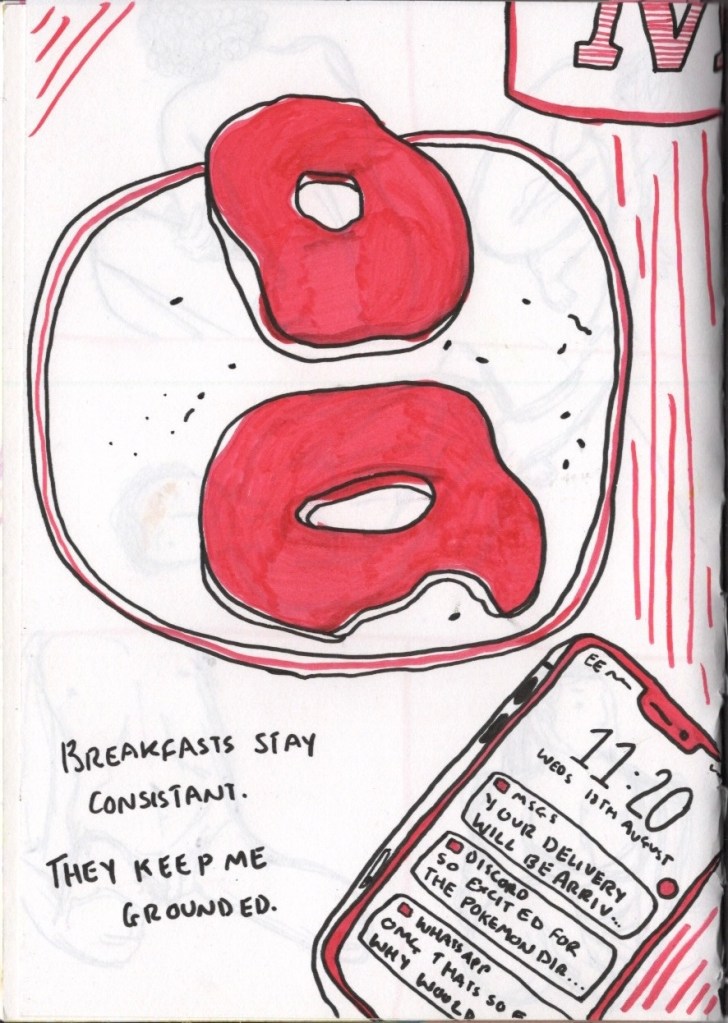
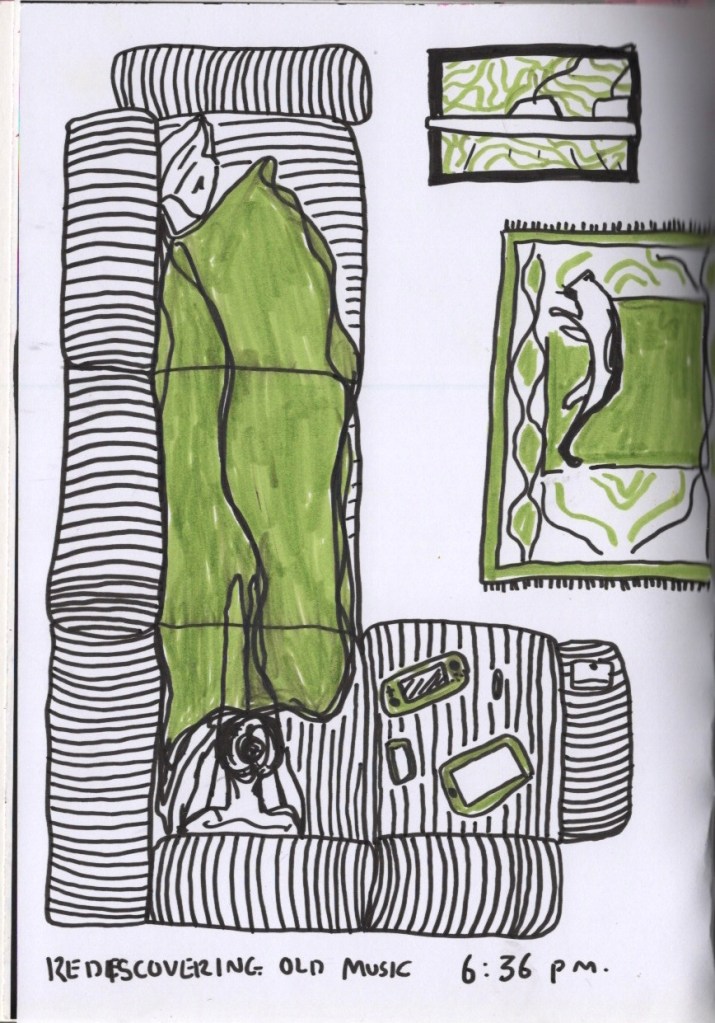
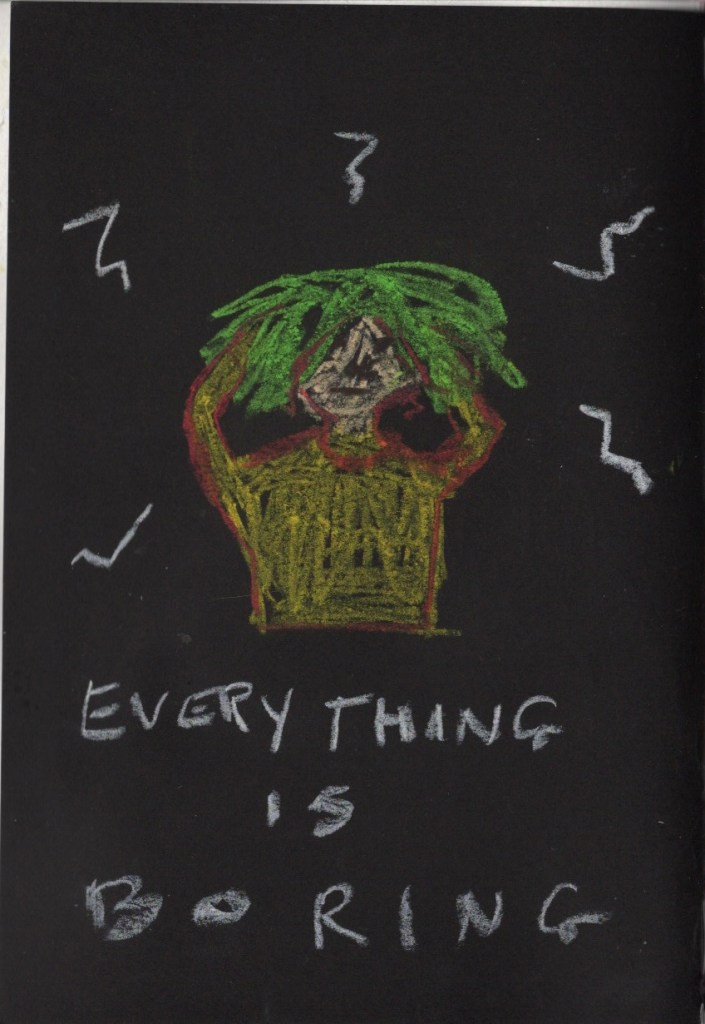
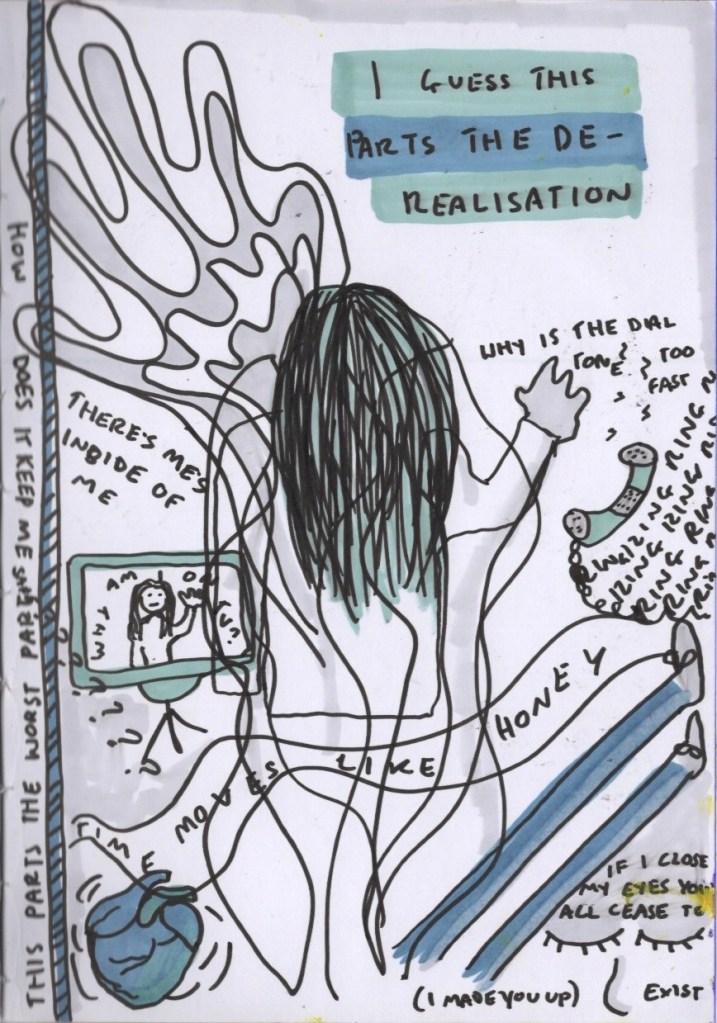
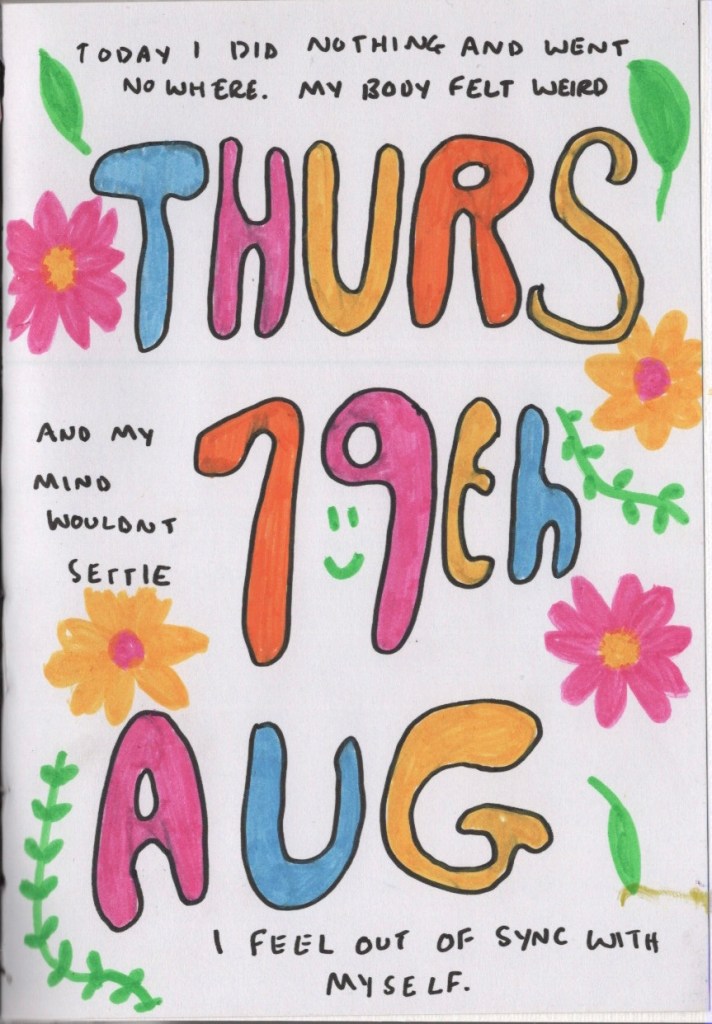
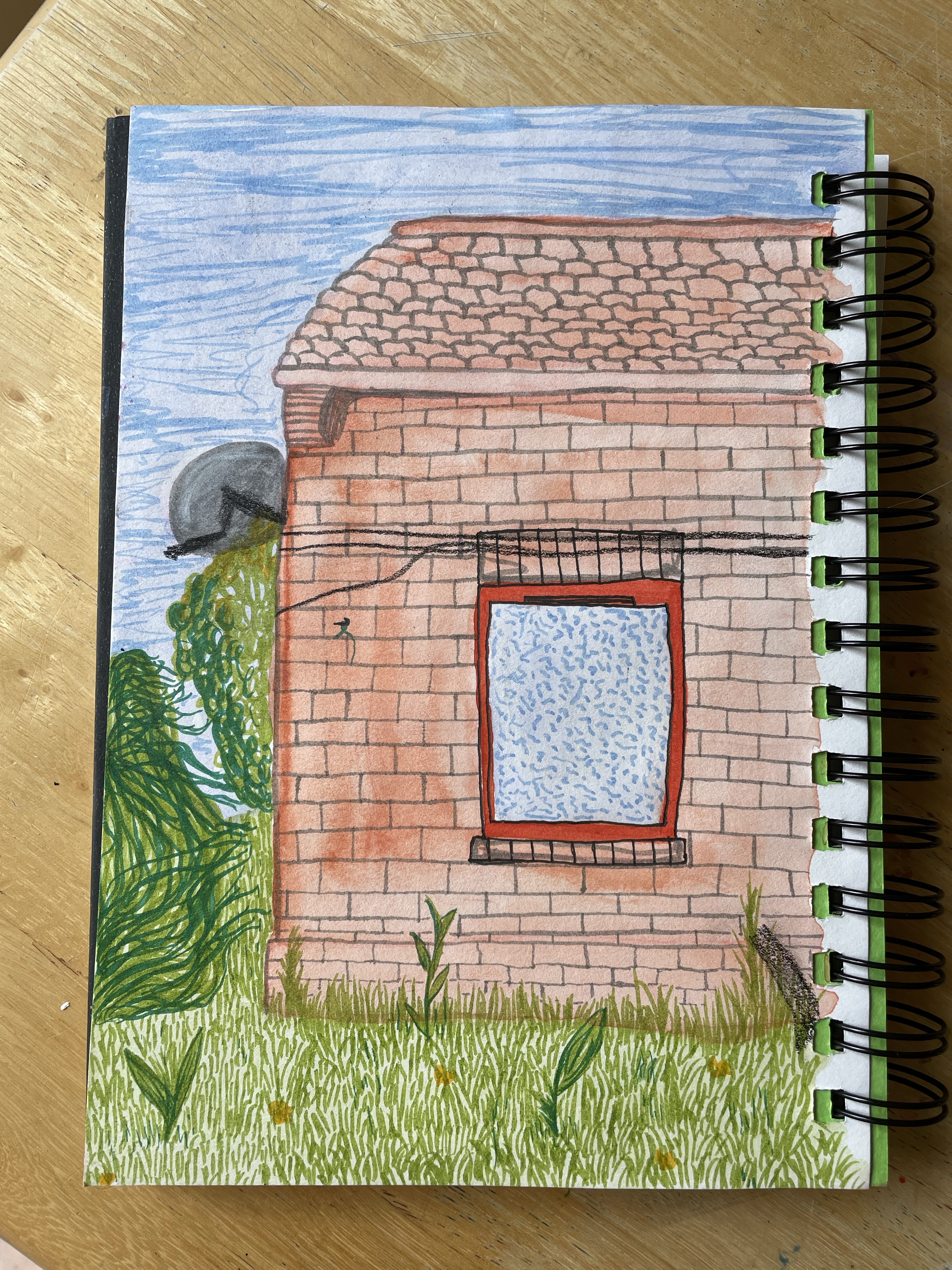
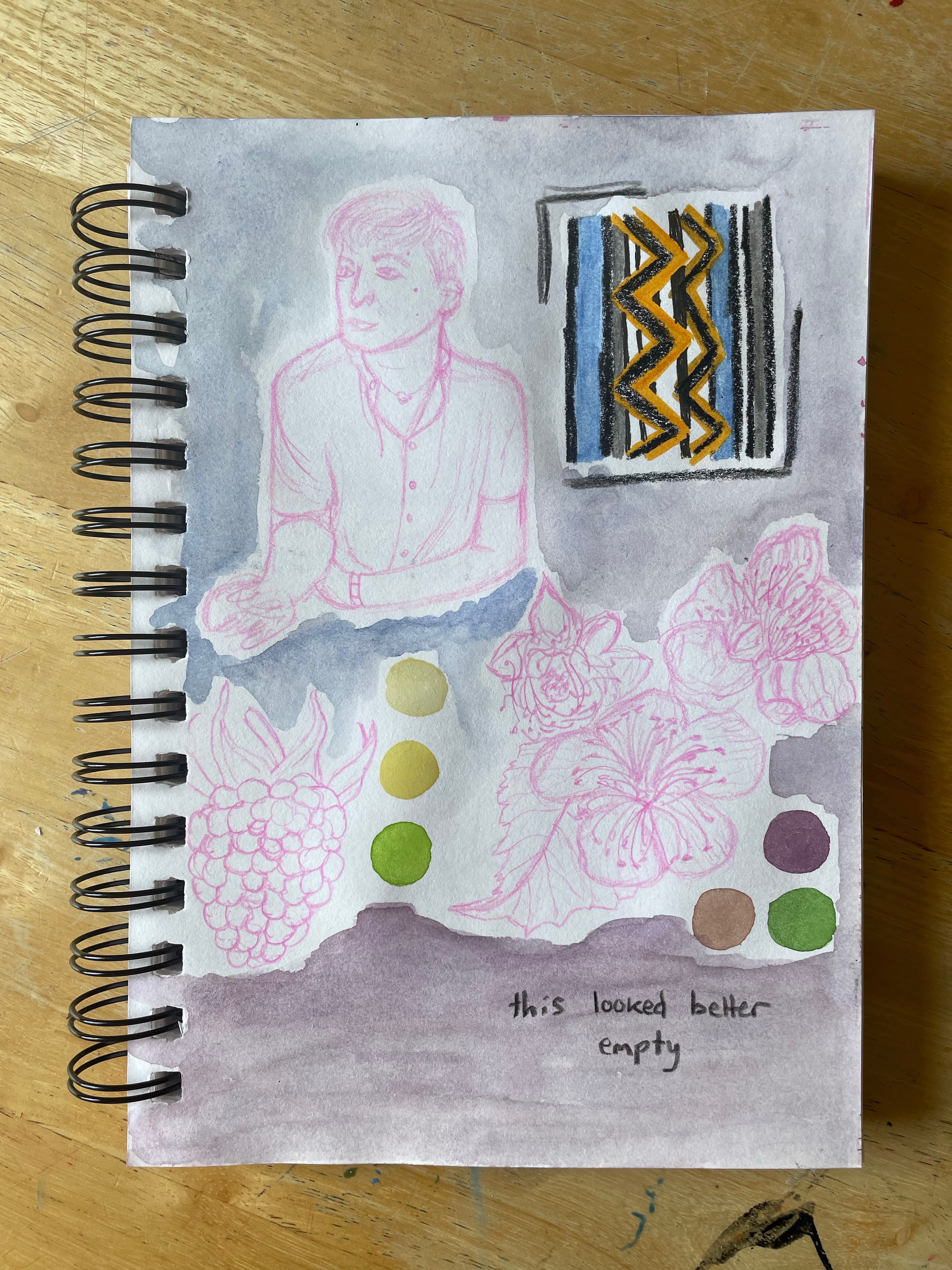
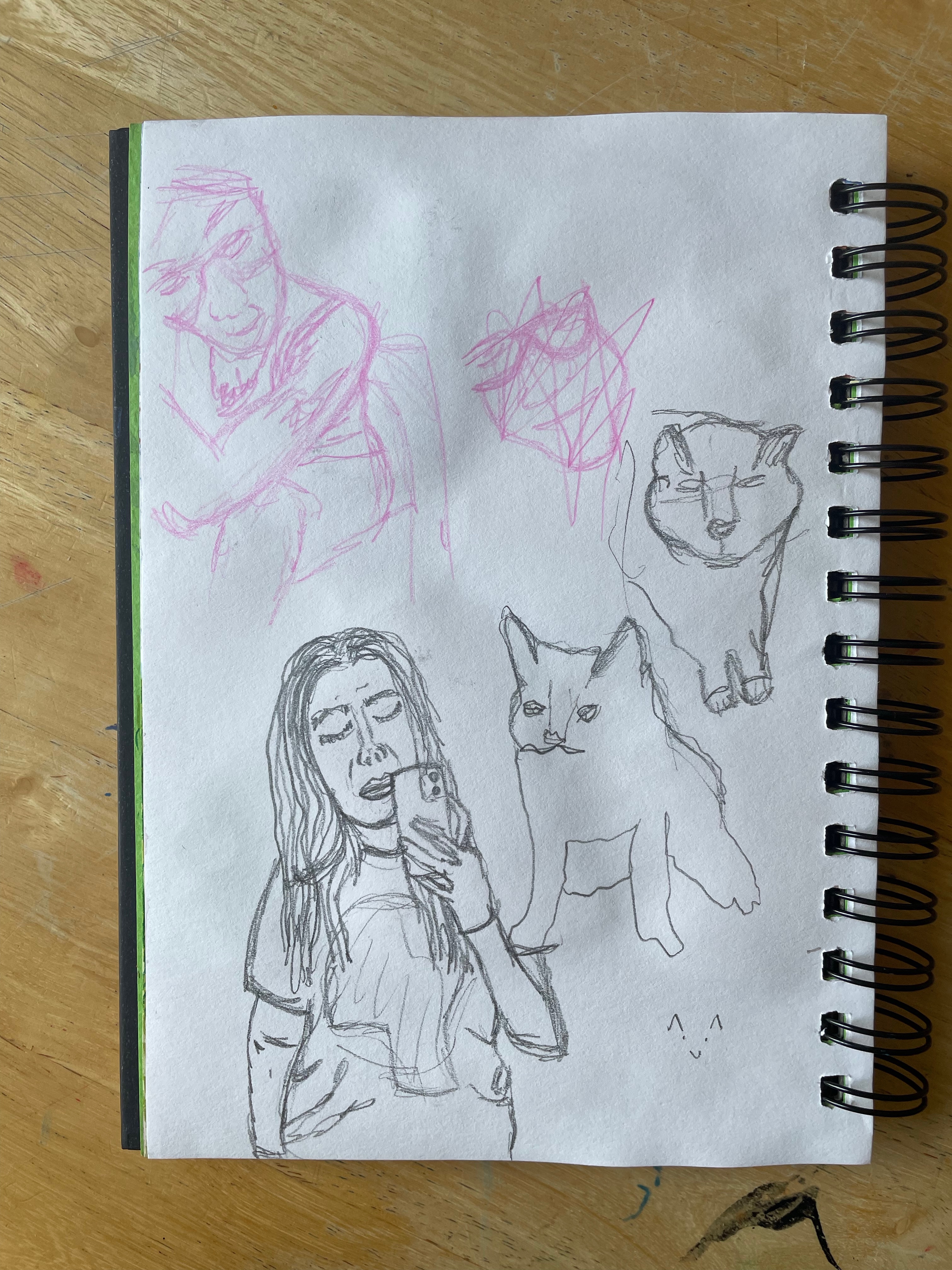
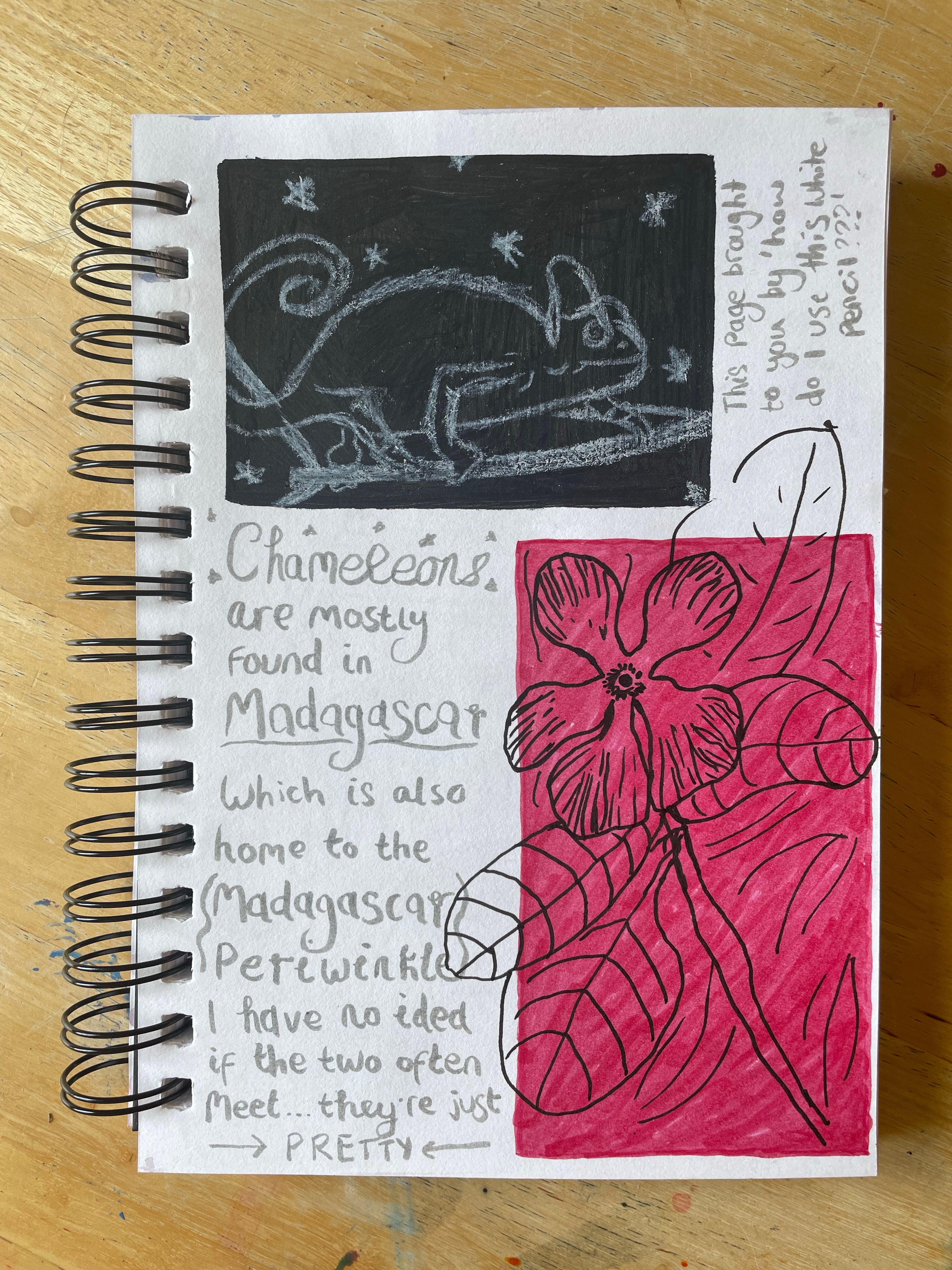
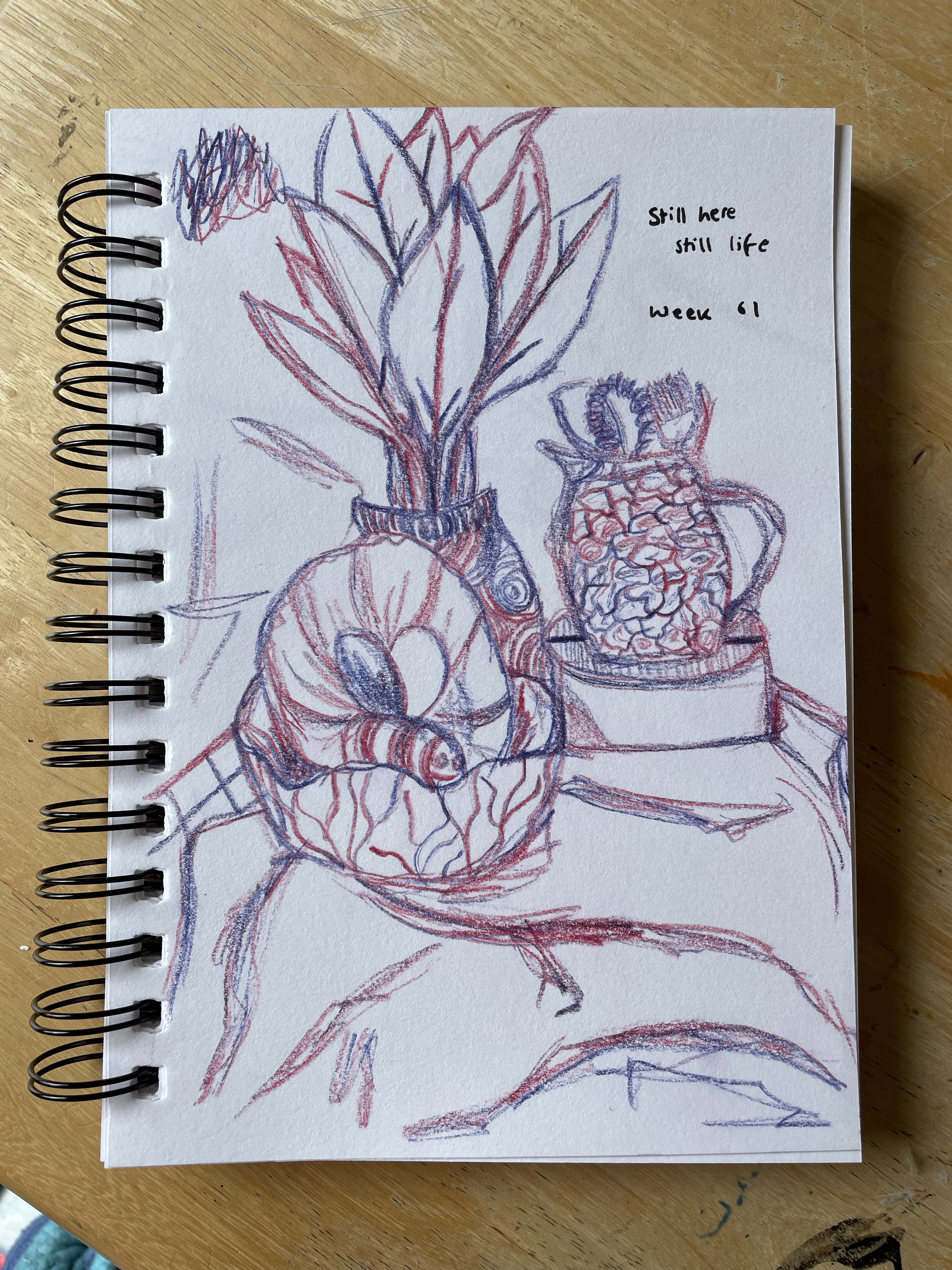
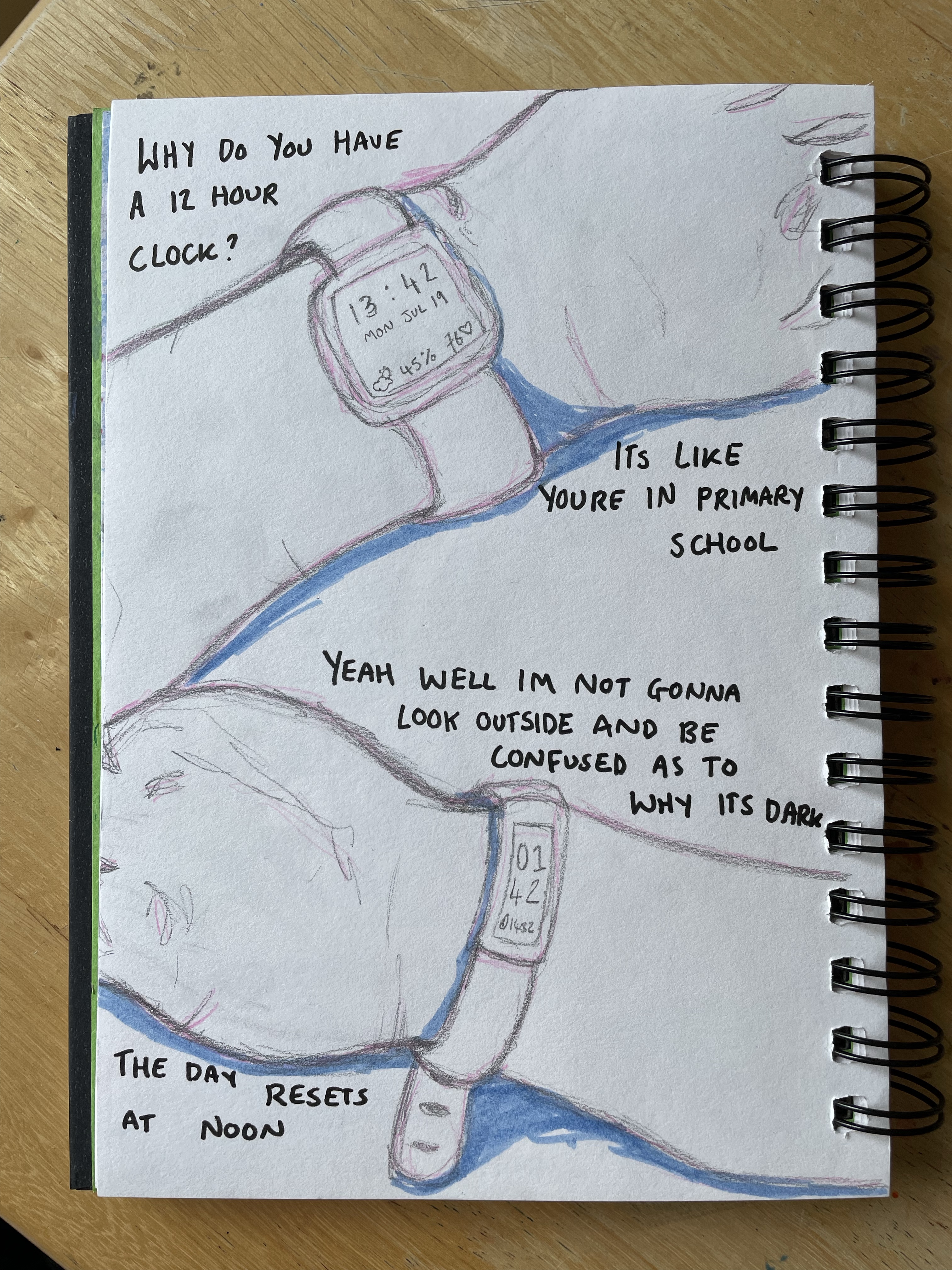
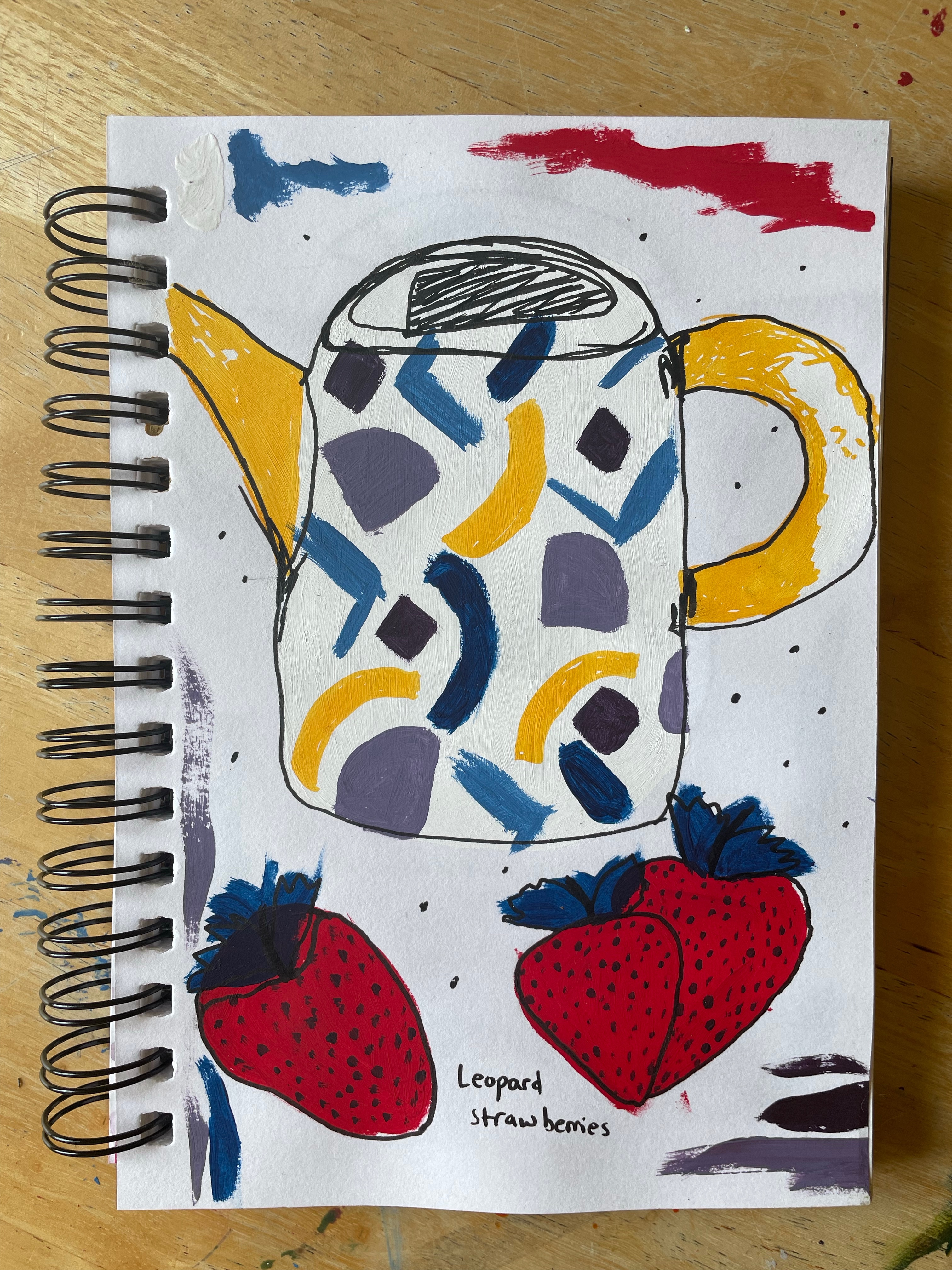
This was a really fun challenge and I definitely want to continue setting myself similar ones. The limited range of colours mixed with the random collection of materials pushed me into a playful and fun headspace. My sketchbook pages flowed naturally and seemed effortless, which was a huge change compared to last year’s perfected pieces. I have loved filling in this sketchbook and I’m excited to see how it turns out! I decided to film a sketchbook tour of the 10 pages I filled for the first book, which you can find below. I will also include images of the pages beneath that.



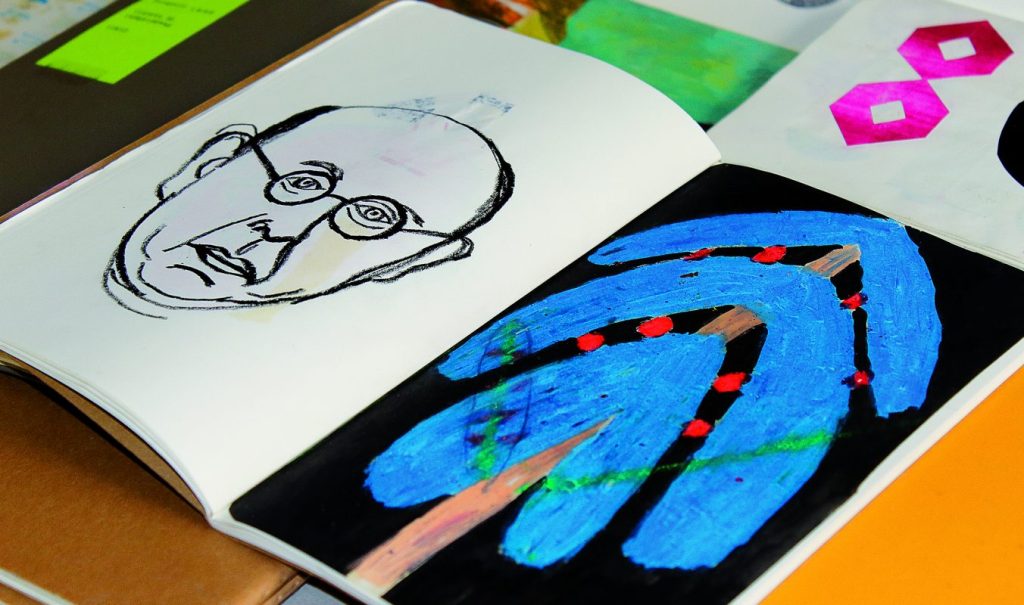
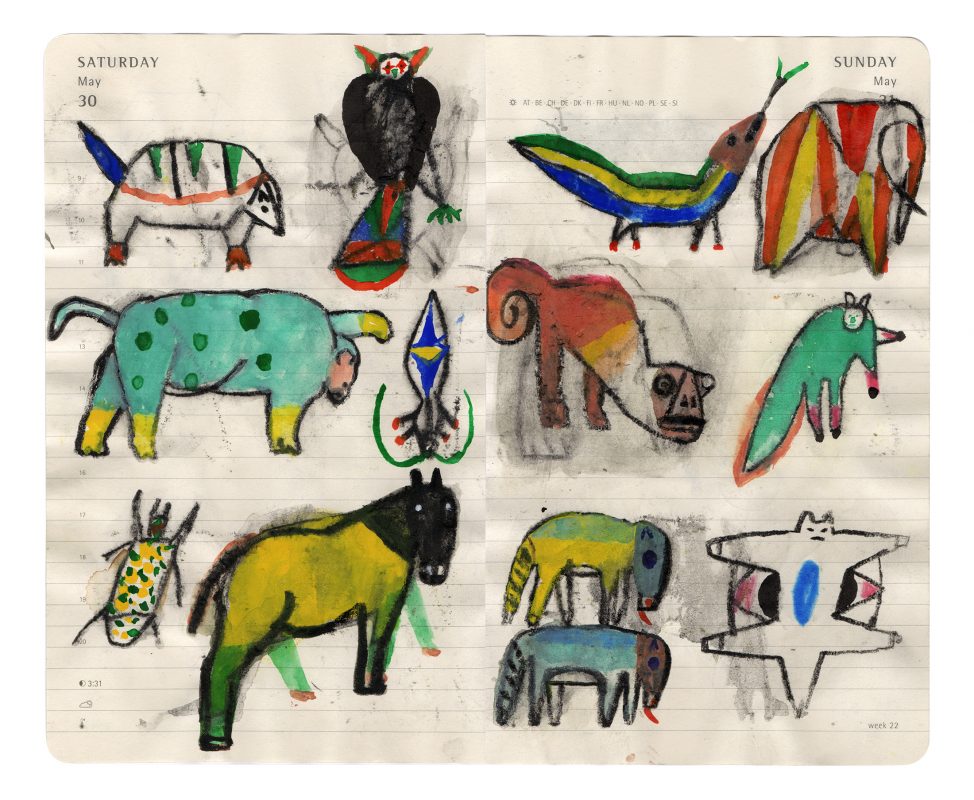
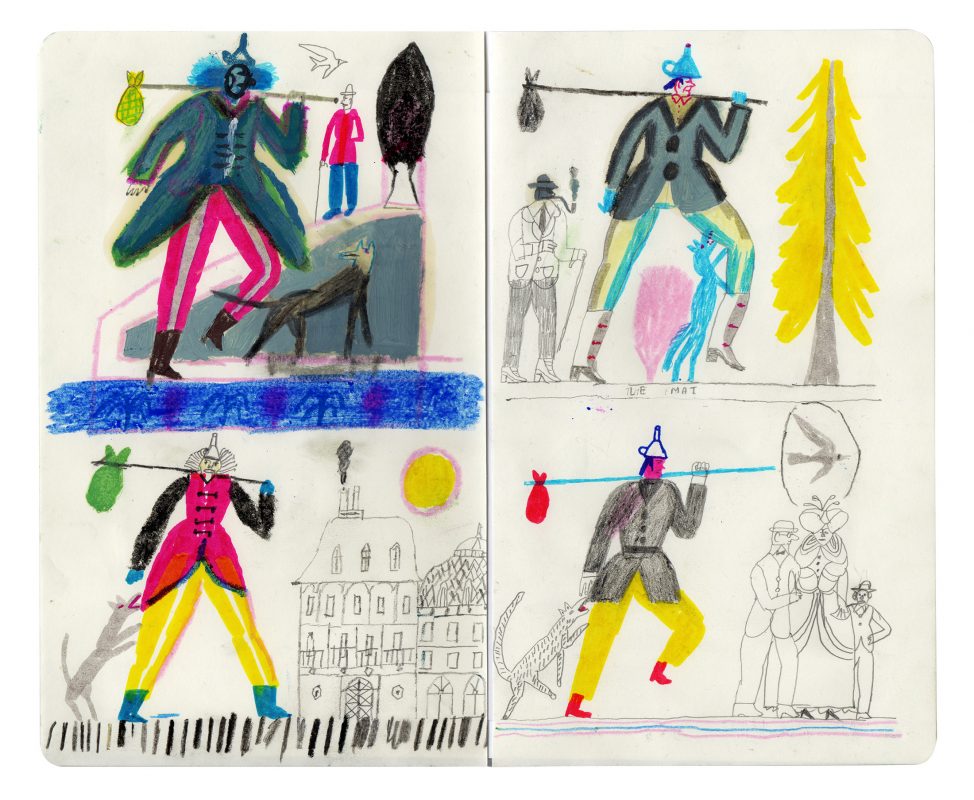

 Learning Log