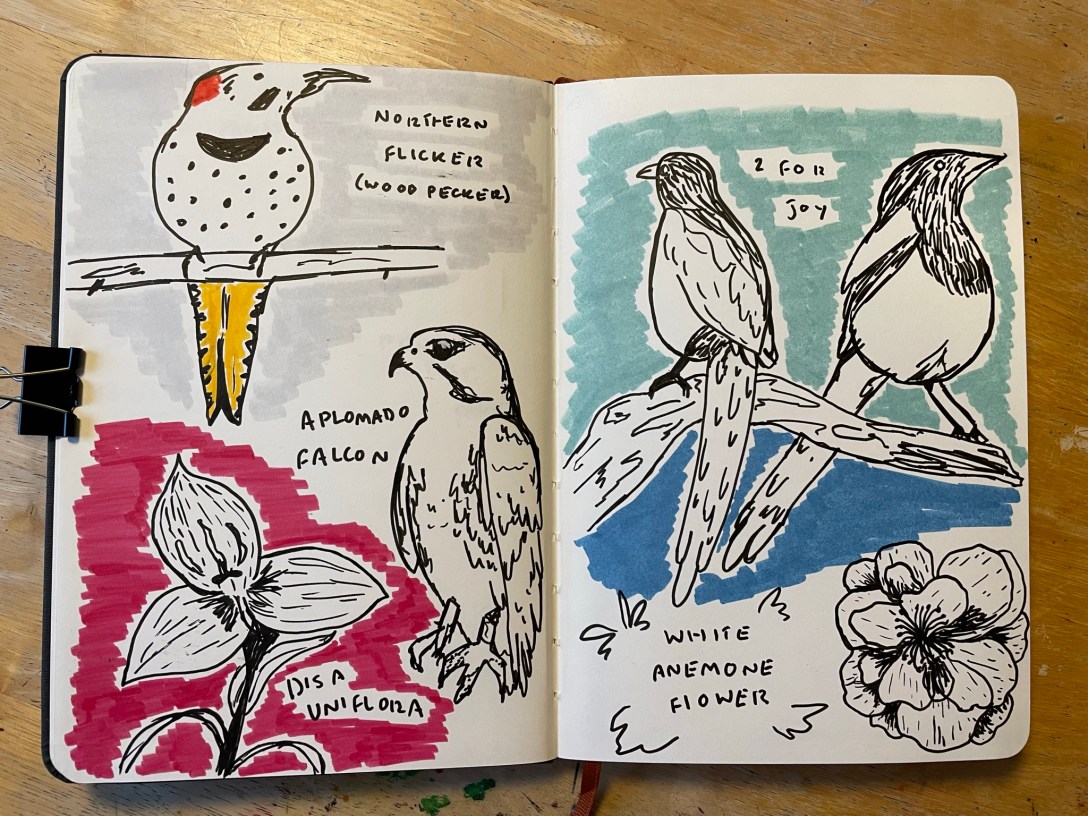
Part 2 was a little bit of a rollercoaster for me. A considerable part of this was down to the overwhelming, tiring, and intense situations in my life, but I also felt quite bored with the unit as time passed. Exercises and tasks took 2x as long as they probably should have, leading the whole of Part 2 to feel like it dragged on and on. I also really did not enjoy Assignment 2. It just didn’t inspire me nor feel like an area of illustration I am interested in working within.
Regardless, I gave it my all, and I’m quite pleased with the results. I learned a lot throughout about my own attitude towards sketchbooks and how I enjoy using them, as well as learning about the various materials I have around me. I also managed to work towards some of the goals I laid out initially in the unit introduction post I made. However, I feel that I could be doing better, and I hope I can be more focused throughout Part 3. My tutor provided me with some really useful feedback and suggestions I would like to try out going forward.
In response to my blind contour drawings, my tutor suggested I try drawing under the table or in the dark in order to make it harder to see the page. She also commented that my blind contour drawings were very good as I already use this skill on a day to day basis. I want to try to push myself further in this way, so I plan on trying these techniques out. I’m especially intrigued by the idea of drawing in the dark. She also suggested I draw moving images or videos rather than still images, incorporating the different coloured pens to show a sense of movement.
Another recommendation my tutor gave was to use objects in my environment in my sketchbook to draw connections between the real places and the pages within. I did do this somewhat in Exercise 2.5, and I enjoyed figuring out how to make the items I had collected fit into the page. I want to try to do more of this, though it’s not a high priority for me. My tutor also responded to a comment I had made in Exercise 2.4 regarding the scale of my sketchbook and recommended I think about working in different sizes. I have considered this when choosing my sketchbook for Part 3, and I am interested in working at much larger scales, too, though I feel a bigger sketchbook would go to waste. I have used A4 and larger sketchbooks in the past, and I find I discard them quite quickly to go back to my smaller ones. I prefer working at a larger scale for one-off pieces or final illustrations.
A point my tutor returned to several times was using my sketchbook pages repeatedly. Her first recommendation was to use my pages ‘as a ground on which to add further markmaking‘. I struggle with this idea – as, for me, the sketchbook pages are finished. I don’t want to add further markmaking to them – the point of the page was to experiment and explore different techniques, or to make a mess, or whatever it was. So long as that purpose has been fulfilled, the page is ‘complete’ in my eyes. I don’t want to go back and add further markmaking. However, I know I could challenge this feeling and maybe set my intentions differently when working on an experimental page. Yes, this page is for experimenting with a medium, but it also could be a space to continue working into long-term. It’s tricky for my brain to be comfortable with this, but I want to work with it somehow.
Another recommendation she made was to use the pre-existing pages more when building illustrative pieces. I struggled with this at the time, but in going back and finishing Assignment 2, I found it much easier to use the pre-existing material I had in the backgrounds for my characters. I’d like to consider how I do this in the future, whether I can directly use the pre-existing pages in projects, use them as a basis and develop them further, or just use them as inspiration. Part 3 seems to focus a great deal on making something out of your sketchbook material, so hopefully, by the end of this part, I’ll be able to do that with greater ease.
There were some further reading recommendations at the end of my feedback which seem extremely useful for my practice. I intend on writing a separate research post on this where I can comment more extensively on the artists and content I explore. (You can find the research post here!)
Going into Part 3, I feel a mixture of things. Initially, I was very optimistic. The circumstances in my life that made committing to work so difficult in Part 2 have settled down for a while, making me feel more confident in my abilities. I feel a lot more creative energy and passion than I did throughout Part 2, and I’m a lot more excited about Assignment 3. However, unfortunately, the exercises and key goals of Part 3 are completely inaccessible to me as a chronically ill disabled person.
Learning to use my sketchbook in public spaces is likely not ever going to happen. I am a part-time wheelchair user, which makes carrying a sketchbook and pencil case – and the act of stopping to sketch whilst in public – pretty difficult tasks. When I don’t use a wheelchair, all of my energy and attention is focused on walking safely, conserving my energy, and ensuring I don’t make myself too unwell. Every time I leave the house – be it in my wheelchair or not – I use the majority of my energy for that day, 100% of my energy if I am walking. At the minute, my health is not in a place where I can leave the house unless for emergencies or out of absolute necessity. Whilst this is not constant, it is a part of my reality, and even when I do and can leave the house, I can’t casually sketch whilst doing so.
Unfortunately, this makes Part 3 really difficult for me. This is so frustrating, as it’s not like I enjoy not being able to sketch in public or leave my house ever. However, I spent some time chatting with my tutor and James Pyman, the head of Visual Communications, and together we came to some compromises. This means that my responses to the exercises within Part 3 will be quite different from the typical responses, and my capacity to explore what is expected of me will be reduced. Thankfully, I have been assured this will not be an issue in the new Illustration units. It’s a real shame that I have to be excluded from some key exercises here, but onwards we go.
The other goal that Part 3 aims to achieve is the ability to go through your existing sketchbook work and provide narrative structure to it, ultimately resulting in fully fleshed out finished designs. This is pretty much how I intend to use my sketchbooks in the future – as grounds for idea generation and development. I’m looking forward to this aspect of Part 3, and hopefully, the work I am able to produce for the exercises will be inspirational in this way.
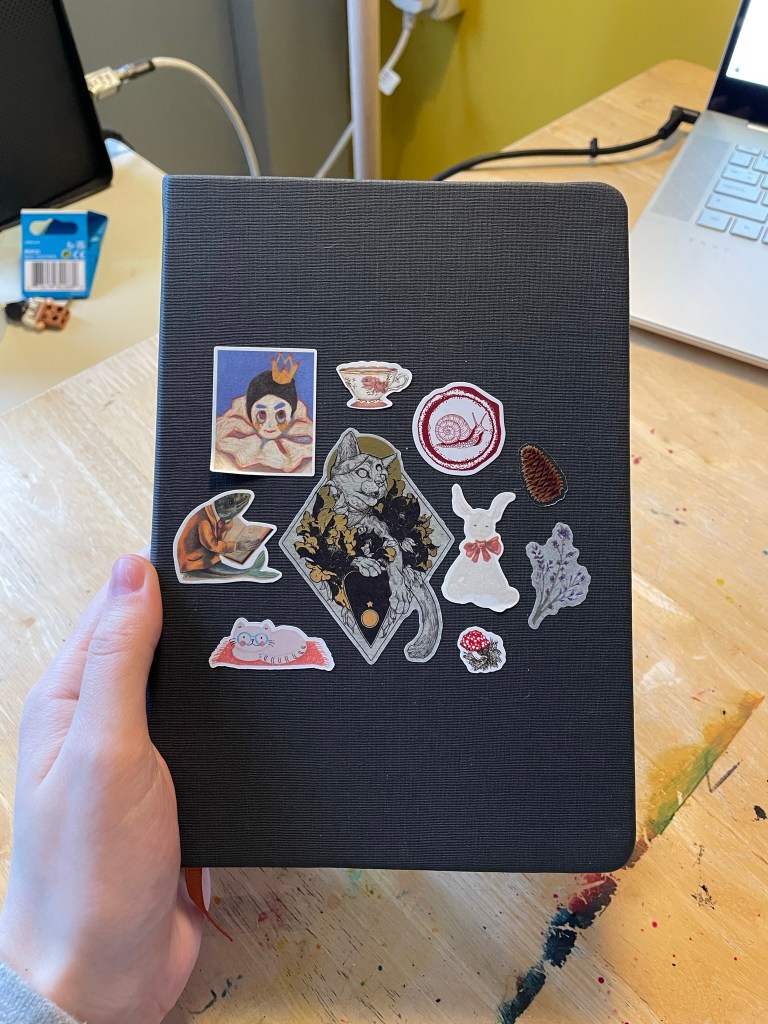
Instead of making another sketchbook for Part 3, I chose to buy one I hadn’t yet tried. I wanted a sturdy and solid A5 book that I could fill to the brim without it breaking. I also didn’t have the time to source paper and sew the binding for another book. I chose to buy the Shoreditch Sketcher – an infamous sketchbook used by most urban sketchers. I felt it fit the ‘drawing in public’ requirements quite well, and despite not planning on using it in this way, I wanted to capture the feel of that as much as possible. I spent some time decorating the front cover – which is gorgeous even without decoration – using stickers that made me feel happy. I don’t usually do this, but I have so many stickers in need of using, and I’m so glad I did! I pretty much spent the whole day staring at how pretty the cover was afterwards.
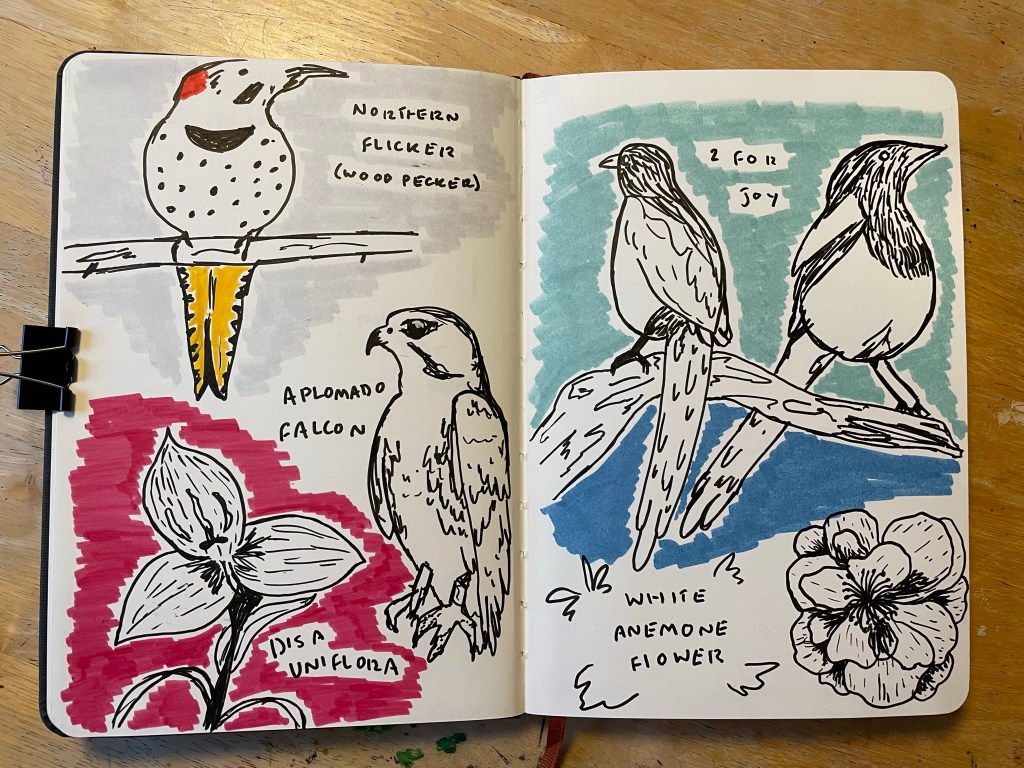
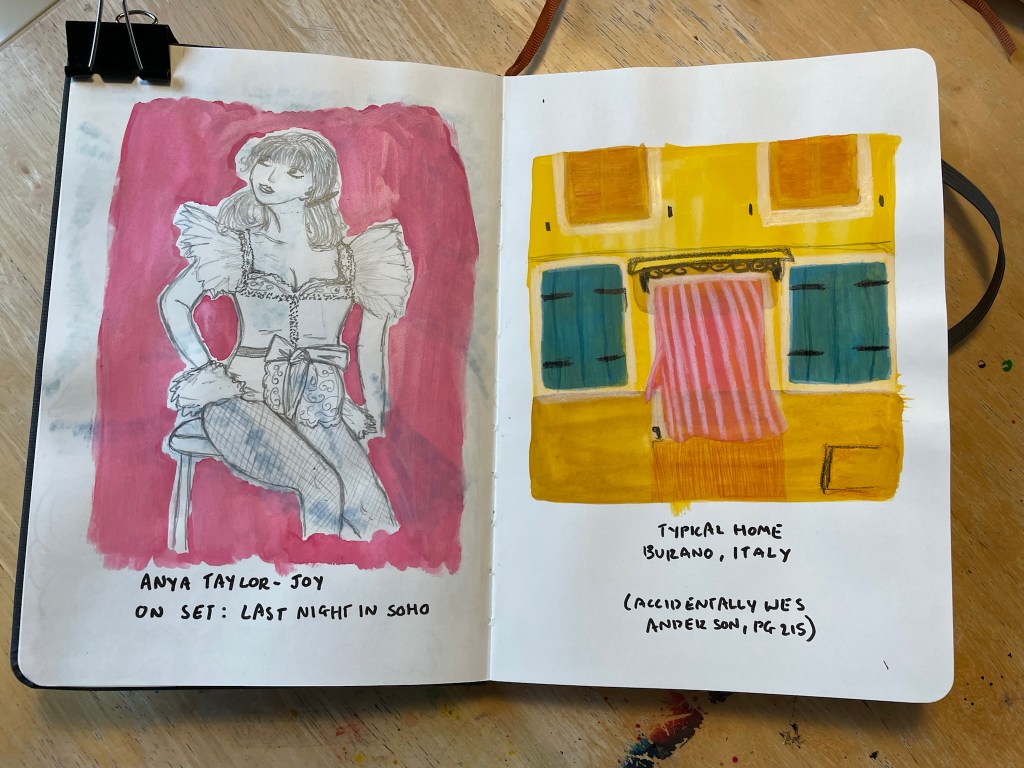
The paper is completely new to me – it is smooth and feels glossy almost, though it is matte. It is also an off-white tone and reasonably thin. I usually opt for toothier paper, some sort of resistance, and a thicker page to ensure it can withstand mixed media. It doesn’t look like it easily holds up inks and other water-based mediums, so I set to work trying out a range of my favourite pens, paints, and pencils. To my amazement, it holds paint BEAUTIFULLY!! It is such a gorgeous paper to work on, and I think I may have been transformed into a long term user of this sketchbook. I have found no issues with it so far, and I have tested out everything that I could possibly use. It even holds up alcohol markers with very minor bleeding.
Whilst disappointed that I can’t approach Part 3 in the way that is asked of me – I am still very much looking forward to it. My sketchbook is wonderful, the plans I have for the exercises excite me, and learning how to use my sketches as a platform for ideas is a goal I wish to achieve. I can’t wait to buckle down and get stuck in with the research and drawing exercises and to hopefully lose myself to the creativity I have bubbling away right now.
 Learning Log
I love blind contour drawing! I did a lot of them during my breaks at work, where they had a cafe (pre-covid). I did a lot of portraits that way. They came out to be really interesting. They are posted on my blog somewhere.
Keep up all the good work you’re doing!
best,
Jack
LikeLike
Thanks! I do a lot of them when building up sketches for illustrations as they’re super helpful to stop thinking about what you’re seeing and to start SEEING what you’re seeing…haha!
LikeLiked by 1 person